Data Science Paths Guide: Career Routes, Skills, Tools, Learning and Specializations
Data science paths describe the different routes people can take to learn data analysis, statistics, programming, machine learning, and related areas. Data science developed from statistics, computing, databases, and scientific research, then expanded as organizations began collecting larger amounts of digital information.
A data science path does not have one fixed sequence. Some people begin with mathematics or statistics, while others come from software development, business analysis, engineering, economics, or another analytical field. The route usually depends on existing knowledge, learning goals, and the type of work a person wants to understand.
What a data science path includes
A typical path combines several areas:
- Mathematics and statistics for understanding patterns, uncertainty, and relationships.
- Programming for cleaning, transforming, analyzing, and modeling data.
- Data visualization for communicating findings through charts, dashboards, and reports.
- Databases and SQL for working with structured information.
- Machine learning for building systems that identify patterns from data.
- Communication and domain knowledge for explaining what the results mean in a real setting.
These areas overlap, but they do not all need to be learned at the same depth. A person focusing on analytics may spend more time with SQL and visualization, while a machine learning specialist may spend more time with algorithms, model evaluation, and programming.
Importance
Data science matters because many everyday decisions now involve digital information. Organizations use data to understand customer behavior, monitor operations, plan resources, detect unusual activity, study scientific questions, and measure outcomes.
For learners, the large number of possible specializations can also create confusion. A person searching for a data science career path may encounter terms such as data analyst, data scientist, machine learning engineer, data engineer, business intelligence analyst, and statistician. These roles overlap in some skills but differ in their main responsibilities.
Career routes and core skills
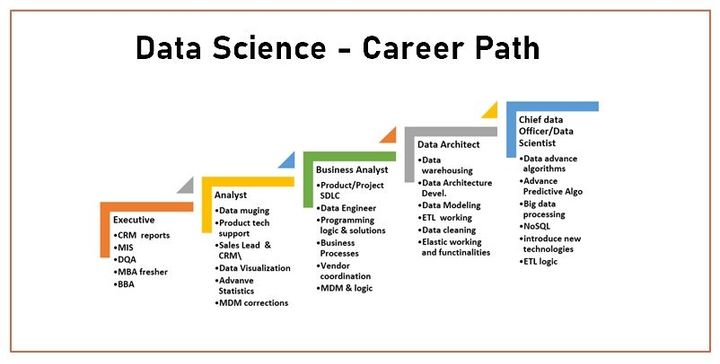
A simple way to understand the field is to connect each route with its main activities.
| Path | Common focus | Useful foundational skills |
|---|---|---|
| Data Analyst | Analysis, reporting, dashboards | SQL, spreadsheets, statistics, visualization |
| Data Scientist | Statistical analysis and predictive modeling | Python or R, statistics, machine learning |
| Machine Learning Specialist | Model development and evaluation | Python, algorithms, mathematics, model testing |
| Data Engineer | Data pipelines and storage | SQL, databases, programming, cloud concepts |
| Business Intelligence Analyst | Business reporting and decision support | SQL, dashboards, data modeling |
| Statistician | Statistical methods and inference | Probability, statistics, research methods |
The table is a general guide rather than a strict classification. Titles and responsibilities vary between organizations and industries.
Learning and specialization choices
Learning can begin with a common foundation and then become more specialized. For example, a learner might start with spreadsheets, basic statistics, SQL, and Python before moving into machine learning or another area.
Specializations can include machine learning, natural language processing, computer vision, business analytics, financial analytics, healthcare analytics, marketing analytics, data engineering, and responsible AI. Each area uses data differently and may require additional subject knowledge.
Recent Updates
From 2024 through 2026, data science learning has increasingly overlapped with artificial intelligence, machine learning, cloud computing, and responsible data use. This has expanded the range of tools that learners may encounter, while also making foundational skills such as statistics, programming, data preparation, and critical thinking important.
India's IndiaAI Mission has placed attention on computing infrastructure, datasets, foundation models, future skills, application development, and safe and trusted AI. AIKosh has also developed as a national platform for datasets, models, toolkits, use cases, and related learning resources. These developments make the connection between data science paths and AI more visible.
Changes in learning patterns
Learning resources increasingly combine theory with practical exercises, notebooks, datasets, visualization tools, and project-based work. Generative AI has also become part of many learning and development workflows, although users still need to check generated code, calculations, sources, and assumptions.
Another change is the wider use of automated data preparation and machine learning tools. These can reduce repetitive work, but understanding data quality, sampling, bias, model evaluation, and interpretation remains important.
Laws or Policies
For an India-focused data science path, privacy and responsible data handling are important parts of the wider learning environment. The Digital Personal Data Protection Act, 2023 establishes a legal framework for processing digital personal data, while the Digital Personal Data Protection Rules, 2025 provide detailed rules and phased commencement provisions.
Data protection and responsible analysis
People working with personal information need to understand concepts such as consent, lawful processing, security safeguards, data minimization, access controls, and responsible retention. The exact obligations depend on the role, organization, type of data, and applicable provisions.
India's National Education Policy 2020 also recognizes artificial intelligence, machine learning, data science, mathematics, and computational thinking as relevant areas of education. Recent education initiatives have continued to connect AI learning with broader technology and skills development.
Policy requirements can change, and professional or organizational responsibilities may differ. This article provides general educational information rather than legal advice.
Tools and Resources
A data science path can use different tools at different stages. Beginners often start with spreadsheets and basic SQL before moving into programming environments.
Common learning and analysis tools
Python and R are widely used for statistical analysis and data work. SQL is important for querying relational databases. Spreadsheet applications can help beginners understand tables, formulas, filtering, summaries, and basic visualization.
For programming and experimentation, Jupyter Notebook provides an interactive environment for combining code, notes, and results. Git and GitHub can help learners track project changes and organize code. Visualization tools such as Tableau and Power BI are commonly used for dashboards and reporting.
Data and learning resources
Kaggle provides datasets, notebooks, competitions, and learning materials related to data science and machine learning. Google Colab provides a browser-based notebook environment that can be used for Python-based experimentation. AIKosh provides access to datasets, models, toolkits, and use cases within India's national AI ecosystem.
A useful learning project can involve a public dataset, a clear question, data cleaning, exploratory analysis, visualization, and a written explanation of the findings. More advanced projects can add predictive modeling, model comparison, documentation, and evaluation.
Building a structured path
A general sequence can look like this:
- Foundation: mathematics, statistics, spreadsheets, and basic programming.
- Data handling: SQL, data cleaning, exploratory analysis, and visualization.
- Applied analysis: statistical testing, dashboards, and practical projects.
- Specialization: machine learning, data engineering, NLP, computer vision, or another field.
- Responsible practice: privacy, security, bias, documentation, and model evaluation.
The sequence can be adjusted according to prior education and the intended specialization.
FAQs
What is a data science career path?
A data science career path is a structured route for developing skills in statistics, programming, data analysis, machine learning, visualization, or related areas. Different routes lead toward different responsibilities.
Which skills are important for a data science path?
Common foundational skills include statistics, SQL, programming, data cleaning, visualization, and communication. More specialized paths may require machine learning, cloud concepts, database engineering, or advanced mathematics.
Can someone from a non-technical background learn data science?
Yes. A learner from business, economics, science, engineering, or another field can build data science skills progressively. The amount of programming and mathematics required depends on the chosen specialization.
What tools are used in data science learning?
Common tools include Python, R, SQL, spreadsheets, Jupyter Notebook, Git, Power BI, Tableau, Kaggle, and Google Colab. Tool selection depends on the learning stage and type of analysis.
What are the main data science specializations?
Common specializations include data analytics, machine learning, data engineering, business intelligence, natural language processing, computer vision, financial analytics, healthcare analytics, and responsible AI.
Conclusion
Data science paths provide several routes into analytical and technology-focused fields rather than one fixed career sequence. A strong foundation can include statistics, programming, SQL, data preparation, visualization, and clear communication, followed by a suitable specialization. Recent developments in AI, data platforms, and privacy regulation have broadened the knowledge expected around modern data work. The appropriate path depends on a learner's existing background, interests, and intended area of specialization.