EV Manufacturing Details: Chassis, Power Electronics, Battery Packs and Assembly Technologies
EV manufacturing combines traditional automotive production with technologies from electrical engineering, electronics, battery science, software, and automated assembly. An electric vehicle typically brings together a structural chassis, electric motor, power electronics, battery packs, thermal systems, wiring, control units, and numerous mechanical components.
Modern EV manufacturing developed from the combination of established vehicle production methods and advances in rechargeable battery and electronic drive systems. Instead of using an internal combustion engine and fuel system as the main energy pathway, an EV uses stored electrical energy and converts it into mechanical movement through an electric drive system.
The manufacturing process begins with individual components and materials and gradually combines them into complete vehicle systems. Chassis structures may be stamped, cast, welded, or bonded, while battery cells are assembled into modules or packs. Power electronics then manage the movement of electrical energy between the battery, motor, charging system, and other electrical components.
Main manufacturing systems
The major systems involved in EV manufacturing include:
- Chassis and body structure, which provide the vehicle's physical framework.
- Battery packs, which store electrical energy for propulsion.
- Power electronics, which control electrical energy and motor operation.
- Electric motors, which convert electrical energy into mechanical motion.
- Thermal management, which controls temperatures in batteries, motors, and electronics.
- Vehicle control systems, which coordinate different electronic and mechanical functions.
- Assembly technologies, which bring individual components and systems together.
These systems must work together because a change in one area can affect vehicle weight, energy use, handling, safety, and manufacturing processes.
Importance
EV manufacturing matters because transportation is increasingly incorporating electric propulsion across passenger vehicles, two-wheelers, three-wheelers, buses, commercial vehicles, and other applications. The transition also affects the industrial supply chain because batteries, semiconductors, electronic controllers, motors, sensors, and specialized production equipment are becoming important parts of vehicle manufacturing.
Why the chassis matters
The chassis supports major vehicle components and contributes to structural strength. EV chassis designs may need to accommodate a large battery pack positioned beneath the passenger compartment. This arrangement can influence the floor structure, weight distribution, crash protection, and available cabin space.
Common production methods include steel stamping, aluminum forming, casting, welding, adhesive bonding, and automated joining. Manufacturers may combine several methods depending on the vehicle architecture and material requirements.
Why power electronics matter
Power electronics control how electrical energy moves through an EV. Components such as inverters, converters, onboard chargers, and high-voltage distribution units perform different functions.
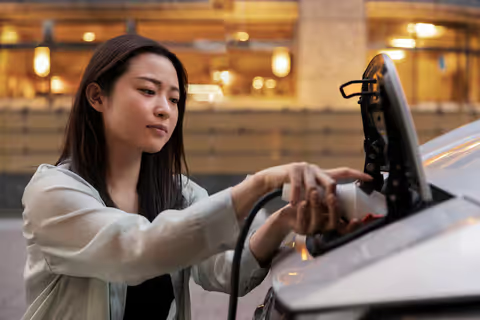
An inverter converts direct current from the battery into the alternating current required by many electric motors. A DC-DC converter can reduce high-voltage battery electricity to a lower voltage for auxiliary systems. The onboard charger manages electricity entering the vehicle from compatible charging equipment.
Why battery packs matter
The battery pack is a central part of an EV because it stores the electrical energy used for propulsion. A pack normally contains many cells connected electrically and arranged within a protective enclosure.
A battery management system monitors factors such as voltage, temperature, current, and state of charge. Thermal management systems help keep cells within an appropriate operating range during charging and driving.
Manufacturing stages at a glance
| Manufacturing stage | Main purpose | Typical technologies |
|---|---|---|
| Chassis production | Create structural framework | Stamping, casting, welding |
| Battery cell production | Store electrical energy | Electrode coating, cell formation |
| Battery pack assembly | Combine cells into a usable unit | Module assembly, busbars, cooling systems |
| Power electronics assembly | Control electrical energy | Semiconductor assembly, circuit boards |
| Motor production | Convert electricity into motion | Winding, rotor assembly, testing |
| Vehicle assembly | Integrate major systems | Robotic and manual assembly |
| Testing | Check systems and vehicle operation | Electrical, mechanical, thermal testing |
Recent Updates
From 2024 through 2026, EV manufacturing in India has continued moving toward greater domestic production of vehicles, components, and battery technologies. Government programs have focused on strengthening manufacturing capacity and developing domestic supply chains.
Battery manufacturing development
India's Production Linked Incentive program for Advanced Chemistry Cell battery storage has a planned capacity of 50 GWh. Government information reported in 2026 states that 40 GWh had been awarded to four beneficiary firms, while actual installed capacity remained considerably lower than the awarded capacity.
The program includes domestic value-addition requirements, with participating manufacturers expected to reach specified levels over the program period. This is intended to encourage production of battery cells and related manufacturing capabilities within India.
Electric passenger vehicle manufacturing
The Scheme to Promote Manufacturing of Electric Passenger Cars in India was approved in 2024, with detailed guidelines notified in 2025. The scheme is intended to encourage investment in domestic manufacturing of electric passenger vehicles and associated supply chains.
Expansion of component manufacturing
The PLI-Auto program continues to support manufacturing capabilities for advanced automotive technologies, including EV-related components. Government reporting in 2026 stated that cumulative investment under the PLI-Auto program had reached ₹44,326 crore by the end of March 2026, with reported employment generation of 67,820.
These developments show a broader movement toward integrated EV manufacturing, where vehicle assembly is increasingly connected with battery production, electronics, component manufacturing, and domestic supply chains.
Assembly technology trends
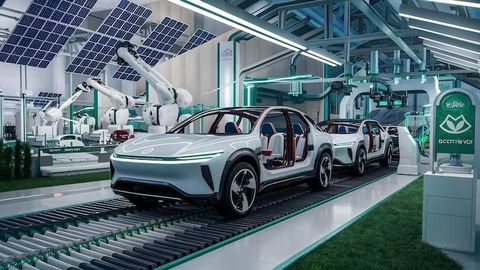
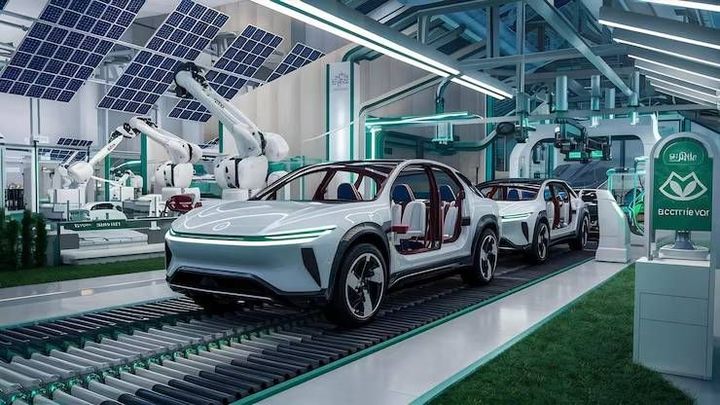
Modern EV factories increasingly use automation for repetitive and precision-sensitive operations. Robotic welding, automated material movement, machine vision, battery inspection, torque-controlled fastening, and computerized end-of-line testing can be integrated into production lines.
Digital manufacturing systems are also becoming more relevant. Sensors and production software can track assembly parameters, identify process deviations, and maintain records for quality control. The degree of automation varies according to factory design, vehicle volume, component complexity, and production strategy.
Laws or Policies
India's EV manufacturing environment is influenced by vehicle regulations, battery safety requirements, manufacturing programs, and environmental rules.
PM E-DRIVE
The PM Electric Drive Revolution in Innovative Vehicle Enhancement, known as PM E-DRIVE, was introduced in 2024. The program covers specified EV categories and includes measures connected with electric mobility and charging infrastructure. The Ministry of Heavy Industries states that the program was initially structured for the period beginning in October 2024 and has subsequently received amendments.
The program is separate from manufacturing-focused initiatives because it also addresses vehicle deployment and supporting infrastructure.
Manufacturing policies
The SPMEPCI framework establishes requirements for eligible electric passenger vehicle manufacturers participating in the scheme. The guidelines and application process are published by the Ministry of Heavy Industries.
The PLI-Auto and PLI-ACC programs address different portions of the wider manufacturing ecosystem. PLI-Auto focuses on advanced automotive technologies, while PLI-ACC focuses on Advanced Chemistry Cell battery manufacturing.
Battery safety and waste management
Battery packs are subject to technical and environmental considerations. BIS has published IS 17855:2022, which specifies performance testing for lithium-ion traction battery packs and systems used in electrically propelled road vehicles.
India's Battery Waste Management Rules apply to batteries across different chemistries and include requirements concerning producers, collection, refurbishment, and recycling. Amendments were issued during 2024 and 2025, making battery lifecycle management an important part of the EV ecosystem.
Manufacturers therefore need to consider not only vehicle assembly but also battery safety, traceability, recycling responsibilities, and environmental compliance.
Tools and Resources
People studying EV manufacturing can use several technical and governmental resources to understand the industry.
Government resources
The Ministry of Heavy Industries provides information about programs such as PM E-DRIVE, PLI-Auto, PLI-ACC, and SPMEPCI. These resources are useful for understanding eligibility structures, manufacturing requirements, policy updates, and implementation information.
Standards and technical references
The Bureau of Indian Standards provides access to Indian Standards and related information through its standards portal. This can help readers identify technical standards associated with EV batteries and other components.
The Automotive Research Association of India also publishes Automotive Industry Standards relevant to vehicle and electrical safety. AIS-156, for example, addresses requirements for L-category electric powertrain vehicles and rechargeable electrical energy storage systems.
Manufacturing analysis tools
Engineers and students can also use battery-sizing calculators, motor-performance calculators, thermal analysis software, CAD platforms, digital manufacturing systems, and lifecycle analysis tools. These resources can help explain relationships between battery capacity, vehicle weight, motor output, thermal behavior, and production processes.
FAQs
What is included in EV manufacturing?
EV manufacturing includes chassis production, battery packs, electric motors, power electronics, thermal systems, wiring, control units, body assembly, software integration, and vehicle testing. These systems are progressively combined during the manufacturing process.
How are EV battery packs manufactured?
Battery pack manufacturing generally involves arranging cells, connecting them electrically, installing monitoring components, adding thermal management components, enclosing the system, and conducting electrical and safety testing. The exact design varies according to battery chemistry, vehicle architecture, and manufacturer requirements.
What does power electronics do in an EV?
Power electronics manage electrical energy between the battery, motor, charging system, and auxiliary electrical systems. Inverters, DC-DC converters, onboard chargers, and high-voltage distribution components perform different electrical control functions.
What role does the chassis play in EV manufacturing?
The chassis provides structural support and must accommodate major components such as the battery pack, suspension, motor, and body structure. EV chassis designs can also influence weight distribution, structural protection, and manufacturing methods.
Which technologies are used in EV assembly?
EV assembly can involve robotic welding, automated fastening, machine vision, battery installation equipment, conveyor systems, electrical testing equipment, torque monitoring, and computerized quality-control systems. The specific combination depends on the vehicle and factory design.
Conclusion
EV manufacturing combines automotive engineering with battery technology, power electronics, software, and automated production systems. Chassis structures provide the physical foundation, while battery packs store energy and power electronics control its movement through the vehicle. From 2024 through 2026, India has continued developing policies and manufacturing programs aimed at expanding domestic EV and battery production. Battery safety, technical standards, recycling requirements, and manufacturing processes are therefore all important parts of the broader EV manufacturing system.