Explore Natural Diamonds With Gemstone Knowledge, Quality Factors, and Expert Insights
Natural diamonds are gemstones formed deep within the Earth through geological processes that occur under intense pressure and heat. Unlike laboratory-grown diamonds, natural diamonds develop through natural geological activity over extremely long periods and are later recovered, cut, and polished for use in jewelry and other applications.
Understanding natural diamonds involves more than looking at sparkle. Gemstone knowledge includes origin, crystal structure, color, clarity, cut, carat weight, treatments, grading reports, and traceability. These factors help explain why two diamonds with similar appearance can have different characteristics and documented grades.
Context
What Are Natural Diamonds
Natural diamonds are crystalline forms of carbon. Their atoms are arranged in a tightly bonded structure that gives diamond its characteristic hardness and optical properties. Most natural diamonds form deep within the Earth's mantle and reach the surface through geological processes associated with volcanic activity.
After rough diamonds are recovered, they can undergo sorting, planning, cutting, polishing, grading, and distribution. The final appearance depends on how the rough crystal is shaped and how facets are positioned. Different cutting styles, such as round brilliant, oval, pear, emerald, cushion, and princess cuts, interact with light in different ways.
Natural diamonds can occur in a broad range of colors. Many are colorless to near-colorless, while others display noticeable yellow, brown, pink, blue, green, or other hues. Fancy-color diamonds are evaluated using different considerations because color can become the dominant visual characteristic.
Geological Formation
The geological history of a natural diamond is one of its defining characteristics. Carbon atoms crystallize under high-pressure conditions deep inside the Earth, and some crystals remain preserved for extremely long geological periods before being transported toward the surface.
The crystal may contain internal features known as inclusions and surface characteristics known as blemishes. These features can provide information about the diamond's formation and also influence its clarity assessment.
Natural diamonds should also be distinguished from diamond simulants. Materials such as cubic zirconia and moissanite can resemble diamond visually but have different chemical and physical properties. Gemological laboratories use specialized testing methods to establish gemstone identity.
Importance
Why Diamond Knowledge Matters
Natural diamonds can differ significantly even when their size or shape appears similar. A structured understanding of quality factors helps readers interpret grading reports and gemstone descriptions without relying only on visual impressions.
The widely recognized 4Cs provide a foundation for understanding diamond characteristics:
| Quality Factor | What It Describes | Main Consideration |
|---|---|---|
| Color | Body color of the diamond | Degree of color presence |
| Clarity | Internal and external characteristics | Number, size, position, and visibility of features |
| Cut | Proportions, symmetry, and finish | Interaction with light |
| Carat Weight | Weight of the gemstone | Physical mass, not visual quality |
These four factors do not operate independently. A change in cut proportions can influence brilliance, while clarity characteristics may be more noticeable depending on their position and the diamond's size.
Understanding Color
For many colorless-to-near-colorless natural diamonds, grading systems use a letter scale to describe the degree of body color. Diamonds toward the colorless end generally show less visible body color when compared under standardized conditions.
Fancy-color diamonds are considered differently because stronger natural color can be the central feature of the gemstone. Hue, tone, saturation, and distribution are important when examining these diamonds.
Understanding Clarity
Clarity refers to internal inclusions and external blemishes observed under standardized grading conditions. Common features may include crystals, clouds, feathers, pinpoints, cavities, or surface marks.
Clarity does not simply mean whether a diamond looks clean to the unaided eye. Professional grading considers the nature, location, size, relief, and number of characteristics. Two diamonds with the same clarity grade can still have different inclusion patterns.
Understanding Cut and Light Performance
Cut describes how a polished diamond's proportions, symmetry, and finish affect its interaction with light. It is particularly important for round brilliant diamonds, where precise facet relationships influence brightness, fire, and scintillation.
Shape and cut are different concepts. Round, oval, pear, emerald, cushion, and other terms generally describe shape or outline, while cut relates to the quality of the faceting and proportions.
Understanding Carat Weight
Carat is a unit of weight used for gemstones. One carat is divided into 100 points. Carat weight should not be confused with dimensions because two diamonds with identical weight can have different measurements depending on their proportions and shape.
A larger carat weight does not automatically indicate higher overall quality. Color, clarity, cut, shape, and the characteristics of the individual stone must be considered together.
Recent Updates
Greater Attention to Diamond Identification
From 2024 through 2026, the diamond sector has continued to focus on distinguishing natural diamonds from laboratory-grown diamonds. Advances in laboratory-grown diamond production have increased the quantity, size, and quality of manufactured stones entering the gemstone market. GIA research has documented significant development in both HPHT and CVD production methods.
This development has increased the importance of accurate identification. Modern gemological laboratories use spectroscopy, microscopy, imaging, and other analytical techniques rather than relying only on visual examination. Some commercial laboratory-grown diamonds also carry laser inscriptions identifying their laboratory origin.
Changes in Laboratory-Grown Diamond Evaluation
Another notable development concerns how laboratory-grown diamonds are evaluated. GIA announced a revised assessment approach in 2025 for D-to-Z laboratory-grown diamonds, using broader descriptive categories rather than the traditional natural-diamond color and clarity nomenclature. The revised approach classifies qualifying laboratory-grown diamonds as either Premium or Standard based on an overall assessment.
This change illustrates an important distinction in modern gemstone education: natural diamonds and laboratory-grown diamonds can share many physical properties, but their origins and identification characteristics are different. Accurate terminology helps maintain clarity when describing each type.
Growing Interest in Traceability
Traceability has also received greater attention across the diamond supply chain. Digital records and chain-of-custody systems can help document stages such as origin, movement, cutting, polishing, and distribution. Industry analysis has identified traceability as an increasingly important part of transparency discussions.
Laws or Policies
International Diamond Trade Frameworks
Diamond trade is influenced by national customs rules, import and export requirements, consumer-protection laws, sanctions, disclosure requirements, and international frameworks. The specific requirements depend on the country or jurisdiction involved.
One important international framework is the Kimberley Process Certification Scheme. It regulates international trade in rough diamonds and aims to prevent conflict diamonds from entering legitimate rough-diamond trade. The Kimberley Process currently includes 60 Participants representing 86 sovereign states, with the European Union represented as one Participant.
The scheme is implemented through national legislation rather than functioning as a standalone international law. Participating jurisdictions must establish controls for rough-diamond imports and exports, and shipments between Participants must comply with certification requirements.
Disclosure and Identification
Consumer-protection rules in many jurisdictions require accurate descriptions of gemstone identity and treatments. Laboratory-grown diamonds and treated natural diamonds should therefore be clearly identified according to the applicable local requirements.
Gemological laboratories also maintain their own examination procedures. For example, GIA states that diamonds submitted for examination are tested to determine whether they are natural, laboratory-grown, or treated, with relevant information disclosed in applicable reports.
Because regulations differ between jurisdictions, readers should treat local customs, taxation, import documentation, and consumer-disclosure requirements separately from international diamond-trade frameworks.
Tools and Resources
Diamond Grading Reports
A recognized gemological grading report can provide structured information about a diamond's identity and quality characteristics. Depending on the laboratory and report type, information may include measurements, carat weight, color, clarity, cut, polish, symmetry, fluorescence, treatments, and other observations.
Reports should be read as technical documents rather than as simple quality labels. The report number, measurements, proportions, and identification details can help connect the document with the physical gemstone.
Diamond Proportion Tools
Online diamond proportion calculators and cut-estimation tools can help explain how measurements relate to faceting and light behavior. These tools are educational and should not be treated as replacements for laboratory examination.
Gemological Reference Materials
Gemology textbooks, laboratory education resources, diamond identification guides, microscopy references, and grading-system explanations can help readers understand technical terminology. Useful subjects include:
- Diamond crystal structure
- The 4Cs
- Diamond treatments
- Natural versus laboratory-grown identification
- Fancy-color diamond terminology
- Cut proportions and symmetry
- Fluorescence
- Inclusions and blemishes
- Diamond traceability
Microscopes and Identification Instruments
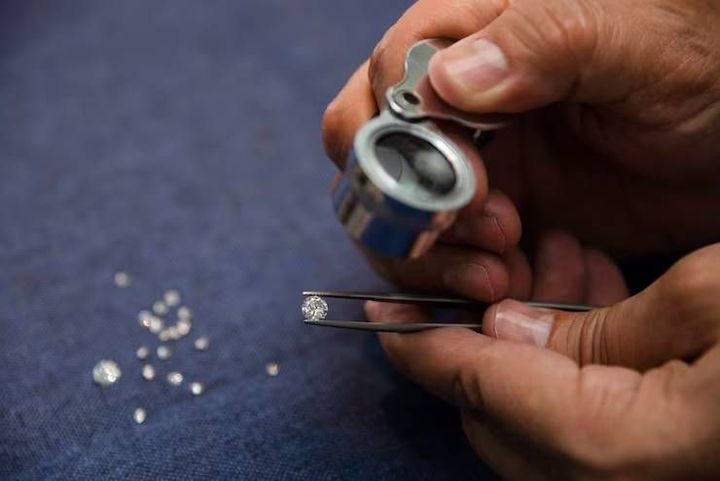
Professional gemologists may use microscopes, refractometers, spectrometers, fluorescence equipment, and specialized diamond-screening instruments. Advanced laboratories combine several analytical techniques because appearance alone cannot reliably establish a diamond's geological origin.
FAQs
What are natural diamonds?
Natural diamonds are crystalline carbon gemstones formed through natural geological processes inside the Earth. They differ from laboratory-grown diamonds because their origin is geological rather than technological.
How are natural diamonds graded?
Natural diamonds are commonly assessed using the 4Cs: color, clarity, cut, and carat weight. A gemological laboratory examines these characteristics under standardized conditions and documents the findings in a grading report.
What are the main natural diamond quality factors?
The primary quality factors are color, clarity, cut, and carat weight. Shape, fluorescence, proportions, treatments, and individual inclusion characteristics can also contribute to a more complete understanding of a particular diamond.
How can natural diamonds be distinguished from laboratory-grown diamonds?
Some differences can be identified through specialized gemological testing. Laboratories may examine growth patterns, inclusions, spectroscopy, fluorescence, and other characteristics because visual inspection alone may not establish origin reliably.
Why is diamond traceability important?
Traceability can document a diamond's movement through different stages of the supply chain. It is relevant to transparency, origin information, regulatory compliance, and chain-of-custody documentation.
Conclusion
Natural diamonds are geological gemstones whose characteristics are understood through origin, crystal structure, color, clarity, cut, and carat weight. Modern diamond education also includes identification methods, laboratory-grown diamond distinctions, treatments, grading reports, and supply-chain traceability. International frameworks such as the Kimberley Process address rough-diamond trade and conflict-diamond controls, while individual jurisdictions establish additional requirements. Understanding these elements provides a clearer foundation for interpreting natural diamond information and gemological documentation.