CNC Machining: A Complete Guide to Computer Numerical Control Manufacturing
CNC machining is a modern manufacturing process that uses computer-controlled equipment to produce accurate parts and components from materials such as metals, plastics, composites, and wood. It is widely used in industries that require precision, repeatability, and consistent production quality.
From aerospace components and automotive parts to medical equipment and industrial machinery, CNC machining supports many applications where dimensional accuracy and reliable manufacturing are important.
What Is CNC Machining?
CNC stands for Computer Numerical Control. CNC machining uses programmed instructions to control the movement of machine tools. Instead of manually operating every movement, an operator or programmer creates a digital machining program that tells the equipment how to cut, drill, mill, turn, or shape a workpiece.
A typical CNC system includes:
- Computer control system
- CNC machine tool
- Cutting tools
- Workholding equipment
- Motors and drive systems
- Measurement and inspection equipment
- CAD/CAM software
The combination of computer programming and mechanical equipment allows manufacturers to produce complex components with consistent dimensions.
How Does CNC Machining Work?
CNC machining generally begins with a digital design. Engineers can create a component using Computer-Aided Design (CAD) software. The design is then prepared for manufacturing using Computer-Aided Manufacturing (CAM) software.
Step 1: Create a CAD Model
The manufacturing process usually starts with a 2D drawing or 3D CAD model. The model defines important details such as dimensions, holes, surfaces, angles, and tolerances.
Step 2: Prepare the Manufacturing Program
CAM software can convert design information into machining instructions. These instructions determine how the cutting tool should move and which operations should be performed.
Step 3: Set Up the CNC Machine
The workpiece is secured to the machine using an appropriate workholding method. Cutting tools are installed, and the machine is configured according to the production requirements.
Step 4: Machine the Workpiece
The CNC controller interprets the programmed instructions and directs the machine's motors and tools. Material is gradually removed until the desired geometry is produced.
Step 5: Inspect the Finished Part
After machining, the component can be inspected using precision measurement equipment. Depending on the application, manufacturers may check dimensions, surface finish, tolerances, and other quality characteristics.
Types of CNC Machines
Different CNC machines are designed for different manufacturing operations. Selecting the right machine depends on the material, component geometry, production volume, and required tolerances.
CNC Milling Machines
CNC milling machines use rotating cutting tools to remove material from a stationary or repositioned workpiece. They can create slots, pockets, holes, contours, and complex surfaces.
Common configurations include:
- 3-axis CNC milling machines
- 4-axis CNC machines
- 5-axis machining centers
- Vertical machining centers
- Horizontal machining centers
CNC Lathes
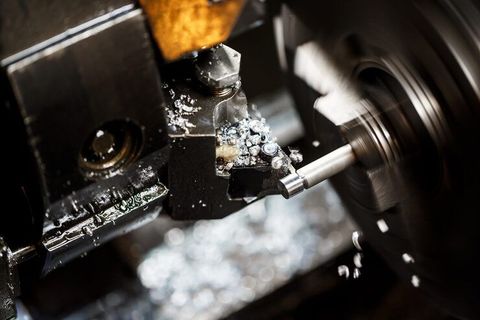
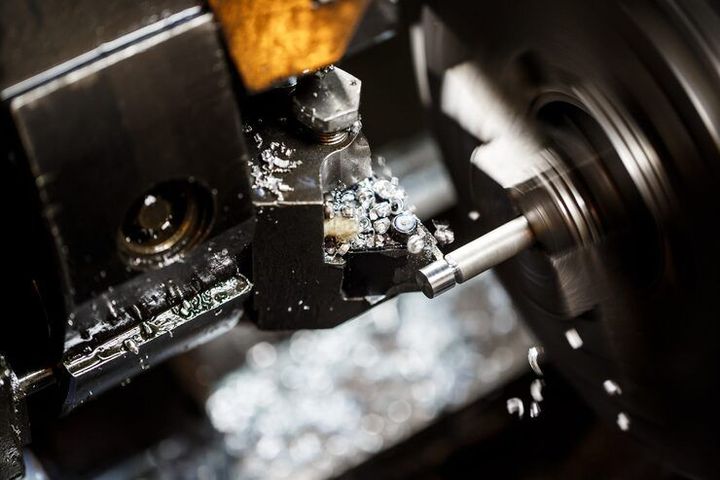
CNC lathes rotate the workpiece while a cutting tool removes material. They are commonly used for cylindrical or rotational components.
Typical applications include:
- Shafts
- Bushings
- Pins
- Threaded components
- Flanges
- Rotational machine parts
CNC Routers
CNC routers are often used for cutting and shaping materials such as wood, plastics, composites, and certain non-ferrous materials.
They can be useful for producing panels, signs, prototypes, furniture components, and other large-format parts.
CNC Plasma and Laser Cutting Machines
CNC plasma and laser systems use computer-controlled movement to cut sheet or plate materials. Laser cutting can provide highly controlled cuts for suitable materials, while plasma systems are commonly used for cutting conductive metals.
Materials Used in CNC Machining
One of the advantages of CNC manufacturing is its compatibility with a wide range of materials.
Metals
Common metals include:
- Aluminum
- Stainless steel
- Carbon steel
- Brass
- Copper
- Titanium
- Tool steel
The appropriate material depends on strength, corrosion resistance, weight, thermal properties, cost, and application requirements.
Plastics
Engineering plastics can also be machined using CNC equipment. Examples include:
- ABS
- Nylon
- PEEK
- Delrin
- Polycarbonate
- PTFE
Material selection is important because different plastics have different thermal and mechanical characteristics.
Composite Materials
Some CNC systems can process composite materials used in specialized manufacturing applications. Machining parameters must be selected carefully because composites can behave differently from conventional metals.
Benefits of CNC Machining
CNC machining offers several advantages compared with many conventional manufacturing methods.
High Precision
Computer-controlled movements can help manufacturers produce components with consistent dimensions. This is particularly important for applications involving close tolerances.
Repeatability
Once a machining process has been properly programmed and set up, the same instructions can be used to manufacture multiple components with consistent characteristics.
Complex Geometries
Modern multi-axis CNC equipment can manufacture shapes that would be difficult or impractical to produce using basic manual machining techniques.
Production Efficiency
Automated machine movements can reduce the amount of manual intervention required during production. This can improve workflow efficiency for suitable manufacturing operations.
Reduced Human Error
Automation can reduce errors associated with manually controlling every machine movement. However, programming, setup, tooling, and inspection still require skilled personnel.
CNC Machining Applications
CNC machining is used across many manufacturing sectors.
Aerospace Manufacturing
Aerospace components can require carefully controlled dimensions, material properties, and manufacturing processes. CNC machining is used for various structural, mechanical, and precision components.
Automotive Manufacturing
Automotive manufacturers and suppliers use CNC machining to produce components such as engine parts, transmission components, brackets, housings, and prototypes.
Medical Device Manufacturing
Precision machining is also used for certain medical and laboratory components. Depending on the application, manufacturers may require strict material control, dimensional inspection, and documented quality processes.
Industrial Equipment
Industrial machinery contains many precision components, including shafts, housings, gears, fixtures, and custom machine parts. CNC manufacturing can support both prototype development and production requirements.
Electronics Manufacturing
CNC equipment can be used to manufacture selected enclosures, heat sinks, brackets, fixtures, and other components used around electronic systems.
CNC Machining and Manufacturing Costs
The cost of CNC machining depends on several variables rather than simply the machine's operating time.
Important cost factors include:
- Material selection
- Part size
- Part complexity
- Machining time
- Required tolerances
- Tooling requirements
- Surface finishing
- Programming time
- Production quantity
- Inspection requirements
- Machine type
How Can CNC Machining Costs Be Reduced?
Manufacturers can often improve cost efficiency by reviewing the design before production.
For example, unnecessary tight tolerances can increase machining and inspection requirements. Excessively complex geometries may also increase programming and production time.
Design for Manufacturing (DFM) principles can help engineers identify practical ways to simplify a component while maintaining its required performance.
CNC Machining Tolerances
A tolerance defines the acceptable variation from a specified dimension. Not every feature of a component necessarily requires the same tolerance.
For example, a critical mating surface may require tighter dimensional control than a non-critical exterior surface.
Why Are Tolerances Important?
Appropriate tolerances can help ensure that components:
- Fit together correctly
- Perform as intended
- Maintain functional requirements
- Remain consistent during production
- Meet engineering specifications
However, unnecessarily tight tolerances can increase manufacturing costs. Engineers therefore need to balance performance requirements with practical manufacturing capabilities.
CNC Machining vs. 3D Printing
CNC machining and additive manufacturing use fundamentally different production methods.
CNC machining is generally a subtractive process, meaning material is removed from a solid workpiece.
3D printing is an additive process, meaning material is deposited or solidified layer by layer to create a component.
CNC machining can be advantageous when dimensional accuracy, material selection, surface finish, or production requirements favor subtractive manufacturing. 3D printing can be attractive for certain complex geometries, prototypes, and low-volume applications.
Neither technology is universally better. The appropriate choice depends on the design, material, quantity, performance requirements, and manufacturing objectives.
CNC Machining Quality Control
Quality control is an important part of precision manufacturing. A CNC machine can follow a programmed path accurately, but the final result can still be affected by tooling, material variation, machine condition, setup, temperature, and programming.
Manufacturers may use:
- Calipers and micrometers
- Height gauges
- Coordinate measuring machines (CMMs)
- Optical measurement systems
- Surface roughness instruments
- Process inspection systems
Preventive Maintenance
Regular machine maintenance can help maintain performance and reduce unexpected downtime. Maintenance programs may include lubrication, cleaning, inspection, tool condition checks, and calibration activities.
Choosing a CNC Machining Service
Businesses looking for CNC machining services should evaluate more than the quoted price.
Technical Capabilities
Consider whether the supplier has the appropriate:
- Machine types
- Number of axes
- Material capabilities
- Tolerance capabilities
- Maximum workpiece dimensions
- Finishing options
Quality Management
For applications with demanding quality requirements, it can be useful to understand the supplier's inspection procedures, documentation practices, and quality management systems.
Production Capacity
A supplier suitable for a small prototype order may not necessarily have the capacity required for large-scale production. Production volume and expected delivery requirements should therefore be considered before selecting a machining partner.
Future Trends in CNC Machining
CNC machining continues to evolve as manufacturers adopt digital technologies and increasingly automated production systems.
Automation
Robotic part handling, automated tool management, and integrated production systems can reduce manual intervention in suitable manufacturing environments.
Digital Manufacturing
CAD, CAM, simulation, machine monitoring, and production management software are increasingly connected. These technologies can improve visibility across different stages of manufacturing.
Advanced Multi-Axis Machining
Multi-axis machines can provide greater flexibility when manufacturing complex components. They can reduce the need for multiple setups in some applications.
Data-Driven Manufacturing
Machine monitoring and production data can help manufacturers identify equipment issues, improve utilization, and support predictive maintenance strategies.
Frequently Asked Questions About CNC Machining
Is CNC machining suitable for prototypes?
Yes. CNC machining can be used for prototypes when engineers need functional components made from production-grade materials or require precise dimensions.
Is CNC machining expensive?
The cost varies considerably. Material, machine time, complexity, tolerances, tooling, finishing, inspection, and order quantity all influence the final cost.
What is the difference between CNC milling and CNC turning?
CNC milling generally uses rotating cutting tools to remove material from a workpiece, while CNC turning typically rotates the workpiece against a cutting tool.
What industries use CNC machining?
CNC machining is used in aerospace, automotive, medical, electronics, industrial equipment, energy, consumer products, and many other manufacturing sectors.
Can CNC machines produce complex parts?
Yes. Advanced CNC systems, particularly multi-axis machining centers, can produce highly complex geometries when the machine, tooling, programming, and workholding are appropriately selected.
Conclusion
CNC machining is an important technology in modern manufacturing because it combines computer-controlled equipment with precision cutting processes. It can support prototypes, custom components, and high-volume production across a wide range of industries.
Understanding machine types, materials, tolerances, tooling, quality control, and manufacturing costs can help businesses and engineers make better production decisions. As automation, digital manufacturing, and machine monitoring continue to develop, CNC machining is likely to remain an important part of precision manufacturing.