Healthcare Software Solutions: A Complete Guide to Digital Healthcare Systems
Healthcare software solutions are digital systems that help hospitals, clinics, laboratories, medical professionals, and other healthcare organizations manage information and daily activities. These systems use software to organize patient records, coordinate appointments, support clinical decisions, and improve communication between healthcare teams.
Traditional healthcare operations often depend on paper files, handwritten prescriptions, printed reports, and manual administrative work. Managing these records can become difficult when patient numbers increase or information must be shared between departments. Digital healthcare systems help organize information in a structured format, making it easier for authorized users to access relevant records.
Healthcare technology includes several types of software, such as:
Electronic health records (EHRs): Digital records containing patient medical histories, diagnoses, medications, and treatment information.
Hospital management systems: Tools for coordinating admissions, departments, staff schedules, and administrative activities.
Telehealth platforms: Digital systems that support remote consultations and communication between patients and healthcare professionals.
Medical billing and coding software: Applications that organize billing records, medical codes, and payment documentation.
Laboratory information systems: Programs that track laboratory samples, test results, and reporting processes.
Pharmacy management systems: Tools that help manage prescriptions, medication records, and inventory information.
These systems may operate independently or connect through shared data standards and integrated platforms. The main purpose is to make healthcare information more organized, accessible, and useful while protecting patient privacy.
How Digital Healthcare Systems Work
A digital healthcare system collects information from authorized users and connected medical processes. For example, a clinic may record a patient's details during registration, document the consultation in an electronic health record, and attach laboratory results to the same record.
When systems communicate correctly, authorized healthcare professionals can review relevant information without repeatedly entering the same details. However, the quality of this process depends on accurate records, suitable software design, staff training, and secure data exchange.
Importance of Healthcare Software in Modern Medicine
Improving Patient Record Management
Accurate patient information is essential for safe medical care. Digital records help healthcare professionals review medical histories, allergies, prescribed medicines, previous diagnoses, and test results.
These records can reduce problems associated with missing paperwork or difficult-to-read handwriting. They can also help clinical teams identify relevant information more quickly.
However, digital records do not automatically eliminate mistakes. Incorrect entries, outdated information, and duplicate records can still occur. Healthcare organizations need clear procedures for checking and updating patient data.
Supporting Efficient Hospital Operations
Hospitals manage many activities at the same time, including patient admissions, appointments, laboratory testing, medication administration, and discharge planning.
Healthcare management software can help coordinate these activities through shared schedules, digital documentation, and administrative dashboards.
Common benefits include:
Better organization of appointments and clinical schedules.
Easier access to authorized patient information.
More consistent documentation across departments.
Improved coordination between administrative and clinical teams.
Clearer tracking of laboratory requests and medical reports.
Better visibility into equipment, beds, and operational resources.
The results depend on how well the software fits the organization's needs and existing processes.
Expanding Access Through Telehealth
Telehealth allows patients and healthcare professionals to communicate through video consultations, secure messaging, or other digital channels. It can be useful for follow-up appointments, selected routine consultations, and discussions about ongoing treatment.
Remote healthcare can reduce the need for some in-person visits, particularly for people who live far from medical facilities. Nevertheless, not every condition can be assessed remotely. Physical examinations, emergency treatment, and certain diagnostic procedures may require an in-person visit.
Understanding the Main Healthcare Software Categories
Software category | Main purpose | Typical users |
|---|---|---|
Electronic health records | Organize medical histories | Doctors, nurses, clinics |
Hospital management systems | Coordinate hospital operations | Administrators, hospital teams |
Telehealth software | Support remote consultations | Patients, clinicians |
Laboratory information systems | Track tests and results | Laboratory professionals |
Pharmacy management software | Manage medication records | Pharmacists, healthcare teams |
Medical imaging systems | Store and review medical images | Radiologists, imaging staff |
Clinical decision support | Present relevant clinical guidance | Authorized medical professionals |
Healthcare organizations may use several categories together to support connected workflows.
Recent Updates and Trends in Digital Healthcare
Artificial Intelligence in Healthcare Software
Artificial intelligence (AI) is becoming an important part of digital healthcare. Depending on its design and intended use, AI can help organize medical information, identify patterns in images, summarize clinical documentation, and support certain administrative tasks.
For example, an AI-enabled system may highlight an unusual pattern in a medical image for a qualified professional to review. It should not be assumed that an AI system can diagnose every condition accurately or replace professional medical judgment.
Important considerations include:
Testing AI tools for accuracy and reliability.
Checking results for errors or unfair outcomes.
Protecting patient information used by digital systems.
Keeping qualified professionals involved in important clinical decisions.
Monitoring system performance after implementation.
Greater Focus on Connected Health Records
Healthcare organizations increasingly recognize the importance of exchanging information between different digital systems. Interoperability allows authorized systems to share structured information in a consistent format.
In India, the Ayushman Bharat Digital Mission (ABDM) supports a connected digital health ecosystem through digital health identities, registries, and consent-based information exchange.
On May 22, 2026, the Indian government reported that more than 100 crore health records had been linked with Ayushman Bharat Health Accounts (ABHA). The announcement also reported that more than 450 public and private health technology solutions had integrated with the ABDM ecosystem. These figures indicate the growing scale of India's digital health infrastructure.
Remote Monitoring and Cloud-Based Systems
Remote patient monitoring uses connected devices and digital platforms to collect health measurements, such as blood pressure, blood glucose, or heart rate, when appropriate for the patient.
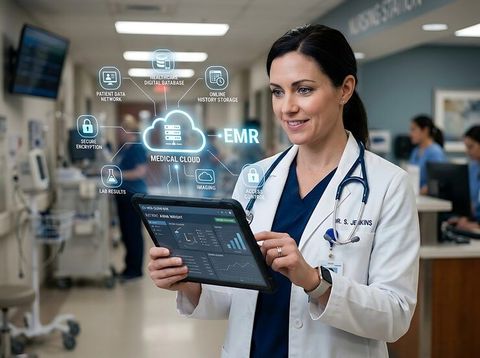
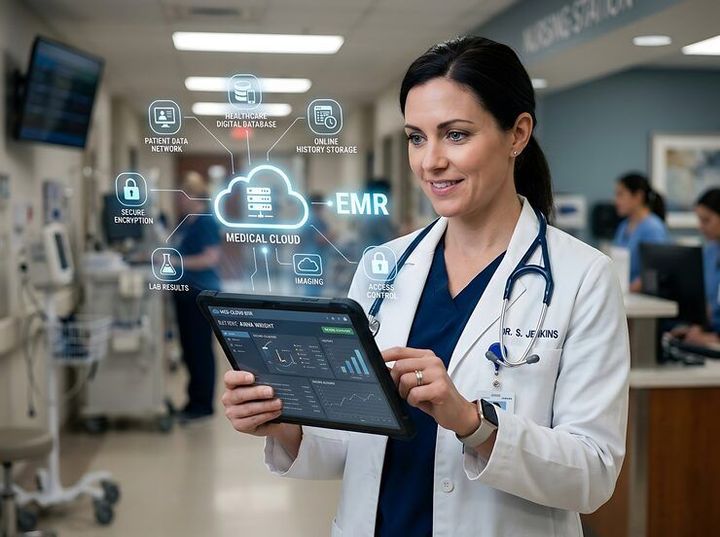
Cloud-based healthcare software allows authorized users to access information through connected devices, subject to permissions and security controls. It can also support data backup and system updates.
However, remote monitoring depends on reliable devices, suitable internet access, and clear procedures for responding to concerning readings. Cloud adoption also requires careful planning for privacy, access control, data recovery, and system availability.
Healthcare Technology Trends at a Glance
Technology trend | Main application | Important consideration |
|---|---|---|
Artificial intelligence | Pattern recognition and documentation support | Human review and validation |
Interoperable records | Information exchange between systems | Common data standards |
Telehealth | Remote consultations | Clinical suitability and access |
Remote monitoring | Tracking selected health measurements | Device reliability |
Cloud computing | Hosting and accessing digital records | Privacy and cybersecurity |
Data analytics | Operational and clinical reporting | Data quality and appropriate use |
These trends are developing at different speeds. Healthcare organizations should evaluate each technology according to its purpose, evidence, and practical limitations.
Laws and Policies Affecting Healthcare Software
Patient Privacy and Data Protection in India
Healthcare software often processes sensitive personal information, including medical histories, test results, prescriptions, and identifying details. Organizations must understand the legal requirements that apply to collecting, using, storing, and sharing this information.
India's Digital Personal Data Protection Act, 2023, and the Digital Personal Data Protection Rules, 2025, establish a framework for personal data protection. The Rules were notified in November 2025, with different provisions taking effect on different dates. Organizations should check the applicable commencement schedule rather than assume every requirement became effective at once.
Healthcare organizations should consider:
Providing appropriate information about personal data processing.
Obtaining consent where required by applicable law.
Limiting access to authorized personnel.
Establishing procedures for handling data breaches.
Maintaining appropriate technical and organizational safeguards.
Following applicable rules for data retention and individual rights.
The precise obligations depend on the organization, the data processing activity, and the provisions in force.
Ayushman Bharat Digital Mission
The ABDM promotes digital health infrastructure and standardized information exchange in India. Its ecosystem includes ABHA, healthcare facility and professional registries, and mechanisms designed to support consent-based sharing of health information.
Healthcare software intended to integrate with this ecosystem may need to follow applicable technical standards, testing procedures, and integration requirements.
Medical Device and Telemedicine Regulations
Software that performs a medical function, such as certain diagnostic or monitoring tasks, may fall within India's medical device regulatory framework depending on its intended purpose and classification. Not every administrative healthcare application is a medical device.
Telemedicine also operates under applicable professional rules and guidelines. Registered medical practitioners must follow relevant requirements concerning patient assessment, appropriate prescribing, documentation, and professional responsibility.
Healthcare organizations should obtain appropriate legal or regulatory guidance before deploying software that influences diagnosis, treatment, or the handling of sensitive patient information. Rules can differ by jurisdiction and software function.
Tools and Resources for Healthcare Software Planning
Essential Digital Healthcare Tools
Healthcare organizations can evaluate several general categories of tools when planning or improving their digital systems.
Electronic record platforms: For documenting patient histories, diagnoses, and treatment information.
Scheduling and workflow tools: For managing appointments, referrals, and departmental activities.
Telehealth applications: For appropriate remote consultations and follow-up communication.
Cybersecurity assessment tools: For identifying vulnerabilities and reviewing access controls.
Data integration tools: For exchanging information between compatible systems.
Reporting and analytics tools: For reviewing operational performance and identifying data quality problems.
Backup and recovery tools: For protecting records and supporting restoration after technical failures.
Training materials and checklists: For helping staff follow consistent procedures.
A Practical Software Evaluation Checklist
Before choosing or upgrading healthcare software, organizations should examine the following factors.
Evaluation area | Questions to consider |
|---|---|
Clinical suitability | Does the system support the organization's actual workflows? |
Data security | Are encryption, access controls, and audit logs available? |
Interoperability | Can it exchange data using appropriate standards? |
Usability | Can staff learn the system with reasonable training? |
Reliability | Are backup and recovery procedures documented? |
Compliance | Does the system support applicable legal requirements? |
Scalability | Can it accommodate expected changes in usage? |
Accessibility | Can intended users access the system appropriately? |
A structured evaluation helps organizations compare systems based on practical needs rather than relying only on feature lists. Pilot testing, staff feedback, security reviews, and implementation planning are also important.
Frequently Asked Questions
What are healthcare software solutions?
Healthcare software solutions are digital applications that help healthcare organizations manage patient records, appointments, clinical documentation, laboratory results, and administrative activities.
How does electronic health record software help patients?
Electronic health records help organize medical histories, prescriptions, allergies, and test results. When authorized professionals have appropriate access, these records can support continuity of care and reduce repeated data entry.
Is healthcare software secure?
Healthcare software can use encryption, access controls, authentication, and audit logs to protect information. However, no system is completely immune to cyberattacks or human error. Regular security reviews and staff training are essential.
What is the role of AI in digital healthcare systems?
AI can assist with selected tasks, including medical image analysis, documentation, data organization, and clinical decision support. Its reliability depends on the specific application, and important medical decisions require appropriate professional oversight.
What should a hospital consider before adopting healthcare software?
A hospital should assess clinical needs, usability, privacy protections, regulatory compliance, interoperability, technical support, staff training, and backup arrangements. Pilot testing can help identify problems before wider implementation.
Conclusion
Healthcare software solutions are changing how medical information is recorded, organized, and shared. Electronic health records, hospital management systems, telehealth platforms, and laboratory applications can help healthcare teams coordinate their work and maintain more consistent documentation.
Disclaimer: The information provided in this article is for informational purposes only. We do not make any claims or guarantees regarding the accuracy, reliability, or completeness of the information presented. The content is not intended as professional advice and should not be relied upon as such. Readers are encouraged to conduct their own research and consult with appropriate professionals before making any decisions based on the information provided in this article.