Lab-Grown Diamonds: An Informative Guide to Technology, Quality and Regulation
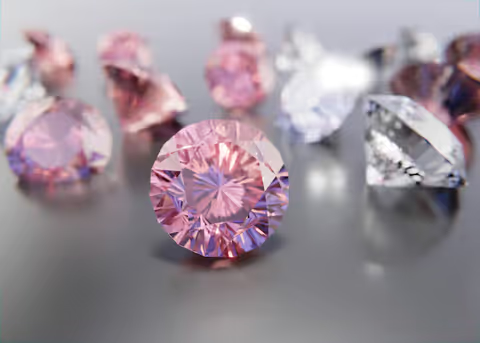
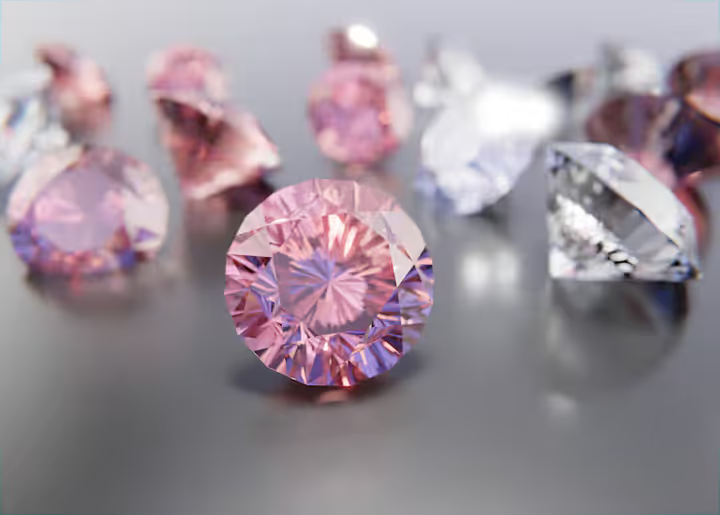
Lab-grown diamonds are diamonds created through controlled technological processes rather than formed naturally deep within the Earth.
They have essentially the same carbon-based crystal structure as natural diamonds and can have similar physical, chemical, and optical characteristics. Understanding how lab-grown diamonds are produced, identified, graded, regulated, and compared with natural diamonds helps consumers and students understand this developing area of materials science and the jewelry industry.
Context
What Are Lab-Grown Diamonds?
Lab-grown diamonds, also called laboratory-grown or laboratory-created diamonds, are crystalline carbon materials produced under controlled conditions. Unlike natural diamonds, which develop through geological processes over extremely long periods, laboratory production recreates some of the physical conditions associated with diamond formation.
A lab-grown diamond is not the same material as a diamond simulant such as cubic zirconia or synthetic moissanite. Simulants may resemble diamond visually but have different chemical or physical structures. Lab-grown diamonds have the characteristic carbon crystal structure associated with diamond.
How Lab-Grown Diamonds Are Created
Two major technologies are used for producing laboratory diamonds: High Pressure High Temperature, commonly called HPHT, and Chemical Vapor Deposition, known as CVD.
HPHT technology uses equipment that subjects a carbon source and a small diamond seed to very high pressure and temperature. Under controlled conditions, carbon crystallizes around the seed and gradually forms a diamond.
CVD uses a controlled chamber containing a carbon-containing gas. Energy is applied to create a plasma, allowing carbon atoms to deposit onto a diamond substrate and form crystalline layers.
HPHT and CVD Comparison
| Characteristic | HPHT | CVD |
|---|---|---|
| Main principle | High pressure and high temperature | Chemical vapor deposition |
| Starting material | Carbon source and diamond seed | Carbon-containing gas and diamond substrate |
| Growth environment | High-pressure apparatus | Controlled vacuum or low-pressure chamber |
| Common development focus | Crystal growth and color control | Layered crystal growth and material quality |
| Identification | Specialized gemological testing | Specialized gemological testing |
Both methods can produce gem-quality diamonds, although the resulting material can have different growth characteristics and trace-element patterns.
Diamond Growth and Processing
After a laboratory diamond has grown, it may undergo cutting and polishing. These processes shape the rough crystal into forms such as round, oval, cushion, emerald, pear, or marquise cuts.
Gemological laboratories can examine the finished stone using specialized instruments. Testing can identify characteristics associated with laboratory growth and distinguish them from naturally formed diamonds.
Importance
Why Lab-Grown Diamonds Matter
Lab-grown diamonds have become an important subject in modern materials science and the jewelry sector because technological advances have made controlled diamond production possible at commercial scale.
Diamonds are also used outside jewelry. Their hardness, thermal conductivity, optical properties, and chemical resistance make diamond materials relevant to cutting tools, electronics research, thermal management, scientific instruments, and other technical applications.
Understanding Physical Properties
Diamond is known for its high hardness and distinctive optical characteristics. These properties arise from the arrangement of carbon atoms in its crystal lattice.
For laboratory-grown diamonds used in jewelry, factors such as clarity, color, cut, and carat weight are commonly considered. However, the growth method can also affect internal characteristics that trained gemologists can examine.
Grading and Identification
A laboratory-grown diamond can be evaluated by a gemological laboratory. Reports may describe measurements, proportions, color, clarity, cut characteristics, and whether the stone is laboratory-grown or naturally formed.
Identification is important because visual inspection alone is not always sufficient to determine the origin of a diamond. Specialized instruments can detect growth-related features and other characteristics that distinguish laboratory-grown material from natural diamonds.
Factors Used to Describe a Lab-Grown Diamond
When examining a laboratory-grown diamond, several characteristics may be considered:
- Carat weight, which describes mass
- Color, which describes body color according to the grading system used
- Clarity, which refers to internal and surface characteristics
- Cut, which describes proportions, symmetry, and finish
- Measurements, including length, width, and depth
- Growth method, such as HPHT or CVD
- Laboratory report, where applicable
These characteristics describe the individual stone rather than determining its geological origin.
Scientific and Industrial Applications
The significance of laboratory diamond technology extends beyond jewelry. Researchers study diamond materials for applications involving heat transfer, high-pressure research, optical systems, quantum technologies, and specialized electronic components.
Diamond's thermal properties can be particularly relevant to systems where managing heat is important. Research into diamond-based materials continues across several scientific and engineering fields.
Recent Updates
Improvements in CVD Production
From 2024 through 2026, research and industrial development have continued to focus on improving CVD diamond growth. Areas of attention include growth rates, crystal quality, defect management, reactor control, and production consistency.
CVD technology can provide precise control over growth conditions, which makes it useful for producing diamond layers and larger crystalline materials for different applications.
Developments in HPHT Technology
HPHT production has also continued to develop through improvements in pressure systems, temperature control, crystal-growth processes, and post-growth treatment.
Researchers and producers continue to study how different growth conditions influence color, clarity, crystal structure, and other characteristics.
Advanced Diamond Materials
Research increasingly extends beyond traditional gem-quality stones. Laboratory-grown diamond materials are being investigated for specialized applications in electronics, photonics, quantum sensing, thermal management, and high-performance scientific equipment.
These applications often require different material characteristics from those sought in jewelry. Purity, crystal defects, electrical properties, and surface characteristics can therefore become more important than appearance.
Identification Technology
As laboratory diamond production has developed, gemological laboratories have continued to improve identification methods. Modern testing can examine fluorescence, spectroscopy, growth patterns, inclusions, and trace elements.
The purpose of such testing is to determine whether a stone is naturally formed, laboratory-grown, or another type of diamond-related material.
Environmental Considerations
Environmental discussions surrounding laboratory-grown diamonds often focus on electricity use, equipment efficiency, energy sources, water use, and industrial processes. The environmental profile of a laboratory-grown diamond therefore depends on how and where it is produced.
It is not scientifically accurate to assume that every laboratory-grown diamond has the same environmental impact. Production technology, electricity generation, facility efficiency, transportation, and processing all influence the overall picture.
Laws or Policies
Regulation in India
India has an important role in diamond cutting, polishing, jewelry manufacturing, and laboratory-grown diamond production. Government policies concerning trade, manufacturing, taxation, product descriptions, and consumer protection can therefore affect the sector.
The Bureau of Indian Standards, Ministry of Consumer Affairs, Department for Promotion of Industry and Internal Trade, and other relevant authorities may have roles depending on the product and activity involved.
Product Identification
Clear identification is important when laboratory-grown diamonds are presented to consumers. A laboratory-grown diamond should not be represented as a naturally mined diamond because the two have different origins.
Jewelry documentation, laboratory reports, invoices, and product descriptions can provide information about whether a diamond is laboratory-grown or naturally formed.
Hallmarking and Jewelry
India's hallmarking framework primarily concerns the purity of precious-metal articles such as gold, silver, platinum, palladium, and related regulated products. A diamond itself is not identified through the same metal-purity hallmarking system.
For jewelry containing a laboratory-grown diamond, consumers may therefore encounter separate information about the metal and the diamond. Gemological documentation can provide additional information about the stone.
Consumer Protection
India's consumer-protection framework addresses misleading representations and unfair commercial practices. Claims concerning a diamond's origin, characteristics, certification, or environmental attributes should therefore be accurate and supported by appropriate evidence.
Specific legal obligations can vary according to the product, transaction, business structure, and applicable regulations. Current government guidance should be consulted when precise legal interpretation is required.
Tools and Resources
Gemological Laboratories
Gemological laboratories use specialized equipment to examine diamonds and prepare reports. Well-known laboratories include the Gemological Institute of America, International Gemological Institute, and other recognized gemological organizations.
A laboratory report can contain information about a stone's characteristics and whether it has been identified as laboratory-grown. The exact format and terminology depend on the laboratory.
Spectroscopy and Identification Equipment
Professional diamond identification may involve spectroscopy, microscopy, fluorescence analysis, photoluminescence, and other techniques. These methods can reveal characteristics that are not visible under ordinary lighting.
Jewelry professionals and gemologists may use dedicated screening instruments before more detailed laboratory examination.
Educational Resources
Useful educational resources include:
- Gemological laboratory guides
- Diamond grading explanations
- CVD and HPHT technical literature
- Materials-science publications
- Government consumer-protection information
- Diamond identification documentation
Comparing Diamond Reports
When examining a laboratory-grown diamond, a report can be used to compare measurable characteristics such as carat weight, color, clarity, cut, dimensions, and growth method.
A report number can also help connect a particular document with a specific stone, depending on the laboratory's verification system.
FAQs
What are lab-grown diamonds?
Lab-grown diamonds are diamonds produced in controlled laboratory or industrial environments using technologies such as HPHT or CVD. They have a carbon crystal structure characteristic of diamond and are distinct from diamond simulants.
How are lab-grown diamonds made?
Lab-grown diamonds are primarily produced using HPHT or CVD methods. HPHT recreates high-pressure and high-temperature conditions, while CVD deposits carbon from a gas onto a diamond substrate under controlled conditions.
Are lab-grown diamonds real diamonds?
Yes, lab-grown diamonds are diamond materials rather than visual simulants. Their origin differs from natural diamonds because they are produced through controlled technological processes instead of geological formation.
How can lab-grown diamonds be identified?
Specialized gemological equipment can identify laboratory-grown diamonds by examining growth patterns, spectroscopy, fluorescence, inclusions, and trace characteristics. A trained gemologist or recognized laboratory can conduct this type of examination.
Do lab-grown diamonds have the same environmental impact?
Environmental impact varies according to production technology, electricity sources, facility efficiency, transportation, and other factors. Therefore, environmental characteristics should be evaluated using specific production information rather than assuming that all laboratory-grown diamonds have identical impacts.
Conclusion
Lab-grown diamonds are crystalline diamond materials produced through controlled HPHT or CVD technologies rather than natural geological processes. Their applications extend from jewelry to scientific and industrial research involving thermal, optical, electronic, and quantum technologies. Identification and documentation help distinguish laboratory-grown diamonds from naturally formed stones, while Indian consumer and product regulations provide a broader framework for accurate descriptions. Production methods, energy sources, material characteristics, and testing technologies continue to develop as laboratory diamond research advances.