AI Video Creation Details: Scripts, Avatars, Voiceovers, Visuals and Production Workflows
AI video creation refers to the use of artificial intelligence to help produce video content from written instructions, images, audio, or existing footage. An AI video workflow can involve several stages, including script development, avatar creation, voiceovers, visual generation, editing, subtitles, and final production. Instead of treating video creation as one single task, these technologies divide production into different components that can be handled with AI-assisted tools.
The idea developed from earlier forms of computer-generated imagery, automated editing, text-to-speech, and machine-learning-based image processing. As generative AI models became more capable, they began producing complete video clips from text and image prompts. In recent years, systems such as Google's Veo models and OpenAI's Sora demonstrated how text, images, motion, dialogue, and sound could increasingly be combined within AI video creation workflows.
An AI video production workflow usually begins with an idea or script. The creator then determines the required visuals, narration, characters, avatar appearance, music, sound effects, captions, and sequence of scenes. Some workflows use AI for nearly every stage, while others combine AI-generated elements with conventional video editing and recorded material.
Main components of AI video creation
Several components commonly appear in an AI video project:
- Script: Defines the information, dialogue, narration, and sequence of the video.
- Avatars: Digital characters that can represent a narrator or presenter.
- Voiceovers: Spoken narration generated from text or created from recorded speech.
- Visuals: AI-generated scenes, images, animations, backgrounds, or video clips.
- Editing: Arranges scenes, audio, captions, transitions, and other elements into a final sequence.
- Production workflow: Connects these stages into a repeatable process.
The exact combination depends on the purpose of the video, its intended audience, required format, and level of human involvement.
Importance
AI video creation matters because producing video traditionally requires several separate skills. A person may need to write a script, prepare visual material, record narration, arrange scenes, synchronize audio, add captions, and edit the final result. AI tools can assist with individual parts of this process and can change how creators organize their production workflow.
This can affect educators, researchers, content creators, businesses, students, filmmakers, and people producing instructional material. For example, an educational video may begin with a written explanation, use AI-generated visuals to illustrate difficult concepts, and then combine narration and captions during editing.
Addressing common production challenges
One challenge is translating an idea into a coherent sequence of scenes. A detailed script can provide structure before visual generation begins. Another challenge is maintaining consistency between scenes. Character appearance, lighting, locations, clothing, camera position, and visual style can change unexpectedly when individual clips are generated separately.
Voiceovers introduce another consideration. AI speech systems can create narration from written text, but pronunciation, emphasis, pacing, pauses, and tone still require review. Similarly, an AI avatar may appear visually convincing while its gestures or mouth movements do not perfectly match the spoken material.
Human review therefore remains important throughout the workflow. AI-generated video can contain incorrect objects, visual inconsistencies, unusual movements, inaccurate information, or unintended changes between scenes.
A simple AI video workflow
| Production stage | Main task | Typical output |
|---|---|---|
| Planning | Define purpose and audience | Video concept |
| Script | Organize information and dialogue | Written script |
| Storyboard | Plan scenes and shots | Scene outline |
| Visual generation | Create scenes or assets | Video clips/images |
| Avatar | Create presenter or character | Avatar footage |
| Voiceover | Produce narration | Audio track |
| Editing | Combine video and audio | Edited sequence |
| Review | Check accuracy and consistency | Revised video |
| Publishing | Prepare final format | Finished video |
This workflow is flexible. Some projects may skip avatars, use recorded voices instead of AI voiceovers, or combine AI-generated scenes with real footage.
Recent Updates
AI video creation changed substantially during 2024–2026. Video-generation models became more capable of responding to detailed prompts, maintaining visual elements, and combining multiple forms of media.
During this period, Google introduced Veo 2 and later Veo 3, with developments covering text-to-video generation, image-to-video workflows, audio generation, dialogue, sound effects, and greater control over scenes. Google also introduced Flow, an AI filmmaking tool designed around its generative media models.
Another development has been greater attention to provenance and identification. Google has used SynthID watermarking for generated media, while its SynthID Detector was introduced to help identify content produced with Google's AI systems. These approaches are intended to provide additional information about the origin of generated media.
OpenAI introduced Sora for video generation in 2024 and later introduced Sora 2 with synchronized dialogue and sound effects. OpenAI subsequently announced that the Sora product would no longer be available after April 26, 2026, illustrating how quickly AI video platforms and product availability can change.
Another continuing trend is greater control over video composition. Recent systems have focused on character consistency, image-to-video generation, vertical formats, higher resolutions, audio integration, and more precise editing. For example, Google's Veo 3.1 updates added vertical video generation and expanded control over visual consistency and output resolution in supported environments.
Laws or Policies
In India, AI video creation is affected by existing information-technology, privacy, intellectual-property, and online-content rules. The Information Technology (Intermediary Guidelines and Digital Media Ethics Code) Rules, 2021 form an important part of the framework for online intermediaries.
India also introduced amendments in 2026 concerning synthetically generated information. According to the Ministry of Electronics and Information Technology, the amendments address synthetic audio, visual, and audiovisual information and strengthen intermediary obligations concerning harmful or unlawful synthetic content. The framework includes requirements involving labelling, metadata, identifiers, user awareness, and technical measures in specified circumstances.
These rules are particularly relevant when AI video creation involves realistic representations of people, impersonation, misleading material, or other content that may fall within unlawful categories. Creators should also consider whether they have appropriate rights or permissions for photographs, recordings, voices, characters, music, trademarks, and other material used in a production.
Privacy is another consideration when a workflow uses a real person's face or voice. Consent, data handling, and the intended use of likeness can become important depending on the circumstances. The exact legal position can vary according to the content, platform, rights involved, and applicable law, so general information about AI video creation should not be treated as legal advice.
Tools and Resources
AI video production can involve several types of tools rather than one application. The appropriate combination depends on the project and the required level of control.
Script and planning tools
Writing tools can help organize narration, dialogue, scene descriptions, shot lists, and storyboard notes. A useful script normally separates spoken words from visual instructions so that the video-generation stage has clear guidance.
Video-generation tools
Generative video platforms can create clips from text prompts, reference images, or other inputs. Some systems focus on short scenes, while others provide additional controls for characters, camera movement, editing, or scene continuity.
Avatar and voiceover tools
Avatar platforms can create digital presenters from selected characters or approved likenesses. Voice-generation tools can convert written scripts into spoken narration, while some systems support customized voices or multilingual speech.
Editing and captioning tools
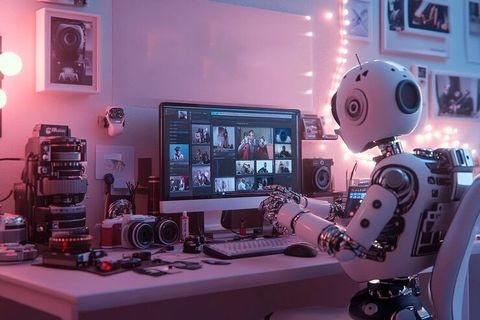
Traditional video editors remain useful even when most footage is generated by AI. Editing software can combine multiple clips, adjust timing, synchronize narration, add captions, correct transitions, and prepare different aspect ratios for various screens.
A practical production checklist can include:
- Verify factual information in the script.
- Separate narration from visual instructions.
- Check character and scene consistency.
- Review AI voice pronunciation and pacing.
- Confirm permission for faces, voices, music, and other protected material.
- Inspect captions for spelling and timing.
- Review generated scenes for unintended or inaccurate details.
- Check whether AI-generated content requires identification or labelling.
- Keep source materials and project versions organized.
These steps help distinguish the creative generation stage from the review and production stages.
FAQs
What is AI video creation?
AI video creation is the use of artificial intelligence to assist with producing video content. It can include script development, AI avatars, voiceovers, visual generation, animation, editing, captions, and other production tasks.
How do AI video scripts and voiceovers work?
AI video scripts provide written instructions or narration for a production. A voiceover system can then convert approved text into spoken audio, with controls for language, pronunciation, pacing, and voice characteristics depending on the platform.
What are AI video avatars used for?
AI video avatars are digital presenters or characters that can deliver scripted narration. They are commonly used for educational explanations, demonstrations, presentations, training material, and other forms of structured communication.
How are AI video visuals created?
AI video visuals can be generated from text prompts, reference images, or combinations of inputs. Modern systems can create short scenes with movement, camera effects, characters, environments, and in some cases synchronized sound.
What should creators check before publishing AI-generated video?
Creators should review factual accuracy, visual consistency, voice and likeness permissions, copyright considerations, captions, and applicable disclosure or labelling requirements. In India, rules concerning synthetically generated information may also apply depending on the content and how it is distributed.
Conclusion
AI video creation combines scripts, avatars, voiceovers, visuals, and editing into a flexible production workflow. Developments from 2024–2026 have expanded capabilities for generating video, synchronized audio, consistent characters, vertical formats, and provenance information. Human review remains important because generated material can contain factual, visual, audio, or consistency problems. In India, creators also need to consider applicable rules concerning synthetic content, privacy, intellectual property, and online publication.