Coffee Brewing Equipment A Complete Guide to Different Types and Their Uses
Coffee brewing equipment includes the tools and appliances used to turn roasted and ground coffee into a prepared beverage. The category ranges from simple manual devices, such as French presses and pour-over brewers, to electric drip machines and espresso machines. Each type uses a different combination of water, temperature, pressure, contact time, and filtration.
The development of coffee brewing equipment is closely connected with changes in household habits, café culture, engineering, and coffee preparation methods. Early brewing relied heavily on basic pots and manual techniques, while later equipment introduced controlled heating, filtration, pressure, and automated water delivery.
Today, coffee brewing equipment can be grouped according to how water interacts with ground coffee. Some methods use gravity, some use pressure, and others depend mainly on immersion. Understanding these differences makes it easier to understand why the same coffee beans can produce different flavors and textures with different equipment.
How coffee brewing equipment works
Most brewing methods involve four basic elements: coffee grounds, water, temperature, and contact time. The equipment controls how these elements interact.
For example, a pour-over brewer allows water to pass through coffee grounds and a filter. A French press keeps coffee grounds immersed in water before separating them with a mesh filter. An espresso machine pushes heated water through finely ground coffee under pressure.
Grinding also has an important role. Finer grounds generally create more resistance to water, while coarser grounds allow water to pass through more easily. The appropriate grind therefore depends on the brewing method.
Importance
Coffee brewing equipment matters because the brewing method affects extraction, strength, clarity, texture, and preparation time. Choosing a particular type of equipment is therefore less about a single universal choice and more about matching the method to personal preferences, available time, and the style of coffee being prepared.
The equipment also affects how much control a person has over the brewing process. Manual methods often allow changes to water flow, timing, and pouring technique, while automated machines can control several stages with less manual involvement.
Understanding the differences can also reduce confusion when comparing brewing methods. A person preparing coffee for one cup may have different requirements from someone preparing several cups at once.
Common types of coffee brewing equipment
The main categories can be summarized as follows:
| Equipment type | Main brewing principle | Typical use |
|---|---|---|
| Pour-over brewer | Gravity and filtration | Manual single-cup brewing |
| French press | Immersion | Full-bodied brewed coffee |
| Drip coffee maker | Automated filtration | Multiple cups |
| Espresso machine | Pressure extraction | Concentrated coffee |
| Moka pot | Pressure-assisted brewing | Strong stovetop coffee |
| AeroPress-style brewer | Pressure and immersion | Small-batch manual brewing |
| Cold brew maker | Long immersion | Cold coffee preparation |
| Percolator | Repeated water circulation | Stovetop or electric brewing |
Each method creates a different brewing environment. There is no single piece of equipment that produces the same result across every preparation style.
Manual brewing equipment
Manual equipment generally requires the user to control several parts of the process. Pour-over brewers, French presses, and AeroPress-style devices are examples.
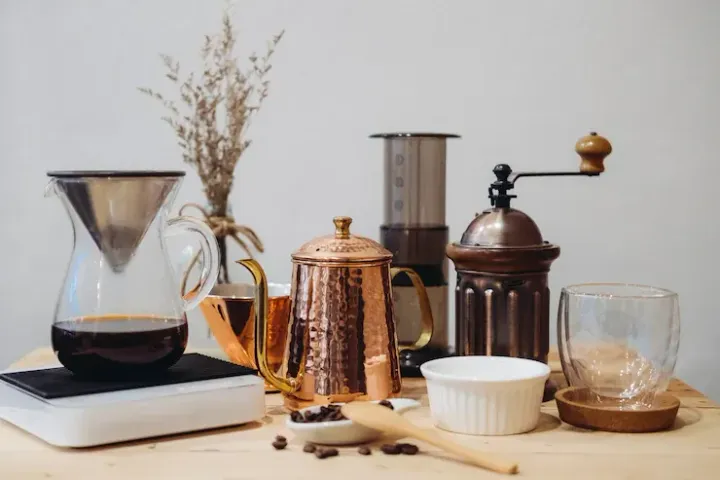
Pour-over brewing uses a cone or similar chamber, a filter, ground coffee, and water. The user controls the pouring pattern and timing, which can influence extraction.
A French press uses immersion. Ground coffee remains in contact with water before a plunger separates the grounds from the liquid. This method normally allows more oils and fine particles into the final cup than paper-filtered brewing.
Electric brewing equipment
Electric drip machines automate water heating and delivery. They are commonly designed around a reservoir, heating system, showerhead or water-distribution mechanism, filter basket, and carafe.
Automatic machines can reduce the amount of manual work involved in brewing several cups. Some models also provide controls for brewing strength, timing, temperature, or volume.
Espresso machines use a different process. They force heated water through compacted finely ground coffee under pressure. Espresso equipment can include a group head, portafilter, pump, boiler or heating system, and steam wand depending on the design.
Recent Updates
Coffee brewing equipment has continued to develop through improvements in temperature control, water distribution, automation, materials, and measurement. During 2024–2026, manufacturers and equipment developers have continued to focus on consistency and greater control over brewing variables.
The Specialty Coffee Association maintains equipment standards covering areas such as home brewers, home grinders, and espresso machines. Its standards program is designed to create shared technical frameworks for equipment performance and testing.
Greater control over brewing variables
Modern equipment increasingly provides users with more control over variables that influence extraction. These can include water temperature, flow rate, pressure, brewing time, and programmable quantities.
For manual brewing, digital scales and precision kettles have also become common tools for measuring water and coffee more consistently. The purpose is not simply automation; measurement can help users understand how changes in the brewing process affect the final beverage.
Equipment testing and standards
Equipment testing has also become more structured. The Specialty Coffee Association maintains a certification program for home brewing equipment that evaluates factors related to brewing quality, consistency, and performance.
Water quality remains another area of attention. Brewing research and equipment testing commonly use defined water characteristics and coffee-to-water ratios so that equipment can be evaluated under controlled conditions.
These developments show a broader movement toward measurable brewing variables rather than relying entirely on visual judgment or personal estimation.
Laws or Policies
Coffee brewing equipment can be affected by several types of regulations depending on where it is manufactured, sold, or used. These may include electrical safety requirements, food-contact material rules, labeling requirements, environmental regulations, and consumer product standards.
Food-contact regulations are particularly relevant because parts of brewing equipment can come into direct contact with coffee or water. The European Commission explains that food-contact materials include kitchenware, food-processing equipment, containers, and other materials that may come into contact with food.
Materials that contact food
Regulatory frameworks in some jurisdictions require materials that contact food to meet safety requirements. The European Union, for example, has a general framework requiring food-contact materials to avoid releasing substances at levels that could harm health or produce unacceptable changes to food composition, taste, or smell.
Changes in chemical restrictions can also affect equipment materials. The European Commission adopted restrictions on bisphenol A in food-contact materials, with transition arrangements for affected products.
Electrical and product safety
Electric coffee makers also fall within product and electrical safety frameworks in many regions. Requirements can cover insulation, heating components, electrical connections, temperature controls, labeling, and safe operation.
NSF International, for example, maintains a protocol covering food protection and safety requirements for household coffee makers, including electrical drip equipment, espresso machines, and certain non-electrical brewing devices.
Because requirements vary between jurisdictions, manufacturers and users should refer to the regulations and standards applicable to their location and equipment category.
Tools and Resources
Several supporting tools can make coffee brewing easier to understand and measure. A digital scale can measure coffee and water quantities, while a timer can help track brewing duration. A thermometer can also help monitor water temperature when the brewing device does not provide temperature control.
A burr grinder is another important piece of equipment because it produces a more consistent particle size than many basic grinding methods. Grind size can then be adjusted according to the brewing method.
Useful resources include:
- Brewing guides for understanding extraction, ratios, and preparation methods.
- Equipment manuals for operating and maintaining specific machines.
- Coffee brewing standards for technical information about equipment testing.
- Digital scales for measuring coffee and water.
- Timers for tracking brewing duration.
- Water-quality references for understanding how minerals and composition can affect brewing.
- Cleaning instructions for removing coffee residue and mineral deposits.
The Specialty Coffee Association provides standards covering home brewers, grinders, and espresso equipment, while its educational resources explain technical aspects of coffee preparation.
Regular cleaning is also important. Coffee oils and mineral deposits can accumulate inside brewing equipment and affect operation or the flavor of later brews. Cleaning procedures vary according to the equipment type, so manufacturer instructions should be followed.
FAQs
What are the main types of coffee brewing equipment?
Common coffee brewing equipment includes pour-over brewers, French presses, drip coffee makers, espresso machines, moka pots, AeroPress-style brewers, cold brew makers, and percolators. Each uses a different brewing process.
How does coffee brewing equipment affect flavor?
Equipment affects factors such as water flow, contact time, temperature, filtration, and pressure. These variables influence how compounds are extracted from ground coffee and therefore affect flavor, strength, and texture.
What coffee brewing equipment is used for espresso?
Espresso machines are designed to force heated water through finely ground coffee under pressure. They commonly include components such as a portafilter, group head, pump, and heating system.
Is a coffee grinder part of coffee brewing equipment?
A grinder is generally considered a preparation tool rather than a brewer itself, but it has an important role in the brewing process. Grind size affects how quickly water moves through or interacts with the coffee grounds.
What should be considered when choosing coffee brewing equipment?
Important factors include the brewing method, quantity of coffee required, level of manual control, preparation time, cleaning requirements, available space, and whether electricity is needed. The choice depends on how the equipment will be used and the type of coffee being prepared.
Conclusion
Coffee brewing equipment ranges from simple manual brewers to automated machines designed for different preparation methods. Each type controls water, coffee, temperature, contact time, filtration, or pressure in a different way. Recent equipment development has focused on greater consistency, measurement, and control, while food-contact and product-safety rules continue to influence equipment design. Understanding these differences provides a useful foundation for comparing brewing methods and their practical uses.