Industrial Air Compressor Basics: Working Principles, Types, Applications and Important Components
An industrial air compressor is a machine that takes air from the surrounding environment and compresses it into a smaller volume, increasing its pressure. The compressed air can then be stored, transported through piping, and used to operate equipment or support industrial processes.
Context
The basic concept comes from the physical relationship between pressure, volume, and gas. When air is confined and its volume is reduced, pressure increases. Mechanical energy from an electric motor, engine, or another drive source is converted into compressed-air energy through a compression mechanism.
Industrial air compressors are generally divided into two broad categories: positive-displacement compressors and dynamic compressors. Positive-displacement machines trap a quantity of air and mechanically reduce its volume, while dynamic machines continuously accelerate air and convert its velocity into pressure.
How an industrial air compressor works
The working process normally begins when atmospheric air enters through an intake system. The compressor then compresses the air and directs it toward a receiver, treatment equipment, or the connected distribution system.
A simplified compression cycle can be described as:
- Air intake: surrounding air enters through the inlet.
- Compression: a mechanical element reduces the air volume or increases its velocity.
- Discharge: compressed air leaves the compression chamber or impeller area.
- Cooling and treatment: heat, moisture, and contaminants may be removed.
- Storage and distribution: treated air moves into a receiver or piping network.
- End use: pneumatic equipment or industrial processes use the compressed air.
The exact sequence depends on compressor design, pressure requirements, air quality requirements, and the equipment connected to the system.
Importance
Industrial air compressors are important because compressed air can be distributed through pipes and used at different points within an industrial facility. Pneumatic tools, actuators, control systems, material-handling equipment, and production machinery can use compressed air as part of their operation.
However, compressed air is not simply a substitute for electricity. Producing compressed air requires significant input energy, and losses can occur through heat generation, leakage, pressure drops, inappropriate applications, and inefficient system operation. The U.S. Department of Energy notes that compressed-air systems should be considered as complete systems rather than focusing only on the compressor itself.
Why compressor selection matters
The required pressure and airflow can vary considerably between applications. Selecting equipment without considering the actual demand can result in excess capacity, unstable pressure, or unnecessary energy use.
Important factors include:
- Required operating pressure
- Required airflow
- Duty cycle
- Air-quality requirements
- Ambient temperature
- Available electrical supply
- Storage capacity
- Cooling method
- Installation environment
- Expected operating pattern
A compressor used intermittently for pneumatic tools has different requirements from one supporting a continuous industrial process.
Industrial air compressor types
Different compressor designs use different methods to increase air pressure. The following table summarizes several commonly encountered types.
| Compressor type | Basic principle | Typical characteristics |
|---|---|---|
| Reciprocating | Pistons compress air inside cylinders | Suitable for intermittent or moderate-flow applications |
| Rotary screw | Rotating screw elements compress trapped air | Common for continuous industrial operation |
| Rotary vane | Sliding vanes reduce the volume of trapped air | Compact design with continuous rotary motion |
| Centrifugal | High-speed impellers accelerate air | Used where high continuous airflow is required |
| Scroll | Interacting scrolls progressively compress air | Compact design for selected applications |
Positive-displacement compressors include reciprocating and rotary designs. Dynamic compressors, such as centrifugal machines, operate differently by transferring velocity energy to continuously flowing air and converting that energy into pressure.
Recent Updates
Industrial air compressor technology has increasingly focused on energy performance, system monitoring, variable-speed operation, heat management, and improved control systems. These developments reflect a broader effort to reduce unnecessary energy use while maintaining stable compressed-air supply.
Variable-speed drive systems can adjust motor speed according to changing air demand. This can be useful in facilities where demand varies significantly instead of remaining constant.
System-level optimization has also received greater attention. The U.S. Department of Energy identifies measures such as reducing inappropriate compressed-air use, improving storage and controls, reducing leaks, and selecting appropriate equipment as important areas for system improvement.
Developments in testing and standards
International compressor standards are also being updated. ISO 1217 covers acceptance testing for displacement compressors, including methods related to volume flow and power requirements. ISO currently lists a new edition of ISO 1217 as under development to replace the existing 2009 edition.
Air quality measurement has also continued to develop. ISO 8573-5:2025 specifies a method for measuring oil vapour in compressed air, while work on other parts of the ISO 8573 series addresses contaminant measurement and air purity.
Efficiency and system monitoring
Modern compressed-air systems increasingly use sensors, electronic controllers, and monitoring systems to track pressure, temperature, flow, operating conditions, and equipment status.
These technologies can help identify changes in system behavior. For example, unusual pressure changes or continuous compressor operation may indicate changes in demand, leakage, or another system condition that requires investigation.
Laws or Policies
Industrial air compressors are affected by different regulations, technical standards, workplace requirements, pressure-equipment rules, environmental regulations, and electrical-safety requirements depending on the location and application. Because these requirements vary between jurisdictions, there is no single regulatory framework that applies to every industrial compressor installation.
International standards can provide technical frameworks for testing and measuring compressor performance. ISO 1217, for example, specifies acceptance-test methods for displacement compressors and includes measurements related to flow rate and power requirements.
Compressed-air quality can also be subject to specific technical requirements when the air comes into direct or indirect contact with sensitive processes. The ISO 8573 series provides methods and classifications for contaminants such as particles, water, oil aerosols, and oil vapour.
Safety considerations
Compressed air contains stored energy, which means pressure-related hazards must be considered during design, installation, operation, and maintenance. Receivers, pressure vessels, valves, piping, electrical systems, and protective devices may be subject to applicable safety requirements.
Equipment should be operated according to its technical documentation and the relevant workplace and pressure-equipment requirements. Specific requirements depend on factors such as operating pressure, vessel size, installation environment, and the intended application.
Tools and Resources
Understanding an industrial air compressor becomes easier when technical information is combined with practical measurement. Compressor manufacturers' technical documentation, engineering references, standards organizations, and industrial energy resources can provide information about pressure, airflow, power requirements, and air quality.
Compressed-air assessment tools can also help analyze system performance. The U.S. Department of Energy provides resources covering compressed-air system analysis, storage strategies, control strategies, air quality, end-use applications, and system assessment.
Useful measurements
Several measurements are commonly used when examining a compressed-air system:
- Pressure: indicates the force exerted by compressed air within the system.
- Flow rate: indicates how much air is being delivered over a given period.
- Temperature: helps assess operating conditions and cooling requirements.
- Power input: indicates the electrical or mechanical energy used by the compressor.
- Dew point: helps describe the moisture condition of compressed air.
- Air quality: identifies contaminants that may affect downstream equipment or processes.
A pressure gauge alone does not provide a complete picture of compressor performance. Flow, power, pressure, operating hours, air quality, and demand patterns can all contribute to a more complete assessment.
Important compressor components
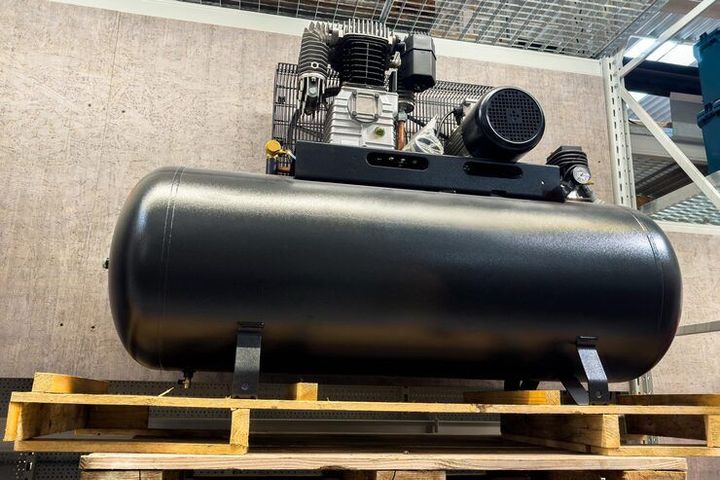
An industrial air compressor normally contains several interconnected components. Their exact arrangement depends on the compressor design.
| Component | Main function |
|---|---|
| Air intake filter | Removes particles from incoming air |
| Compression element | Raises air pressure |
| Motor or engine | Provides mechanical power |
| Cooling system | Removes heat produced during compression |
| Separator | Separates oil or moisture where applicable |
| Air receiver | Stores compressed air and helps manage demand fluctuations |
| Pressure control | Helps regulate operating pressure |
| Safety valve | Provides pressure protection |
| Dryer | Reduces moisture in compressed air |
| Filters | Remove specified contaminants |
| Piping | Transports compressed air to points of use |
| Controller | Monitors and manages compressor operation |
The compression element is the central component, but the supporting equipment is also important because compressed air must be cooled, treated, controlled, stored, and distributed appropriately.
FAQs
What is an industrial air compressor?
An industrial air compressor is a machine that converts mechanical energy into pressurized air. The compressed air can be stored and distributed for pneumatic equipment, manufacturing processes, controls, and other industrial applications.
What are the main industrial air compressor types?
Common industrial air compressor types include reciprocating, rotary screw, rotary vane, scroll, and centrifugal compressors. Their operating principles and suitable applications differ according to airflow, pressure, duty cycle, and system requirements.
How does an industrial air compressor work?
An industrial air compressor draws atmospheric air into a compression mechanism. The machine either reduces the volume of trapped air or increases the velocity of continuously flowing air, producing compressed air that can then be cooled, treated, stored, and distributed.
What are the important components of an industrial air compressor?
Important components can include the intake filter, compression element, motor, cooling system, separator, pressure controls, safety devices, receiver, dryer, filters, controller, and distribution piping. The exact components vary by compressor design.
Why is compressed-air quality important?
Compressed air may contain particles, water, oil aerosols, oil vapour, or other contaminants. The required purity depends on the application, and the ISO 8573 series provides methods for measuring several types of compressed-air contamination.
Conclusion
Industrial air compressors use mechanical energy to produce pressurized air for a wide range of industrial applications. Reciprocating, rotary, and dynamic compressors use different methods to increase air pressure, while supporting components manage cooling, storage, treatment, control, and distribution. Recent developments have placed greater attention on energy performance, system monitoring, testing methods, and compressed-air quality. Understanding the working principle, compressor type, application, and major components provides a foundation for understanding how industrial compressed-air systems operate.