Industrial Machines Development: Smart Manufacturing Technologies Explained
Industrial machine development refers to the continuous improvement of equipment used for manufacturing, processing, assembly, inspection, packaging, material handling, and other industrial activities. Traditional machines mainly performed specific mechanical operations, while modern equipment increasingly combines mechanical engineering with software, sensors, automation, artificial intelligence, and connected control systems.
The development of industrial machinery exists because manufacturing environments must handle changing production requirements, quality expectations, energy considerations, and increasingly complex products. A modern production machine can collect information about its operating condition, communicate with other equipment, and adjust certain processes based on programmed instructions or real-time data.
This transition is closely associated with Industry 4.0, also known as the fourth industrial revolution. It connects physical equipment with digital technologies such as the Industrial Internet of Things (IIoT), machine learning, robotics, cloud computing, edge computing, digital twins, and advanced analytics.
Smart manufacturing does not necessarily mean replacing every conventional machine. In many factories, existing equipment can be upgraded with sensors, controllers, industrial networks, monitoring systems, and software. This creates a gradual path from conventional machinery toward connected manufacturing.
Importance: Why Smart Manufacturing Matters Today
Smart manufacturing matters because industrial production is becoming more data-driven and interconnected. Manufacturers need better visibility into equipment performance, production conditions, quality information, and resource use.
Modern industrial machine development can address several common manufacturing challenges:
- Unexpected equipment downtime
- Inconsistent production quality
- Limited visibility into machine performance
- Difficult manual data collection
- Complex production scheduling
- High energy consumption
- Repetitive production activities
- Increasing process complexity
- Difficult coordination between machines and production systems
Sensors can continuously monitor temperature, vibration, pressure, speed, position, current, and other operating parameters. This information can then be analyzed to identify unusual conditions or changing machine behavior.
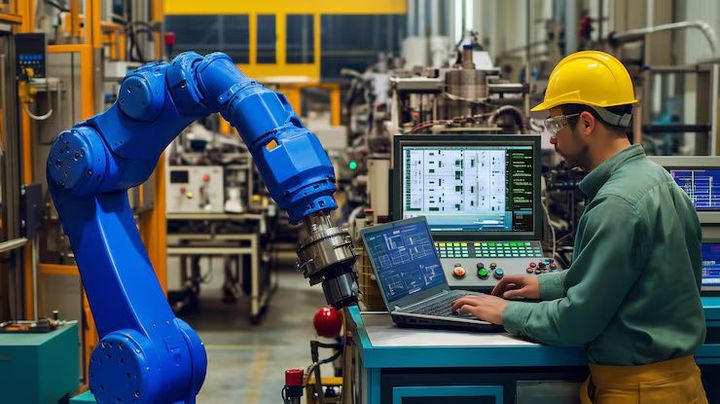
Automation is another important part of smart manufacturing. Programmable logic controllers, industrial robots, machine vision systems, automated guided vehicles, and computer numerical control equipment can coordinate production activities with limited manual intervention.
Artificial intelligence is also becoming increasingly relevant. AI systems can analyze large quantities of production data, identify patterns, support quality inspection, and help engineers understand possible equipment problems.
Digital twins provide another important capability. A digital twin is a digital representation of a physical machine, production line, or process. When connected to operational data, it can help engineers study machine behavior and evaluate possible process changes before applying them to physical equipment.
The World Economic Forum's 2026 outlook describes a broader shift from isolated automation toward connected and increasingly intelligent industrial operations, including greater use of AI and physical AI.
| Technology | Common Industrial Application | Main Purpose |
|---|---|---|
| IIoT Sensors | Machine monitoring | Collect operating data |
| AI & Machine Learning | Quality and prediction | Analyze patterns |
| Robotics | Assembly and handling | Automate repetitive activities |
| Digital Twins | Process simulation | Study machine behavior |
| Machine Vision | Inspection | Detect visual differences |
| Edge Computing | Real-time control | Process data near equipment |
| Cloud Platforms | Data management | Store and analyze information |
Recent Updates: Smart Manufacturing Trends in 2025–2026
The development of industrial machinery has accelerated through the integration of AI, robotics, digital twins, advanced sensors, and connected industrial systems.
In September 2025, the World Economic Forum highlighted the development of physical AI, where robotics, computer vision, artificial intelligence, and physical machines work together. The discussion described a progression beyond conventional rule-based automation toward robotic systems capable of interpreting environments and adapting their actions.
In April 2026, the World Economic Forum's Intelligent Industrial Operations Outlook 2026 described a shift toward intelligent, connected, and increasingly autonomous industrial operations. The report highlighted AI, physical AI, and other frontier technologies as important developments across industrial value chains.
Digital twins are also becoming more sophisticated. A 2026 World Economic Forum report described how real-time production data, spatial intelligence, and AI can combine to make digital twins more interactive and useful for manufacturing decisions.
India has also expanded its focus on advanced manufacturing. In October 2025, NITI Aayog presented a roadmap identifying AI and machine learning, advanced materials, digital twins, and robotics as high-impact technologies for advanced manufacturing across priority sectors.
In February 2026, a government-led stakeholder consultation at the Central Manufacturing Technology Institute in Bengaluru examined approaches for strengthening India's advanced manufacturing capabilities and developing a coordinated strategy.
These developments show that industrial machine development is moving from isolated automation toward connected systems in which machines, software, data, and people work together.
Laws or Policies: Manufacturing Technology in India
Industrial machine development in India is influenced by manufacturing, technology, environmental, workplace, and industrial policies. The exact requirements depend on the machine, industry, location, and application.
The SAMARTH Udyog Bharat 4.0 initiative under the Ministry of Heavy Industries supports awareness and adoption of Industry 4.0 technologies. Its activities include smart manufacturing demonstrations, technology development, digital maturity assessments, and Industry 4.0 experience centres.
In August 2026, the Ministry of Heavy Industries reported that four SAMARTH centres had supported more than 2,700 industries through demonstration and awareness activities, with approximately 33,000 professionals trained through more than 300 training programmes.
India's Production Linked Incentive (PLI) framework also supports manufacturing development across selected sectors. Government information published in July 2026 reported that PLI schemes cover 14 key sectors and are intended to strengthen manufacturing capabilities and supply chains.
The BHAVYA Scheme, for which implementation guidelines were released in May 2026, focuses on developing integrated industrial infrastructure through industrial parks. This broader manufacturing ecosystem can support technology-intensive production facilities.
Businesses implementing smart machinery should also consider applicable machinery safety requirements, electrical safety provisions, environmental regulations, workplace protections, cybersecurity practices, and sector-specific standards. Requirements should be checked against the machine's actual application and the relevant Indian authority or applicable international framework.
Tools and Resources for Smart Manufacturing
A structured technology assessment can help organizations understand where industrial machine development can provide practical improvements.
Useful categories of tools include:
- Machine monitoring systems: Track temperature, vibration, pressure, speed, and operating status.
- PLC programming tools: Configure and monitor automated industrial control systems.
- SCADA platforms: Provide supervisory monitoring and process visualization.
- OEE calculators: Measure equipment availability, performance, and quality.
- Predictive maintenance software: Analyze machine data for abnormal patterns.
- Digital twin platforms: Create virtual representations of machines and production processes.
- CAD software: Support machine design and engineering development.
- Simulation tools: Model production processes before physical implementation.
- Machine vision systems: Support automated inspection and measurement.
- Industrial data dashboards: Present production information in an accessible format.
- Cybersecurity assessment frameworks: Help identify risks in connected industrial environments.
- Technical standards databases: Help engineers identify relevant manufacturing and safety requirements.
- Training resources: Provide structured learning about PLCs, robotics, IIoT, AI, automation, and industrial networking.
A practical starting point is to identify one measurable production problem, collect relevant machine data, and evaluate whether a digital or automated solution can address it. A gradual approach can reduce unnecessary complexity and make technology adoption easier to evaluate.
FAQs: Industrial Machine Development and Smart Manufacturing
What is industrial machine development?
Industrial machine development is the process of designing, improving, automating, and connecting machinery used in manufacturing and industrial production. It includes mechanical, electrical, software, control, and data technologies.
What technologies are used in smart manufacturing?
Common technologies include IIoT sensors, PLCs, robotics, AI, machine learning, machine vision, digital twins, edge computing, cloud platforms, industrial networking, and advanced automation systems.
How does AI support industrial machinery?
AI can analyze machine and production data to identify patterns, support quality inspection, detect unusual conditions, and assist with predictive maintenance and process optimization. Its usefulness depends on data quality, system design, and appropriate human oversight.
What is a digital twin in manufacturing?
A digital twin is a digital representation of a physical machine, production line, or process. When connected to real operational data, it can help users study performance, simulate conditions, and evaluate possible changes.
Can existing industrial machines become smart machines?
In many cases, existing equipment can be upgraded with sensors, controllers, communication systems, monitoring software, and other technologies. However, the practical approach depends on the machine's age, control architecture, condition, connectivity, safety requirements, and production objectives.
Conclusion
Industrial machine development is increasingly shaped by the combination of mechanical engineering, automation, software, data analytics, AI, robotics, and connected systems. The goal is not simply to make machines more complex, but to make industrial processes more observable, controllable, adaptable, and easier to manage.