Industrial Rubber Crumb Processing Machines: Types, Technology, and Recycling Applications
Industrial rubber crumb processing machines are specialized systems that transform waste rubber into small, granular particles known as rubber crumb. These particles can be used in selected construction materials, sports surfaces, molded rubber products, and other industrial applications.
Discarded tires are one of the main raw materials for rubber crumb production. Other suitable materials may include rejected rubber components, conveyor belt scraps, and manufacturing residues. The material must be evaluated before processing because its composition can affect the quality and suitability of the finished granules.
Rubber crumb processing exists to recover useful material from rubber waste. Instead of sending all discarded rubber to landfills or other disposal routes, recycling systems can separate, reduce, and prepare the material for another application.
How the Processing System Works
A typical rubber crumb production line uses several connected stages. The exact arrangement depends on the incoming material, desired particle size, contamination levels, and intended application.
The main processing stages include:
Material inspection: Incoming rubber is checked for metal, fabric, stones, and other unwanted materials.
Primary shredding: Large rubber items are cut into smaller pieces for easier handling.
Secondary size reduction: Smaller fragments pass through granulators or similar machines.
Metal separation: Magnetic equipment removes steel particles released during processing.
Fiber separation: Screening, air classification, or other separation methods remove textile contaminants.
Particle classification: Screens divide the rubber crumb into different size ranges.
Quality inspection: Samples are examined for particle size, cleanliness, moisture, and other relevant properties.
Not every facility uses the same sequence. Some systems process whole tires, while others receive pre-shredded rubber that requires fewer initial stages.
Types of Industrial Rubber Crumb Processing Machines
Different machines perform different functions within a rubber recycling plant. Selecting the appropriate equipment depends on the rubber feedstock, required output quality, processing capacity, and final application.
Primary Rubber Shredders
Main function: Initial size reduction
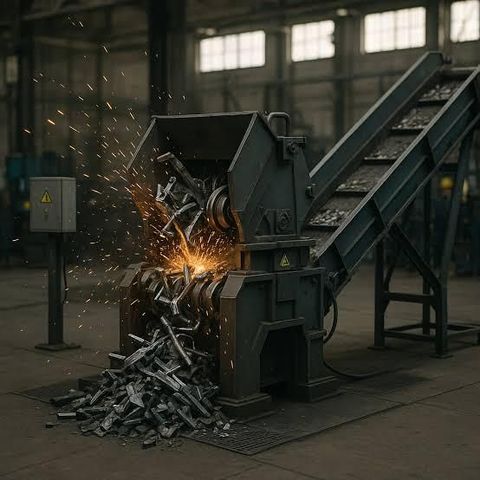
Primary shredders handle large rubber items, including used tires and thick rubber components. They use rotating shafts fitted with cutting elements to break the material into manageable pieces.
Important features include:
Heavy-duty cutting assemblies
Variable processing speeds
Reversible operation for handling blockages
Safety guards and emergency stop systems
These machines prepare rubber for subsequent granulation and separation stages.
Rubber Granulators
Main function: Producing smaller rubber particles
Rubber granulators reduce shredded material into smaller, more uniform pieces. Their cutting mechanisms and screen openings help determine the resulting particle size.
Granulators are important when the final application requires controlled rubber granules. Regular inspection of cutting blades, screens, and bearings helps maintain consistent processing performance.
Fine Grinding Machines
Main function: Producing fine rubber powder or crumb
Fine grinding machines process rubber into smaller particles after the initial shredding and granulation stages. Some systems use specialized grinding mechanisms to produce fine rubber powder.
The heat generated during grinding can affect rubber properties. Certain systems therefore use cooling arrangements to manage temperature and support consistent material quality.
Magnetic and Fiber Separation Equipment
Main function: Removing unwanted materials
Tire rubber often contains steel reinforcement and textile fibers. Magnetic separators remove ferrous metal, while air classifiers and other separation equipment help extract lightweight fibers.
Effective separation improves the purity of the final rubber crumb and reduces contamination in downstream applications.
Vibrating Screens and Classification Systems
Screens separate rubber particles according to their dimensions. Multiple screen sizes can create different product grades from the same processing line.
Oversized particles may be returned for further grinding, while particles that meet the required specifications move to storage or packaging.
Key Technologies Used in Rubber Crumb Production
Ambient Grinding Technology
Ambient grinding processes rubber at or near ordinary operating temperatures. Mechanical cutting and grinding break the material into smaller particles without deliberately cooling it to cryogenic temperatures.
This approach is commonly used for tire recycling because it supports multiple processing stages and particle-size options.
However, the resulting particles can have irregular shapes and rough surfaces. Performance depends on the equipment configuration, rubber composition, and operating conditions.
Cryogenic Grinding Technology
Cryogenic grinding uses extremely low temperatures, often created with liquid nitrogen, to make rubber brittle before size reduction.
The cooled rubber fractures more readily under mechanical force. This can produce particles with different surface characteristics compared with ambient grinding.
Cryogenic processing requires specialized cooling equipment, insulated systems, and careful handling procedures. Its suitability depends on product specifications, energy requirements, and the properties of the incoming rubber.
Automated Process Control
Modern rubber recycling lines can use sensors, programmable logic controllers, and automated monitoring systems to coordinate equipment operation.
These technologies help operators monitor variables such as motor load, temperature, vibration, conveyor movement, and production flow.
Automation can also help identify abnormal operating conditions earlier. However, it does not remove the need for maintenance, trained operators, and regular quality inspections.
Importance of Rubber Crumb Processing Machines
Supporting Waste Reduction
Used tires and rubber products can remain in the waste stream for long periods when they are not properly managed. Rubber crumb processing provides another route for recovering material from suitable waste.
Recycling can reduce the amount of rubber directed to disposal facilities, although the environmental benefit depends on collection, processing efficiency, transportation, and the actual use of recycled material.
Supporting Manufacturing and Infrastructure
Rubber crumb has several potential applications across different industries.
Road construction: Selected rubber crumb is incorporated into crumb rubber modified bitumen for particular pavement applications.
Sports surfaces: Suitable granules may be used in running tracks and other engineered sports surfaces.
Molded rubber products: Processed material can be incorporated into certain mats, tiles, and molded components.
Construction materials: Some applications use rubber granules in flooring systems, acoustic products, or specialized composite materials.
Industrial products: Recycled rubber can serve as an ingredient in selected products where its physical properties meet technical requirements.
The suitability of rubber crumb varies by application. Product specifications, exposure conditions, and applicable safety requirements should be assessed before use.
Improving Resource Efficiency
Rubber recycling helps recover material that would otherwise remain unused. A well-designed processing line can also separate steel and textile fractions for appropriate downstream management.
Nevertheless, not all incoming material becomes usable rubber crumb. Contamination, processing losses, and differences in feedstock composition influence the final recovery rate.
Comparison of Rubber Crumb Processing Technologies
The following table provides a general comparison of common processing approaches.
Technology | Main purpose | Key consideration |
|---|---|---|
Primary shredding | Break large rubber items | Handles bulky feedstock |
Mechanical granulation | Produce smaller granules | Screen and blade condition |
Fine grinding | Produce finer particles | Heat and particle consistency |
Ambient grinding | Mechanical size reduction | Particle shape and surface |
Cryogenic grinding | Fracture cooled rubber | Cooling requirements |
Magnetic separation | Remove ferrous metal | Separation efficiency |
Fiber separation | Remove textile material | Purity of the output |
Screening | Classify particle sizes | Screen condition and accuracy |
Recent Developments and Industry Trends
Greater Use of Process Monitoring
During 2025 and 2026, industrial recycling continued to receive attention as part of wider circular-economy planning. Digital production monitoring, improved material tracking, and automated equipment control are relevant developments for rubber recycling facilities.
These technologies can help operators document material flows, identify equipment problems, and improve consistency. Actual results depend on system design and operating practices.
Focus on Environmental Performance
Environmental management remains an important issue for tire recycling. In India, the Central Pollution Control Board revised its standard operating procedure for certain waste-tire pyrolysis units in January 2025, with a focus on improving environmental performance. Pyrolysis is a different processing route from mechanical crumb production, but the development reflects wider regulatory attention to tire waste management.
Increased Attention to Circular-Economy Systems
In January 2026, NITI Aayog published a report examining the circular economy of waste tires in India. The report discussed material-flow verification, environmental monitoring, and regulatory improvements for tire recycling.
For rubber crumb processors, these developments highlight the importance of traceable material handling, accurate production records, and suitable environmental controls.
These are broader industry directions rather than evidence that every processing plant has adopted new technologies.
Laws and Policies Affecting Rubber Recycling
Waste-Tire Regulations in India
India's waste-tire management framework includes the Hazardous and Other Wastes (Management and Transboundary Movement) Amendment Rules, 2022. Schedule IX establishes Extended Producer Responsibility (EPR) requirements for relevant tire producers, recyclers, and retreaders.
EPR places defined waste-management responsibilities on producers. Registered stakeholders must follow applicable registration, reporting, and certificate procedures.
Mechanical rubber crumb processing may fall within the recognized waste-tire recycling framework, but operators should confirm the exact requirements applicable to their facility and activities.
Environmental Permissions and Workplace Safety
Depending on the facility and location, relevant requirements may include:
Applicable consent and authorization requirements from state pollution control authorities.
Dust collection and air-emission controls.
Safe storage and handling of rubber waste.
Fire prevention and emergency response procedures.
Machine guarding, electrical safety, and worker protection.
Accurate records of incoming waste and processed materials.
Rules vary across countries and jurisdictions. Facilities should verify current requirements with the relevant environmental and industrial safety authorities.
Tools and Resources for Rubber Recycling Facilities
General-purpose tools can help operators assess process performance and plan equipment maintenance.
Useful Operational Tools
Particle-size analysis tools: Measure the distribution of rubber granules and help verify product specifications.
Production tracking spreadsheets: Record incoming material, processed quantities, rejected fractions, and output grades.
Energy monitoring meters: Track electricity use across shredders, granulators, and grinding systems.
Preventive maintenance schedules: Document blade inspections, lubrication, bearing checks, and screen replacement.
Dust and air monitoring instruments: Help evaluate workplace conditions and environmental control performance.
Material-flow diagrams: Map the movement of rubber, steel, textile fibers, and rejected material through the plant.
Operators in India can also consult the Central Pollution Control Board's official waste-tire EPR portal for applicable rules, registration information, and reporting guidance.
Frequently Asked Questions
What Is the Main Purpose of Industrial Rubber Crumb Processing Machines?
Their main purpose is to convert discarded rubber into smaller particles that can be used in suitable industrial applications. The processing line may also recover steel and separate textile contaminants.
What Is the Difference Between a Rubber Shredder and a Granulator?
A shredder performs the initial reduction of large rubber items into smaller pieces. A granulator processes those pieces further to produce more controlled particle sizes.
Which Industries Use Recycled Rubber Crumb?
Applications include selected road construction projects, sports surfaces, flooring systems, molded rubber components, and specialized construction materials. Suitability depends on the material's quality and the requirements of the application.
What Factors Affect Rubber Crumb Quality?
Important factors include the original rubber composition, particle-size distribution, contamination, grinding temperature, and the efficiency of metal and fiber separation.
Are Rubber Crumb Processing Machines Environmentally Friendly?
They can support material recovery and reduce the quantity of rubber sent for disposal. However, environmental performance depends on electricity consumption, dust control, noise management, fire prevention, waste handling, and the end use of the recycled material.
Conclusion
Industrial rubber crumb processing machines play an important role in converting discarded tires and other suitable rubber materials into reusable granules. Shredders, granulators, grinding equipment, separation systems, and screening machines work together to prepare material for different applications.