Industrial Winding Machines: Guide to Automation and Precision Technology
Industrial winding machines are automated or semi-automated systems designed to wind materials around a core, bobbin, spool, reel, or other shaped component. Depending on the application, they can handle materials such as copper wire, aluminum wire, textile yarn, film, tape, fiber, cable, and other flexible materials.
Winding is an important manufacturing process because the material must usually be placed in a controlled pattern. Incorrect tension, uneven layers, excessive speed, or poor alignment can affect the final product.
Industrial winding machines were developed to provide better control than manual winding methods. Modern systems can combine programmable controls, sensors, motors, tension-control mechanisms, and automated material handling.
Common machine categories include:
- Coil winding machines
- Wire winding machines
- Cable winding machines
- Textile winding machines
- Film winding machines
- Precision winding machines
- Transformer winding machines
- Motor winding machines
- Automatic spool winding machines
The basic process normally involves feeding material, controlling tension, rotating the winding element, positioning the material, and monitoring the finished winding pattern.
Automation has expanded the role of these machines. Instead of controlling only rotation, modern equipment can coordinate several movements at the same time. This allows manufacturers to create repeatable winding patterns for different applications.
Importance
Industrial winding technology matters because winding quality can influence electrical performance, mechanical stability, material usage, and the appearance of a finished component.
For electrical manufacturing, controlled winding is particularly important. Motors, generators, transformers, inductors, coils, and other components can require carefully arranged conductors. Small variations in winding tension or positioning may affect the consistency of the finished component.
The technology also affects textile and flexible-material production. Controlled winding can help maintain organized layers and reduce problems caused by loose, overlapping, or uneven material.
Modern winding machines are increasingly connected with broader manufacturing automation systems. Sensors can monitor operating conditions, while programmable controllers can manage machine movements and production parameters.
Important areas include:
- Precision: Controlled movement helps maintain consistent winding patterns.
- Automation: Repetitive operations can be programmed and monitored.
- Quality control: Sensors and inspection systems can identify process variations.
- Material management: Accurate tension and positioning can reduce unnecessary material variation.
- Production consistency: Repeatable settings help maintain similar results between production cycles.
- Data collection: Connected equipment can record operating information for analysis.
The technology is relevant to electrical equipment manufacturers, textile producers, cable processors, renewable-energy equipment makers, automotive component manufacturers, and other industrial sectors.
Main Technologies Used in Winding Machines
Several technologies work together to create a modern winding system.
Servo motor systems provide controlled movement and speed. They are useful where accurate positioning, acceleration, deceleration, and repeatable motion are required.
Tension-control systems help maintain a stable pulling force on the material. This is important for wire, yarn, film, and other materials that can change shape or performance when tension varies.
Programmable logic controllers coordinate machine operations according to programmed parameters. Operators can configure sequences for different winding patterns and production requirements.
Human-machine interfaces provide a visual method for entering settings and monitoring machine conditions. A well-designed interface can make it easier to observe speed, tension, alarms, and production information.
Sensors and inspection cameras can provide information about material position, breaks, alignment, diameter, and other process conditions.
Recent Updates
During 2025 and 2026, industrial winding technology has increasingly been discussed in connection with servo control, Industry 4.0, connected production, artificial intelligence, and more flexible winding processes. Industry coverage in April 2026 highlighted developments around hairpin and wave winding, foil winding, profiled Litz wire, and other advanced winding approaches for motors, transformers, and related electrical applications.
Another continuing development is the integration of winding equipment with digital monitoring systems. These systems can collect information from sensors and controllers and present production data for analysis.
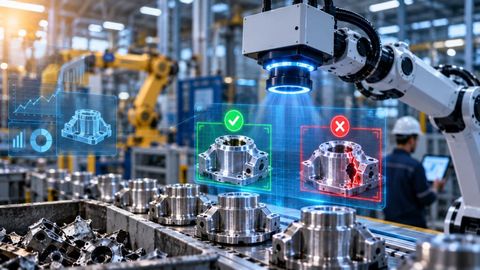
AI-assisted inspection is also becoming a technology area of interest. Camera-based systems can potentially identify visible winding irregularities and support quality monitoring. However, the usefulness of such systems depends on the material, application, camera setup, training data, and inspection requirements.
A simplified view of the technology trend is:
| Technology | Main Purpose | Typical Benefit |
|---|---|---|
| Servo control | Accurate motion | Repeatable positioning |
| Tension control | Stable material force | More consistent winding |
| PLC automation | Process coordination | Repeatable operation |
| Sensors | Process monitoring | Earlier detection of variation |
| Machine vision | Visual inspection | Automated quality checks |
| IoT connectivity | Data collection | Production visibility |
| Digital analytics | Data interpretation | Process improvement |
These developments do not mean every application requires advanced AI or connected equipment. Machine selection should depend on the material, winding pattern, required precision, production volume, and safety requirements.
Laws or Policies
Winding machines are industrial machinery, so applicable safety requirements depend on the country or market where the equipment is installed and used.
In the European Union, Regulation (EU) 2023/1230 establishes health and safety requirements for machinery and related products. The regulation is scheduled to apply from 20 January 2027, replacing the Machinery Directive 2006/42/EC framework from that date. The regulation covers areas including machinery design, construction, conformity assessment, and technical documentation.
The regulation is particularly relevant for manufacturers and organizations placing machinery on the EU market. Requirements can vary according to the type of machinery and applicable conformity-assessment procedure.
In India, workplace machinery safety is also addressed through occupational safety legislation. The Occupational Safety, Health and Working Conditions Code includes duties concerning the safety of articles used in factories and the identification and minimization of risks associated with their design and manufacture.
Other countries have their own machinery safety, electrical safety, workplace protection, and conformity requirements. Organizations should therefore check the rules applicable to their location and intended market rather than assuming that one regulatory framework applies worldwide.
Important safety considerations for winding equipment can include:
- Emergency stopping systems
- Machine guarding
- Electrical protection
- Safe access to moving components
- Operator instructions
- Risk assessment
- Preventive inspection
- Appropriate personal protective equipment
- Training for machine operation
Tools and Resources
Several general tools can help engineers, technicians, operators, and students understand winding processes.
Winding calculators can help estimate relationships involving wire length, turns, coil dimensions, winding diameter, and other parameters.
Tension measurement tools can help evaluate whether material tension remains within the required operating range.
Digital multimeters and electrical testing equipment can be useful when winding is associated with electrical components, although the appropriate testing method depends on the application.
CAD and manufacturing software can assist with component dimensions, winding layouts, mechanical clearances, and production planning.
PLC programming environments are used to configure automated machine sequences where programmable controllers are involved.
Maintenance checklists can document inspections of bearings, guides, sensors, motors, electrical connections, tension systems, and safety components.
Technical standards and regulatory databases are useful for understanding machinery safety and conformity requirements in different markets.
A basic winding-process checklist can include:
- Material type and dimensions
- Required winding pattern
- Target number of turns
- Tension range
- Rotation speed
- Layer arrangement
- Core or bobbin dimensions
- Inspection requirements
- Safety controls
- Maintenance intervals
FAQs
What are industrial winding machines used for?
Industrial winding machines are used to place flexible materials such as wire, cable, yarn, film, or tape around a core, spool, bobbin, or other component in a controlled pattern. Applications vary across electrical, textile, cable, automotive, energy, and general manufacturing.
Why is tension control important in winding?
Tension control helps maintain consistent material placement. Excessive or insufficient tension can contribute to uneven layers, deformation, material damage, or changes in the finished winding pattern.
How does automation improve winding processes?
Automation allows machine movements and operating parameters to be programmed and repeated. Sensors and controllers can also monitor conditions and provide information when process values move outside defined limits.
Are all industrial winding machines fully automatic?
No. Winding equipment can be manual, semi-automatic, or fully automated. The appropriate configuration depends on the application, material, production requirements, winding complexity, and desired level of process control.
What should be considered when selecting winding technology?
Important factors include material type, core dimensions, winding pattern, required precision, tension requirements, production volume, machine speed, inspection needs, safety requirements, and compatibility with existing manufacturing equipment.
Conclusion
Industrial winding machines have become an important part of modern manufacturing because they provide controlled and repeatable material placement. Their applications range from electrical coils and transformers to cables, textiles, films, and other flexible materials.