Plant Automation Solutions Guide: Technologies, Processes, Controls, Applications and Benefits
Plant automation solutions combine sensors, control systems, software, communication networks, and machines to monitor and manage industrial processes. Automation developed from mechanical controls and electrical systems into programmable controllers, computerized supervision, robotics, and connected production platforms.
In a modern plant, automation can link physical equipment with digital information. Sensors detect conditions such as temperature, pressure, flow, position, vibration, or speed. Controllers process these signals and can adjust equipment according to defined operating logic.
The main purpose is to make industrial processes more consistent, observable, and controllable. Automation can be applied to a single machine, a production line, a utility system, or an entire plant, depending on the process and level of integration.
How plant automation works
A typical system has several layers. Field devices collect information, programmable logic controllers or distributed control systems process it, and supervisory software presents operating information to people. Actuators, drives, valves, motors, and robots then carry out control actions.
Industrial communication networks connect these layers. Common technologies include Ethernet-based networks, fieldbus systems, wireless connections, and industrial protocols designed for machine-to-machine communication.
Importance
Plant automation solutions matter because industrial processes often involve repeated actions, continuous measurements, and equipment that must operate within defined limits. Manual monitoring alone can make it difficult to observe every process variable at the same time.
Automation can help address several practical challenges:
- Monitoring equipment conditions continuously
- Coordinating machines and process stages
- Recording production and operating data
- Detecting abnormal conditions through alarms
- Applying repeatable control sequences
- Supporting safer separation between people and hazardous equipment
Automation also affects people outside the plant. Manufacturing, water treatment, food processing, energy, logistics, pharmaceuticals, and other sectors depend on controlled industrial processes. Reliable monitoring can support product consistency and help plant teams understand how equipment behaves over time.
The effect of automation depends on system design. Poorly configured controls, incomplete sensor coverage, weak cybersecurity, or unclear alarm settings can create new risks. Human oversight, maintenance, testing, and documented procedures remain important parts of an automated environment.
Main technologies used
| Technology | Main role | Typical application |
|---|---|---|
| PLC | Sequence and machine control | Production machines |
| DCS | Continuous process control | Chemical and process plants |
| SCADA | Supervisory monitoring | Utilities and distributed assets |
| HMI | Human-machine interaction | Operator stations |
| Sensors | Measurement and detection | Temperature, pressure, flow |
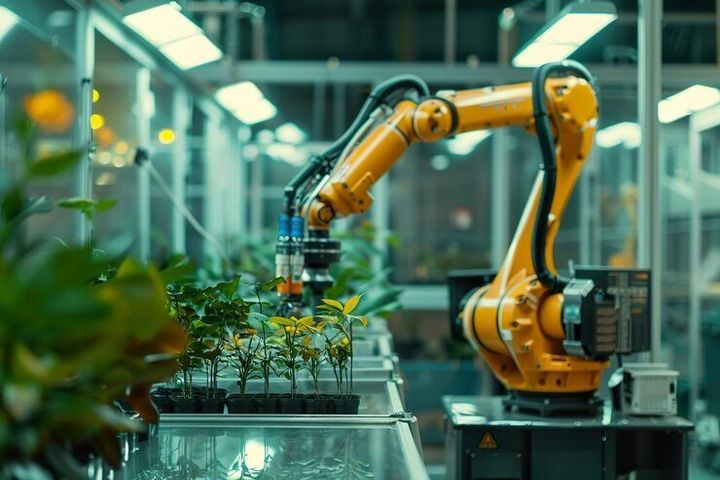
| Robots | Automated physical movement | Assembly and handling |
| MES | Production information management | Manufacturing operations |
| IIoT platforms | Connected data and analysis | Connected equipment |
Applications and benefits
Plant automation can be used across many industrial settings. In food and beverage plants, it can coordinate filling, mixing, temperature control, packaging, and cleaning sequences. In water facilities, automated controls can monitor pumps, tank levels, flow rates, filtration stages, and chemical dosing. In manufacturing, robots, conveyors, machine tools, inspection systems, and material-handling equipment can be coordinated through a shared control structure.
Potential benefits include clearer process visibility, repeatable machine sequences, faster detection of abnormal conditions, better use of operating data, and more structured maintenance planning. These benefits are not automatic; they depend on suitable equipment, accurate measurements, correct configuration, staff training, and ongoing system maintenance.
Recent Updates
From 2024 through 2026, plant automation has increasingly connected traditional control systems with data platforms, artificial intelligence, industrial Internet of Things devices, digital twins, and stronger cybersecurity practices. The focus is moving beyond isolated machine control toward connected systems that can share information across production and management layers.
Digital twins are another area of development. Indian standards include the IS 17885 series, based on ISO 23247, covering a digital twin framework for manufacturing, including reference architecture, digital representation, and information exchange.
Cybersecurity has also become more important as operational technology becomes more connected. CERT-In guidance has highlighted measures such as stronger authentication, access control, patch management, and protection against cyber threats. CERT-In materials also identify ISA/IEC 62443 as a relevant series for industrial automation and control system cybersecurity.
Artificial intelligence is increasingly being considered for areas such as anomaly detection, predictive maintenance, visual inspection, process analysis, and production planning. These uses generally depend on reliable data, suitable models, clear operating boundaries, and human review rather than automation alone.
India's manufacturing policy direction has also emphasized technology adoption. The National Manufacturing Mission announced in the Union Budget 2025–26 covers small, medium, and large industries and includes policy support, implementation planning, and governance. The Economic Survey has described the mission as supporting innovation, technology adoption, manufacturing capacity, and deeper integration of smaller manufacturers into value chains.
Laws or Policies
In India, plant automation is influenced by workplace safety rules, electrical requirements, machinery standards, environmental requirements, and cybersecurity guidance. The exact obligations depend on the type of plant, equipment, process, location, and industry.
The Occupational Safety, Health and Working Conditions Code, 2020 came into force in late 2025. Central rules issued under the code cover areas such as establishment registration and workplace requirements. Automated machinery does not remove the responsibility for maintaining safe working conditions.
The Bureau of Indian Standards maintains Indian Standards covering industrial automation, programmable controllers, robotics, machine safety, electrical equipment, and industrial cybersecurity. BIS also notes that certification is generally voluntary unless the Central Government makes compliance mandatory for a particular product or category.
Electrical control equipment may also fall under specific quality-control requirements. For example, BIS lists requirements related to low-voltage switchgear and controlgear under the Electrical Equipment Quality Control Order and its amendments.
For a plant, compliance therefore involves more than selecting an automation platform. Electrical design, machine guarding, emergency controls, worker protection, data security, documentation, inspection, and applicable environmental rules may all need to be considered.
Tools and Resources
Several resources can help readers understand plant automation solutions and related technologies.
Standards and technical references
The BIS Standards portal can be used to search Indian Standards by number or keyword. Its catalogue covers many areas relevant to automation, electrical systems, machine safety, and industrial equipment.
Monitoring and control software
SCADA and HMI platforms help operators view process information, alarms, trends, and equipment status. PLC programming environments are used to create control logic, while historians and manufacturing information systems can retain operating data for later analysis.
Planning and analysis tools
Useful planning resources can include process flow diagrams, input-output lists, control narratives, alarm registers, equipment databases, network diagrams, and maintenance records. Simulation and digital-twin tools can also help teams study process behavior before changes are introduced into operating equipment.
Cybersecurity resources
CERT-In publications provide guidance for improving organizational cybersecurity. For industrial environments, security planning can include asset inventories, network segmentation, access controls, backups, patch procedures, incident-response plans, and monitoring of critical systems.
FAQs
What are plant automation solutions?
Plant automation solutions are combinations of hardware, software, sensors, controllers, networks, and operating procedures used to monitor and control industrial processes.
How does industrial automation improve plant operations?
Industrial automation can provide continuous monitoring, repeatable control sequences, automatic alarms, data collection, and coordination between equipment. Its results depend on system design, maintenance, and operating conditions.
What technologies are included in plant automation?
Common technologies include PLCs, DCS, SCADA, HMIs, sensors, industrial robots, variable-speed drives, MES platforms, IIoT systems, and industrial communication networks.
Is cybersecurity important for plant automation solutions?
Yes. Connected control systems can introduce cybersecurity risks, particularly when operational technology communicates with enterprise networks or external systems. Access control, network separation, patch management, backups, and monitoring are among the measures used to reduce exposure.
Are plant automation systems covered by Indian standards?
Relevant Indian Standards exist for areas such as programmable controllers, industrial robots, machine safety, digital twins, electrical equipment, and industrial cybersecurity. Applicable requirements depend on the equipment and industrial process.
Conclusion
Plant automation solutions bring together sensing, control, software, communication, and physical equipment to manage industrial processes. Recent developments are connecting automation with digital twins, IIoT, artificial intelligence, and cybersecurity practices. In India, workplace safety rules and BIS standards provide important parts of the regulatory and technical context. Automation can support consistent monitoring and control, but safe operation still depends on appropriate design, human oversight, maintenance, and compliance.