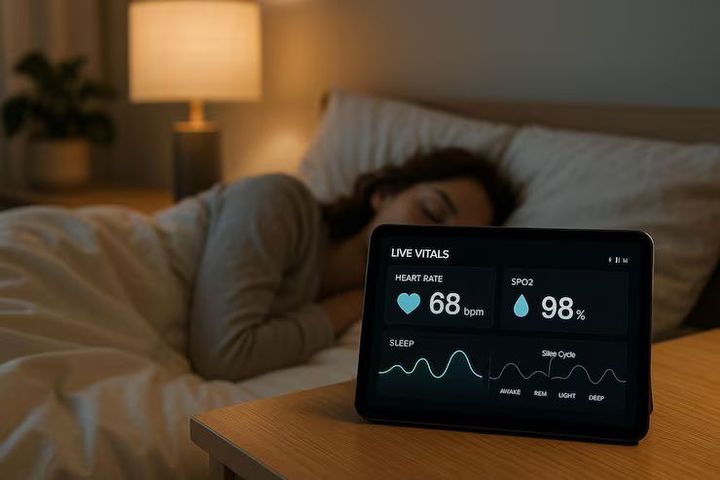
Sleep Calculator Advice: Sleep Scheduling, Cycle Timing, Bedtime Planning and Wake-Up Times
A sleep calculator is a planning tool that uses a desired wake-up time, bedtime, or approximate sleep duration to estimate a suitable sleep schedule. It is based on simple time calculations and general knowledge about sleep duration and sleep cycles. These tools are designed to make bedtime planning easier rather than to measure sleep quality or diagnose a sleep condition.
Sleep itself follows repeating stages rather than remaining at one uniform level throughout the night. Sleep consists of non-rapid eye movement (NREM) sleep and rapid eye movement (REM) sleep. According to the National Heart, Lung, and Blood Institute, a typical sleep cycle repeats approximately every 80 to 100 minutes, with several cycles occurring during a normal night.
The commonly used idea of a “90-minute sleep cycle” is therefore an approximation. Actual cycle length can vary from person to person and from one part of the night to another. A sleep calculator may use an estimated cycle length to provide possible bedtime or wake-up times, but those calculations should not be treated as an exact description of an individual's sleep stages.
Sleep scheduling also involves more than cycle timing. Age, daily routine, work or school schedules, light exposure, physical activity, environmental conditions, and individual sleep needs can all affect when someone becomes sleepy and when they naturally wake.
Importance
Why sleep scheduling matters
Sleep supports normal physical and mental functioning. The Centers for Disease Control and Prevention states that adequate sleep and good sleep quality are important parts of healthy sleep, while the amount of sleep needed varies with age. For adults aged 18–60, the general recommendation is at least seven hours per night.
A sleep calculator can help people understand the relationship between bedtime and wake-up time. For example, someone who needs to wake at 6:30 a.m. can work backward from a planned sleep duration to estimate when to prepare for bed.
The calculation is particularly useful for people who frequently change their sleeping schedule. Students, shift workers, parents, travelers, and people with early morning commitments may use scheduling tools to organize their routines.
Sleep duration and age
Sleep needs are not identical across all age groups. The CDC lists different daily sleep recommendations for infants, children, teenagers, and adults.
| Age group | General recommended sleep |
|---|---|
| Newborns, 0–3 months | 14–17 hours |
| Infants, 4–12 months | 12–16 hours, including naps |
| Toddlers, 1–2 years | 11–14 hours, including naps |
| Preschool children, 3–5 years | 10–13 hours |
| School-age children, 6–12 years | 9–12 hours |
| Teenagers, 13–17 years | 8–10 hours |
| Adults, 18–60 years | 7 or more hours |
| Adults, 61–64 years | 7–9 hours |
| Adults, 65 years and older | 7–8 hours |
These figures are general population guidance rather than personalized instructions. Individual sleep needs can vary.
What a sleep cycle means
A sleep cycle includes several stages of NREM sleep followed by REM sleep. Deep NREM sleep tends to occur more during the earlier part of the night, while REM periods generally become longer as the night progresses.
This is why simply dividing a night into identical 90-minute blocks does not perfectly represent normal sleep. A calculator can use cycle estimates for planning, but obtaining enough total sleep and maintaining a regular schedule are also important considerations.
Recent Updates
Current sleep planning trends
From 2024 through 2026, digital health tools have continued to make sleep information easier to access through smartphones, watches, wearable devices, and online calculators. Many tools combine bedtime planning with information such as sleep duration, wake-up schedules, daily activity, and recorded sleep patterns.
There is also greater emphasis on sleep regularity rather than focusing only on a single night's duration. The CDC recommends maintaining a consistent bedtime and wake-up time, including on weekends, as part of healthy sleep habits.
Recent population data also illustrate why sleep duration remains an important public-health topic. A CDC analysis published in 2026 using 2024 U.S. data found that 30.5% of adults slept less than seven hours on average during a 24-hour period.
Technology and sleep tracking
Modern wearable devices can estimate sleep periods and may classify portions of sleep into different stages. These measurements are different from clinical sleep studies, which use specialized sensors and physiological measurements.
For everyday planning, a calculator can be useful without requiring detailed sleep-stage information. It can answer simple questions such as when to go to bed to allow a certain number of hours before a planned wake-up time.
Laws or Policies
Sleep calculators in India
In India, there is no general law that establishes a specific formula that every sleep calculator must use for bedtime or wake-up calculations. Sleep calculators are generally informational digital tools rather than regulated medical diagnostic instruments.
When a digital sleep tool collects personal information, privacy and data-protection considerations may become relevant. India's Digital Personal Data Protection Act, 2023 establishes a framework concerning the processing of digital personal data. The Ministry of Electronics and Information Technology also notified the Digital Personal Data Protection Rules, 2025.
The rules are relevant to organizations that process personal data and establish requirements concerning responsible data handling. A basic calculator that only performs a calculation without storing personal information has a different data profile from an application that records sleep histories, account details, or other personal information.
Sleep information can also become more sensitive when combined with broader health information. Users should therefore understand what information a digital tool collects, why it is collected, how it is used, and how long it may be retained.
Health information and professional guidance
A calculator should not be treated as a medical diagnosis. Persistent difficulty falling asleep, repeated nighttime waking, unusually strong daytime sleepiness, or other ongoing sleep concerns may require evaluation by an appropriate healthcare professional.
General sleep recommendations provide population-level information and do not replace individualized medical assessment.
Tools and Resources
Sleep calculator
A basic sleep calculator usually requires one or two inputs, such as a planned wake-up time or intended bedtime. It then calculates possible sleep periods based on a selected duration or an approximate number of sleep cycles.
For example, if a person plans to wake at 6:30 a.m. and wants eight hours of sleep, a simple calculation places the intended sleep period at approximately 10:30 p.m. to 6:30 a.m. This calculation does not necessarily represent the actual time spent asleep because falling asleep can take time.
Bedtime planning worksheet
A simple written template can help organize a consistent schedule:
- Planned wake-up time
- Intended sleep duration
- Approximate bedtime
- Estimated time needed to fall asleep
- Evening routine
- Morning routine
- Actual sleep and wake times
Recording these details over several days can help identify patterns between planned and actual schedules.
Sleep tracking devices
Smartphones and wearable devices can record movement and other signals that may be used to estimate sleep periods. These tools can provide useful personal information, but estimates of sleep stages are not equivalent to measurements from a clinical sleep study.
Sleep education resources
Government health websites and recognized medical organizations provide educational information about sleep duration, sleep stages, healthy routines, and sleep-related concerns. The CDC provides age-based sleep recommendations, while the National Institutes of Health explains the structure of NREM and REM sleep.
FAQs
How does a sleep calculator determine bedtime?
A sleep calculator generally works backward from a planned wake-up time or forward from a planned bedtime. It may use a target sleep duration and, in some cases, approximate sleep-cycle timing. Because sleep cycles vary, the calculated time is an estimate rather than an exact physiological prediction.
How many sleep cycles should I plan for?
Adults typically experience several sleep cycles during a night. The National Heart, Lung, and Blood Institute describes cycles that repeat approximately every 80 to 100 minutes. The total amount of sleep should remain a primary consideration rather than trying to force sleep into a fixed number of identical cycles.
What is a suitable bedtime for a 6:00 a.m. wake-up time?
The answer depends on the desired amount of sleep. For example, eight hours of planned sleep would place bedtime around 10:00 p.m. if the person falls asleep immediately. Additional time may be needed for the transition from wakefulness to sleep.
Does sleep cycle timing determine the ideal wake-up time?
Not precisely. Sleep-cycle timing can help with general planning, but cycles vary in length and composition. Regular sleep timing and sufficient total sleep are important parts of healthy sleep.
Can a sleep calculator diagnose a sleep problem?
No. A sleep calculator performs a scheduling calculation and cannot diagnose a sleep disorder. Persistent or concerning sleep difficulties should be discussed with an appropriate healthcare professional.
Conclusion
A sleep calculator provides a simple way to estimate bedtime, sleep duration, and wake-up times. Sleep cycles normally repeat throughout the night, but their length and composition vary, so cycle-based calculations should be treated as approximate. Adequate sleep duration, regular timing, and sleep quality are all relevant to healthy sleep. Digital sleep tools can support planning and tracking, but they do not replace professional assessment when ongoing sleep problems occur.