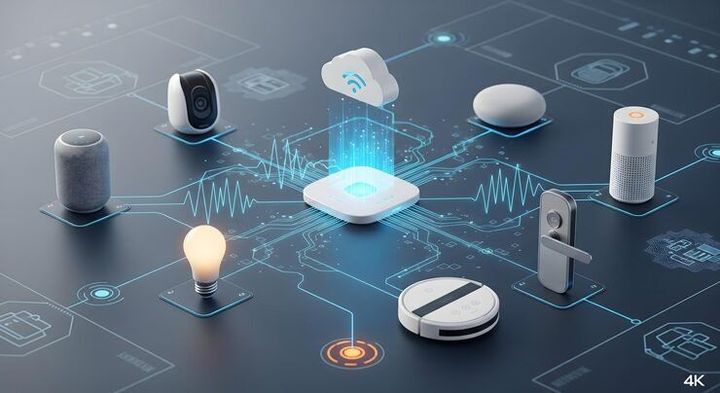
Smart Sensors Explanation: How They Work, Process Data, Connect Systems and Support Automation
Smart sensors are electronic devices that detect physical or environmental conditions and convert those conditions into useful digital information. Unlike basic sensors that may only detect or measure one physical value, a smart sensor can combine sensing, data processing, communication, and diagnostic functions within a connected system.
The idea developed from traditional sensing technology used in industrial equipment, vehicles, buildings, scientific instruments, and electronic devices. As computing components became smaller and communication networks became more accessible, sensors gained the ability to process information locally and communicate with other devices.
A smart sensor normally includes several functional parts. The sensing element detects a condition such as temperature, pressure, movement, vibration, humidity, light, sound, or chemical concentration. An electronic circuit then converts the detected condition into a measurable signal.
A processor can interpret that signal, filter unwanted variations, perform calculations, or identify changes in the measured condition. A communication component can then transfer the processed information to another device, control system, computer, or cloud platform.
How Smart Sensors Work
The basic process can be understood as a sequence:
- Detection: The sensing element measures a physical condition.
- Conversion: The measurement becomes an electrical or digital signal.
- Processing: A processor filters, calculates, or interprets the signal.
- Communication: Information moves through a suitable connection.
- Response: A connected system can display information or trigger an automated operation.
For example, a smart temperature sensor in a building can detect room temperature, process the measurement, and send the information to a building control system. The control system can then use that information when managing heating, ventilation, or cooling equipment.
Common Types of Smart Sensors
Smart sensors can measure many different conditions. Their design depends on the environment and the information required.
| Sensor Type | What It Measures | Common Applications |
|---|---|---|
| Temperature sensor | Temperature | Buildings, machines, electronics |
| Pressure sensor | Fluid or gas pressure | Pumps, pipelines, equipment |
| Vibration sensor | Mechanical movement | Machinery monitoring |
| Humidity sensor | Moisture in air | Buildings, storage areas |
| Motion sensor | Movement | Lighting, security, automation |
| Light sensor | Light intensity | Displays, lighting systems |
| Proximity sensor | Nearby objects | Manufacturing equipment |
| Gas sensor | Specific gases | Environmental and industrial monitoring |
Importance
Smart sensors matter because many modern systems need information continuously rather than through occasional manual measurements. A connected sensor can collect measurements at regular intervals and make that information available to other parts of a system.
For households, sensors can support automated lighting, climate control, energy monitoring, and security systems. In transportation, they can monitor vehicle conditions, surroundings, and movement. In agriculture, sensors can measure soil moisture, temperature, and environmental conditions.
Industrial environments also use smart sensors for machine monitoring and automation. Measurements such as vibration, temperature, pressure, and electrical conditions can help operators understand how equipment is behaving.
Supporting Automation
Automation depends on accurate information about the physical environment. Smart sensors provide this information to controllers and software systems.
A simple automated process may work like this: a sensor detects a change, the processor evaluates the measurement, and a controller determines whether another device should respond. This can happen repeatedly without requiring a person to manually check every measurement.
For example, a smart sensor may detect that the temperature inside a machine has moved beyond a defined operating range. The connected control system can record the event, display an alert, or adjust another component according to its programmed rules.
Processing Data Locally
One important feature of some smart sensors is local data processing, sometimes called edge processing. Instead of sending every raw measurement to a remote computer, the sensor or nearby device can perform certain calculations first.
This can reduce unnecessary data transmission and allow a system to respond to measurements with less dependence on a remote platform. Local processing can also be useful when connectivity is intermittent or when only selected information needs to be transmitted.
However, local processing does not eliminate the need for suitable system design. Sensor accuracy, calibration, communication reliability, software configuration, and cybersecurity can all affect the quality of the resulting information.
Connecting Different Systems
Smart sensors can communicate using different technologies. Depending on the application, a device may use wired connections, Wi-Fi, Bluetooth, cellular networks, Ethernet, or specialized industrial communication protocols.
Some systems use gateways between sensors and larger networks. A gateway can collect information from multiple devices and pass it to another network or computing platform.
India's Telecommunication Engineering Centre works on technical and policy aspects of Machine-to-Machine communication and Internet of Things technologies, including IoT standards and gateway-related requirements.
Recent Updates
From 2024 through 2026, development around smart sensors has increasingly focused on connectivity, cybersecurity, interoperability, local processing, and integration with automation systems.
Greater Focus on IoT Security
As more sensors become connected to networks, cybersecurity has become an important part of sensor design. A compromised sensor can potentially provide incorrect information or become an entry point into a connected system.
India's Bureau of Indian Standards developed IS 19319:2025 for assessing security and privacy controls for IoT devices. The standard describes 74 checkpoints across three assurance levels for IoT device security and privacy.
Smart Infrastructure Development
Smart sensors are increasingly considered part of larger connected infrastructure rather than isolated measuring devices. Applications include traffic monitoring, environmental measurement, water systems, buildings, energy management, and industrial systems.
CERT-In published Cyber Security Guidelines for Smart City Infrastructure in 2025. The guidance discusses security considerations for connected systems including parking sensors, air-quality sensors, water-quality sensors, smart water meters, and traffic-related equipment.
More Attention to Interoperability
Another continuing development is the effort to make devices from different technical environments communicate more consistently. Standards organizations and government bodies are working on IoT architectures, gateways, communication standards, and interoperability.
BIS identifies IoT and digital twin technologies, including sensor networks, within its standardization work. India's TEC has also continued work around adoption of oneM2M standards and IoT-related technical requirements.
Integration With Intelligent Software
Sensor systems are also increasingly connected with analytics, machine learning, and other software tools. These systems can examine large volumes of measurements and identify patterns that may be difficult to notice through individual readings.
The role of software does not replace the sensing element. Instead, the sensor provides measurements while software interprets those measurements within a larger operational context.
Laws or Policies
In India, smart sensors can fall under several different regulatory areas depending on what they measure, how they communicate, where they are deployed, and whether they process personal information.
IoT and Technical Standards
The Telecommunication Engineering Centre maintains an IoT division that works on Machine-to-Machine and IoT specifications, standards, and technical or policy inputs. Its work includes smart-city IoT standards and adoption of relevant international specifications.
BIS also maintains standards related to IoT architecture, interoperability, security, and connected technologies. Whether a particular sensor or connected device requires mandatory compliance depends on the product category and applicable government notifications. BIS notes that its certification system is generally voluntary, while certain products are subject to compulsory requirements through government directions.
Data Protection
Some smart sensors collect information that can be associated with identifiable people. Examples can include certain building-monitoring systems, wearable devices, cameras, or access systems.
India's Digital Personal Data Protection Act, 2023 and the Digital Personal Data Protection Rules, 2025 establish a framework for processing digital personal data. The Rules were notified in November 2025 and use a phased commencement structure.
Where personal data is involved, organizations need to consider applicable requirements concerning notice, consent, security safeguards, retention, and individual rights. The exact obligations depend on the nature of the data and the role of the organization handling it.
Cybersecurity Requirements
Connected sensor systems can also be affected by cybersecurity requirements. CERT-In's directions under the Information Technology Act, 2000 address information security practices, incident prevention, response, and reporting.
CERT-In has also issued cybersecurity guidance in recent years covering IoT-related risks and broader digital infrastructure. These developments reflect increasing attention to secure connected devices and systems.
Tools and Resources
Several resources can help readers understand, design, test, or manage smart sensor systems.
Standards and Technical References
The Bureau of Indian Standards provides information about Indian Standards through its standards resources. Its “Know Your Standard” platform allows users to search standards by Indian Standard number or keyword and review related documents and information.
The Telecommunication Engineering Centre provides IoT-related technical information and standards material relevant to connected devices and communication systems.
Sensor Development Tools
Developers and students can use microcontroller platforms, development boards, digital multimeters, oscilloscopes, data loggers, and software development environments to understand sensor behavior.
Common development activities include:
- Reading sensor measurements.
- Converting analog signals into digital values.
- Filtering measurement noise.
- Recording sensor readings.
- Connecting sensors to communication networks.
- Creating dashboards for measured information.
- Testing alerts and automated responses.
Data Monitoring Platforms
Connected sensor projects may use databases, dashboards, cloud platforms, or local monitoring applications to store and visualize measurements. The appropriate platform depends on factors such as the number of sensors, communication method, data volume, response requirements, and privacy considerations.
For industrial applications, monitoring platforms may also connect sensor information with programmable logic controllers, supervisory control systems, manufacturing software, or digital-twin environments.
FAQs
What are smart sensors and how do they work?
Smart sensors are sensing devices that combine measurement with processing and communication capabilities. They detect physical conditions, convert measurements into digital information, process the data, and can transmit useful information to another system.
How do smart sensors support automation?
Smart sensors provide real-time or periodic information that automated systems can use to make programmed decisions. A sensor can detect a change in temperature, pressure, movement, or another condition and send that information to a controller or software system.
What types of data can smart sensors process?
Smart sensors can work with measurements such as temperature, pressure, vibration, humidity, light, motion, proximity, and gas concentration. Some devices can also calculate derived values or identify changes in measurement patterns.
How do smart sensors connect to IoT systems?
Smart sensors can connect through wired or wireless communication technologies such as Ethernet, Wi-Fi, Bluetooth, cellular networks, and specialized industrial protocols. A gateway may collect information from multiple sensors before sending it to another computing system.
Are smart sensors affected by data protection and cybersecurity rules?
They can be, depending on the information collected and how the system is deployed. Sensors that process information associated with identifiable individuals may involve data-protection requirements, while connected devices can also require appropriate cybersecurity controls. India's IoT and data-protection frameworks continue to develop alongside connected technology.
Conclusion
Smart sensors combine physical measurement, data processing, and communication to connect real-world conditions with digital systems. They are used across buildings, transportation, manufacturing, environmental monitoring, agriculture, and other connected applications. Recent developments have placed greater attention on IoT security, interoperability, data protection, and integration with automated systems. Their operation depends on the quality of sensing components, data processing, communication networks, software, and the rules applicable to the particular use case.