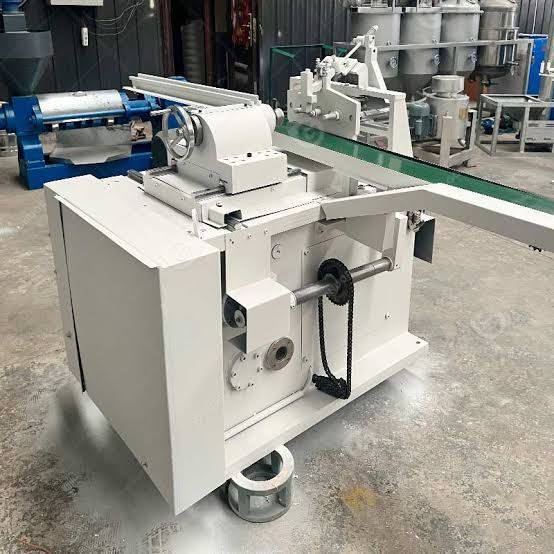
Soap Extrusion Lines: A Guide to Extrusion Processes, Equipment and Soap Production
Soap extrusion lines are integrated industrial systems used to transform prepared soap material into a continuous refined soap mass and then shape it for later cutting, stamping, or packaging.
A typical line may include mixers, refiners, plodders or extruders, vacuum chambers, dies, conveyors, cutters, and electronic controls. The arrangement depends on the soap formulation, production scale, bar dimensions, and required physical characteristics.
Modern soap extrusion lines developed from mechanical soap-making equipment that gradually reduced reliance on manual shaping and refining. Continuous extrusion became important because soap could be processed into a consistent profile before being divided into individual bars. Today, these systems are used for many types of solid soap, including toilet soap, laundry soap, cleansing bars, and some specialty formulations.
Context
What Soap Extrusion Lines Do
Soap extrusion lines are designed to convert prepared soap noodles, chips, or another processed soap base into a compact and uniform continuous mass. The material is mixed, refined, compressed, and pushed through a die that determines the cross-sectional shape of the emerging soap.
A simplified process can include several stages:
Mixing combines soap ingredients or previously prepared soap material.
Refining works the material and helps produce a more uniform texture.
Extrusion compresses and moves the soap through a controlled passage.
Vacuum treatment can remove trapped air from the soap mass.
Die forming produces a continuous soap profile.
Cutting divides the profile into individual pieces.
Stamping creates the required shape and surface identification.
Packaging prepares the finished bars for storage and distribution.
Not every line contains all of these stages. Some facilities use separate equipment for soap production, while others integrate several stages into one continuous arrangement.
Main Components of an Extrusion Line
A soap extrusion line commonly begins with a feed hopper or conveyor that transfers prepared material into the processing system. A mixer may be positioned before the extrusion stage when additional ingredients, fragrance materials, pigments, or other formulation components need to be distributed through the soap mass.
A refiner or roll mill can improve material uniformity by repeatedly working the soap. The plodder is one of the central components of many lines. It uses a screw mechanism to compress and transport the soap through a barrel toward the forming die.
Vacuum plodders contain a vacuum chamber that can remove entrapped air from the soap mass. This can help produce a denser profile and reduce visible air pockets. The die then shapes the continuous soap profile before downstream cutting and stamping equipment.
Types of Soap Extrusion Equipment
Different extrusion arrangements are selected according to formulation and production requirements. Single-stage systems may combine refining and extrusion in a relatively compact configuration. Duplex or multi-stage systems can separate refining and final extrusion into distinct sections.
Vacuum plodders are used where air removal and compact material formation are important. Duplex vacuum plodders can provide multiple processing stages, allowing refining and final extrusion to occur in a coordinated sequence.
Equipment can also be distinguished by screw design, barrel arrangement, die configuration, drive system, and automation level. These differences affect throughput, pressure, temperature management, and the type of soap material that can be processed.
Importance
Maintaining Uniform Soap Profiles
A major purpose of soap extrusion is to create a continuous profile with relatively consistent dimensions. Uniform extrusion helps downstream cutters and stamping equipment operate with predictable material geometry.
Variations in moisture, formulation, temperature, pressure, or feed rate can affect the extrusion process. Monitoring these conditions is therefore an important part of production control.
Supporting Different Formulations
Soap formulations can contain different proportions of fatty-acid salts, moisture, fragrances, colorants, additives, and other ingredients. These differences influence hardness, plasticity, flow behavior, and processing requirements.
An extrusion line needs to accommodate the physical characteristics of the material being processed. Screw speed, pressure, temperature, refining intensity, and die dimensions may require adjustment for different formulations.
Improving Material Handling
Continuous extrusion creates a defined path between material preparation and bar formation. Conveyors and automated feeders can reduce repeated manual movement of the soap mass and help coordinate different stages.
This is particularly relevant in facilities processing large quantities of soap. However, automated equipment still requires inspection, cleaning, maintenance, and appropriate operator controls.
Supporting Production Quality
Soap quality can be affected by several physical properties, including moisture distribution, hardness, texture, dimensions, surface appearance, and internal density. Extrusion equipment provides a controlled mechanical process that can be monitored through measurable parameters.
Common production checks may include:
Soap moisture
Extrusion pressure
Barrel temperature
Screw speed
Bar dimensions
Profile weight
Surface condition
Stamping accuracy
The exact inspection program depends on the formulation, product category, applicable standards, and manufacturing process.
Applications of Soap Extrusion Lines
| Application | Typical processing focus | Related equipment |
|---|---|---|
| Toilet soap | Refining, extrusion, shaping | Refiners, vacuum plodders, dies |
| Laundry soap | Forming and dimensional control | Plodders, cutters, stamping units |
| Cleansing bars | Texture and profile consistency | Mixers, refiners, extruders |
| Specialty soap bars | Formulation-specific processing | Mixers, vacuum systems, custom dies |
| Small-format bars | Accurate cutting and shaping | Extruders, cutters, stamping machines |
| Large production lines | Continuous material movement | Automated feeders, conveyors, controls |
Recent Updates
Increased Automation
From 2024 through 2026, soap manufacturing equipment has reflected wider industrial movement toward automated control and digital monitoring. Modern extrusion lines may use programmable logic controllers, touchscreen interfaces, electronic drives, temperature sensors, and pressure monitoring.
Automated control can coordinate screw speed, feed rate, temperature, and downstream equipment. Recorded operating information can also help production personnel compare batches and investigate process variations.
Improved Vacuum and Pressure Monitoring
Vacuum extrusion remains an important area of equipment development. More precise pressure and vacuum monitoring can help operators observe conditions inside different sections of the processing system.
Electronic sensors can provide continuous readings rather than relying entirely on manual inspection. The practical result depends on equipment design, calibration, formulation, and operating conditions.
Energy Management
Motors, heaters, vacuum pumps, conveyors, and other components contribute to the energy requirements of a soap extrusion line. Equipment development has increasingly included variable-frequency drives, improved motor controls, insulation, and monitoring systems.
Energy management is also connected with production scheduling and equipment condition. Reducing unnecessary idle operation can help facilities manage energy use more systematically.
Digital Maintenance and Diagnostics
Industrial equipment is increasingly incorporating condition monitoring and digital diagnostic functions. Sensors can track parameters such as motor load, temperature, vibration, and pressure.
Such information can help identify changes that may require inspection. It does not eliminate routine maintenance because mechanical components such as screws, barrels, seals, bearings, and cutting elements still experience wear.
Flexible Line Configuration
Manufacturers of soap products may process several formulations or bar sizes on related equipment. Modular dies, adjustable cutters, variable-speed drives, and programmable controls can make line configuration more adaptable.
Changeover procedures remain important because residual material from one formulation can affect another product. Cleaning and documented production procedures help manage this transition.
Laws or Policies
Product Standards in India
Soap manufacturing in India is influenced by applicable Bureau of Indian Standards requirements for relevant soap categories. Standards can address characteristics such as composition, quality parameters, testing methods, labeling, and other product specifications.
The applicable standard depends on the specific type of soap being manufactured. Producers should consult current BIS publications and the requirements applicable to their product category rather than relying on an outdated specification.
Legal Metrology and Packaging
Packaged soap products may be subject to Legal Metrology requirements concerning declarations such as net quantity and other packaged-commodity information. The applicable requirements depend on the product and packaging arrangement.
Label information may also be governed by consumer and product-specific regulations. Packaging declarations should therefore be reviewed against the current rules applicable in India.
Workplace Safety
Soap extrusion lines contain rotating screws, conveyors, cutting mechanisms, electrical systems, heated surfaces, and pressurized processing areas. Machinery guarding, electrical protection, emergency controls, worker training, and safe operating procedures are therefore important.
India's occupational safety framework includes the Occupational Safety, Health and Working Conditions Code, 2020, together with applicable rules and implementation provisions. Facilities should verify the current requirements relevant to their location and industrial activity.
Environmental Considerations
Soap manufacturing can involve wastewater, packaging waste, chemical handling, noise, and other environmental considerations. Depending on the facility and process, applicable requirements may involve the Central Pollution Control Board and the relevant State Pollution Control Board.
Waste handling, discharge, emissions, and chemical storage should be managed according to the rules applicable to the facility. Environmental requirements can vary according to plant scale, location, materials, and processing methods.
Tools and Resources
Process Measurement Tools
Several instruments can support monitoring of soap extrusion:
Moisture meters for checking material moisture
Pressure sensors for extrusion sections
Temperature sensors for barrels and processing areas
Digital weighing systems for batch measurement
Tachometers or electronic speed monitoring for rotating equipment
Vibration sensors for mechanical condition monitoring
Data logging systems for recording production parameters
The selection of measurement equipment depends on the process stage and the precision required.
Technical and Regulatory Resources
Equipment manuals provide information about screw configuration, die dimensions, operating ranges, lubrication requirements, cleaning procedures, and maintenance intervals. Electrical drawings and machine documentation can also help with inspection and troubleshooting.
For Indian regulatory information, useful references include the Bureau of Indian Standards, Legal Metrology authorities, the Ministry of Consumer Affairs, Food Safety and Standards Authority of India where applicable, and pollution-control authorities.
Manufacturing teams may also use maintenance checklists, batch records, cleaning records, calibration schedules, and process-control sheets to document routine production activities.
FAQs
What are soap extrusion lines used for?
Soap extrusion lines are used to refine, compress, shape, and prepare soap material for cutting and stamping. They can be configured for different soap formulations and bar dimensions.
How does a soap extrusion line work?
Prepared soap material enters the processing section, where it may be mixed and refined before being compressed by a screw mechanism. The material passes through a die to form a continuous profile, which can then be cut and stamped into individual bars.
What is a vacuum plodder in a soap extrusion line?
A vacuum plodder is an extrusion machine that includes a vacuum chamber. The vacuum can help remove trapped air from the soap mass before it passes through the forming die.
Which factors affect soap extrusion?
Important factors include formulation, moisture level, material temperature, screw speed, feed rate, pressure, refining conditions, and die dimensions. Changes in these parameters can influence the shape and physical characteristics of the extruded soap.
What equipment is connected to soap extrusion lines?
A complete line may include mixers, refiners, vacuum plodders, dies, conveyors, cutters, stamping machines, weighing systems, and packaging equipment. The exact arrangement depends on the manufacturing process and product format.
Conclusion
Soap extrusion lines provide a controlled method for refining and shaping prepared soap material into continuous profiles for later cutting and stamping. Their main components can include mixers, refiners, vacuum plodders, dies, conveyors, cutters, and automated control systems. Recent developments have emphasized digital monitoring, pressure and vacuum control, energy management, flexible configurations, and equipment diagnostics. In India, soap production facilities also need to consider applicable product standards, packaging rules, workplace safety requirements, and environmental regulations.