Chocolate Coating Machines Information With Temperature Control, Coating Methods, and Equipment Insights
Chocolate coating machines are food-processing systems designed to cover products with a controlled layer of melted chocolate or compound coating. They are used for products such as biscuits, wafers, confectionery pieces, snack items, bars, nuts, fruit pieces, and other foods that require a chocolate exterior.
A chocolate coating machine combines heating, melting, tempering, pumping, coating, cooling, and product handling into a coordinated production process.
Chocolate coating has been performed manually for many years by dipping individual products into melted chocolate. As production volumes increased, mechanical systems were developed to provide more consistent coating thickness and controlled movement through the chocolate curtain or coating area.
A modern chocolate coating line can contain a melting tank, chocolate holding tank, tempering unit, pump, coating head, wire or belt conveyor, vibration system, cooling tunnel, and control panel. The arrangement varies according to the type of chocolate, product shape, production capacity, and required coating characteristics.
Temperature control is one of the central elements of chocolate processing. Chocolate contains cocoa butter or other fats that respond to temperature changes. Heating, cooling, and controlled agitation therefore need to be coordinated to achieve a suitable coating condition.
How Chocolate Coating Machines Work
The process generally begins with solid chocolate being melted in a controlled heating system. The chocolate is then maintained within an appropriate temperature range before reaching the coating section.
Depending on the chocolate formulation, a tempering stage may be used. Tempering involves carefully controlling heating and cooling so that cocoa butter crystals form in a desired structure. Proper tempering can influence appearance, texture, setting behavior, and stability.
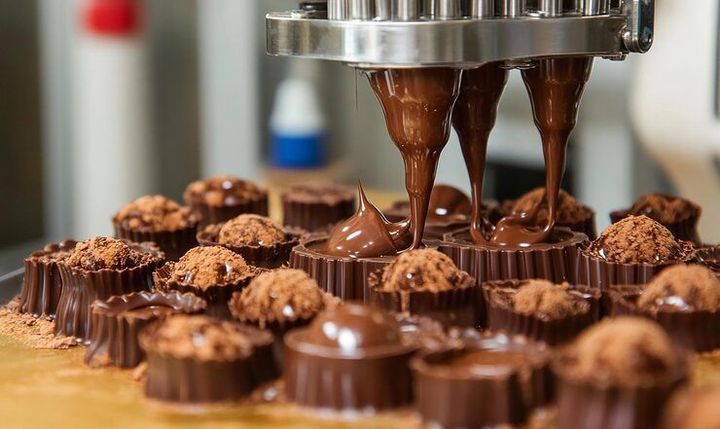
The prepared chocolate is pumped toward the coating head. Products travel along a conveyor and pass beneath a continuous chocolate curtain or through another coating arrangement. Excess chocolate can drain away and may be collected for controlled recirculation.
After coating, products usually enter a cooling tunnel. Controlled cooling allows the chocolate layer to set before the products move toward inspection, packaging, or additional processing.
Main Equipment Components
A chocolate coating machine may contain several interconnected components:
Melting tank for controlled chocolate heating
Holding tank for maintaining chocolate conditions
Tempering unit for controlled crystallization
Pump for moving chocolate through the system
Coating curtain or enrobing head for product coverage
Conveyor belt for product movement
Vibration system for controlling excess chocolate
Cooling tunnel for chocolate setting
Sensors for temperature and equipment monitoring
Control panel for managing operating sequences
The equipment configuration depends on the product and chocolate formulation. Small production systems may combine several functions in one machine, while larger lines can use separate modules connected into a continuous process.
Importance
Chocolate coating machines are important because coating quality depends on controlled processing conditions. Uneven temperature, inconsistent product movement, unsuitable chocolate flow, or inadequate cooling can affect the appearance and physical characteristics of the finished coating.
Automated equipment can make repeated coating processes more consistent by controlling conveyor speed, chocolate temperature, pump operation, and cooling conditions. It can also reduce the amount of direct manual handling required during repetitive production stages.
Applications of Chocolate Coating Equipment
Chocolate coating equipment can be used for many product categories. Common applications include:
Biscuits and cookies
Wafer products
Chocolate bars
Confectionery centers
Nuts and seeds
Dried fruit pieces
Snack products
Ice cream components
Bakery products
Cereal-based products
The coating process needs to account for product size, shape, surface texture, temperature, and moisture. A smooth biscuit may require a different conveyor and coating arrangement from a fragile confectionery center.
Coating Methods
Several coating methods can be used depending on the product and desired result. Enrobing is a widely used method in which products travel through a continuous curtain of chocolate. The chocolate can cover the top, sides, and bottom of the product.
Bottom coating uses a controlled chocolate layer beneath the product. This approach may be combined with a top coating or another finishing stage.
Dipping involves placing products into melted chocolate. It can be performed manually or through mechanical systems and may be appropriate for products with particular shapes.
Panning uses rotating containers to gradually build layers of chocolate or other coatings around smaller pieces. This method differs from continuous enrobing because products move within a rotating vessel rather than along a conveyor under a chocolate curtain.
Temperature Control
Temperature control affects nearly every stage of chocolate coating. Chocolate must be melted sufficiently for pumping and coating while remaining within a suitable range for the particular formulation.
Important variables can include:
Melting temperature
Tempering temperature
Holding temperature
Chocolate viscosity
Product temperature
Cooling temperature
Cooling duration
Conveyor speed
Different chocolate types have different processing characteristics. Dark, milk, and white chocolate can require different temperature profiles because their compositions are not identical.
Recent Updates
From 2024 through 2026, chocolate coating equipment has continued moving toward automated temperature management, digital controls, improved energy monitoring, flexible production configurations, and more detailed process data. The general direction is toward greater integration between mechanical equipment and digital control systems.
Advanced Temperature Monitoring
Modern chocolate coating systems can use multiple temperature sensors throughout the process. Sensors may monitor chocolate within melting tanks, tempering units, pipes, coating heads, and cooling sections.
Digital controllers can compare measured temperatures with configured process parameters. Automated heating and cooling systems can then adjust equipment operation within defined control limits.
This approach can reduce dependence on manual temperature checks, although physical inspection and appropriate process controls remain important.
Digital Control Systems
Touchscreen interfaces and programmable controllers are increasingly common in automated chocolate processing. Operators can monitor temperatures, conveyor movement, pump activity, alarms, and production sequences from a centralized interface.
Data logging can also provide records of selected operating conditions. These records may be useful for process review, equipment maintenance, and production documentation.
Energy Management
Chocolate processing requires heating and cooling at different stages. Equipment manufacturers and facility planners are therefore paying greater attention to thermal insulation, efficient heating systems, cooling management, motor controls, and energy monitoring.
Cooling tunnels may use controlled airflow and refrigeration systems to establish suitable conditions for chocolate setting. Monitoring electrical and thermal demand can help facilities understand how different production stages use energy.
Flexible Production
Food manufacturers may process different products on the same production line. Modern coating equipment can therefore be configured with adjustable conveyor speeds, interchangeable components, variable coating settings, and programmable operating recipes.
Changeover requirements remain important because chocolate residues and different formulations can require cleaning and process adjustments between production runs.
Automation and Quality Monitoring
Sensors and digital controls can monitor chocolate temperature, flow, conveyor speed, and other selected parameters. Some production environments also use machine vision to examine coating coverage, product position, shape, or surface appearance.
Automated inspection does not replace all physical quality checks. Instead, it can provide additional information that operators can use alongside established inspection procedures.
Laws or Policies
Chocolate coating machines are influenced by food safety rules, machinery safety requirements, electrical regulations, hygiene provisions, labeling requirements, and environmental rules. The exact requirements depend on the country, product category, facility, and equipment configuration.
Food Hygiene Requirements
Food-processing equipment generally needs to be designed and maintained in a way that supports hygienic production. Surfaces that contact chocolate or food products should be appropriate for their intended use and capable of being cleaned according to the applicable procedures.
Facilities may also need documented cleaning routines, sanitation controls, pest-management procedures, allergen controls, and records related to food safety.
Where chocolate products contain ingredients associated with food allergies, production facilities may need procedures for allergen identification, separation, cleaning, and labeling according to applicable regulations.
Machinery Safety
Chocolate coating machines contain heated surfaces, moving conveyors, pumps, rotating components, electrical systems, and cooling equipment. Safety provisions may include guards, emergency-stop controls, access controls, warning systems, and appropriate electrical protection.
Maintenance procedures may require isolation of electrical, thermal, mechanical, pneumatic, or hydraulic energy before workers access specific machine areas.
Food Contact Materials
Materials that come into direct contact with chocolate or other food products may be subject to applicable food-contact requirements. These requirements can address material composition, migration characteristics, cleanliness, and suitability for the intended application.
Rules vary between jurisdictions, so manufacturers and facilities need to identify the requirements applicable to their production environment.
Tools and Resources
Planning and operating chocolate coating equipment involves several technical resources. Equipment specification sheets can provide information about conveyor dimensions, heating requirements, cooling capacity, chocolate throughput, electrical requirements, and temperature ranges.
Process diagrams can show the movement of chocolate and products through melting, tempering, coating, cooling, and packaging stages. Temperature-recording tools can help document process conditions during production.
Useful resources include:
Chocolate tempering charts
Temperature monitoring instruments
Viscosity measurement tools
Conveyor speed calculators
Equipment specification sheets
Production flow diagrams
Cleaning and sanitation checklists
Preventive maintenance schedules
Food safety planning templates
Energy monitoring systems
Machine inspection checklists
Production data dashboards
A simplified comparison of coating approaches is shown below:
| Coating Method | Basic Process | Common Application |
|---|---|---|
| Enrobing | Product passes through chocolate curtain | Biscuits, wafers, bars |
| Bottom Coating | Chocolate is applied beneath product | Bars and confectionery |
| Dipping | Product is immersed in chocolate | Irregular or individual pieces |
| Panning | Product rotates while layers build | Small confectionery pieces |
| Spray Coating | Chocolate or coating is applied through controlled spray | Selected specialty products |
Facility layout also matters. Chocolate coating equipment needs appropriate space for product conveyors, cooling tunnels, cleaning access, ingredient handling, electrical panels, and maintenance activities.
FAQs
What are chocolate coating machines?
Chocolate coating machines are food-processing systems that apply controlled layers of melted chocolate to products. They can include melting, tempering, pumping, coating, cooling, and conveyor equipment.
Why is temperature control important in chocolate coating machines?
Temperature control affects chocolate viscosity, flow, crystallization, coating appearance, and setting behavior. Different chocolate formulations can require different temperature profiles during melting, tempering, coating, and cooling.
What chocolate coating methods are commonly used?
Common methods include enrobing, bottom coating, dipping, panning, and selected spray applications. The appropriate method depends on the product shape, chocolate formulation, coating thickness, and production arrangement.
What features are found in automated chocolate coating equipment?
Automated systems can include temperature sensors, programmable controllers, conveyor controls, pumps, tempering units, cooling tunnels, digital interfaces, alarms, and process-data recording.
What factors affect chocolate coating machine selection?
Important factors include product dimensions, chocolate type, coating method, required coating thickness, production volume, conveyor speed, temperature requirements, cooling capacity, cleaning procedures, floor space, and applicable food-processing requirements.
Conclusion
Chocolate coating machines combine controlled heating, tempering, pumping, coating, conveying, and cooling into an integrated food-processing system. Temperature control is particularly important because chocolate characteristics change with heating and cooling conditions. Recent equipment developments include digital monitoring, automated temperature control, flexible production settings, energy management, and selected machine-vision applications. Equipment configuration depends on chocolate formulation, product characteristics, coating method, production requirements, hygiene procedures, and applicable regulations.

You May Also Like