Commercial Air Compressor Systems Information With Air Compression Technology and Maintenance Details
Commercial air compressor systems are mechanical systems that convert electrical or other forms of power into compressed air for equipment, tools, production processes, and facility operations. An air compressor draws atmospheric air into a chamber, reduces its volume or increases its pressure, and then sends the compressed air into a storage receiver or directly toward a point of use.
Compressed air is often described as a utility because it can support many different operations within one facility. Manufacturing plants, workshops, warehouses, food processing areas, laboratories, construction operations, and commercial buildings may use commercial air compressor systems for different purposes. The required pressure and airflow depend on the equipment being supplied.
There are several major compressor designs. Reciprocating compressors use pistons moving inside cylinders, while rotary screw compressors use rotating elements to compress air continuously. Centrifugal compressors use high-speed rotating impellers and are generally associated with larger airflow requirements. Each design has different operating characteristics, maintenance needs, and suitable applications.
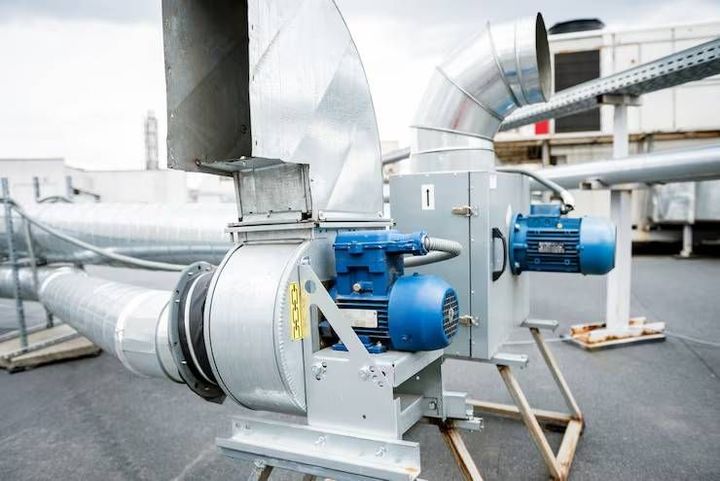
A complete air compression installation normally includes more than the compressor itself. Common components include an air receiver, intake filter, aftercooler, moisture separator, air dryer, line filters, pressure controls, valves, piping, drains, and monitoring equipment.
Importance
Commercial air compressor systems matter because compressed air can operate pneumatic equipment without placing an individual motor inside every tool or machine. This can simplify the movement of mechanical power around a facility and support equipment such as pneumatic actuators, packaging machinery, assembly tools, control systems, and material-handling mechanisms.
However, compressed air is not automatically an efficient form of energy. A compressor can consume substantial electrical power, particularly when operating at high pressure, running during idle periods, or supplying air through poorly maintained piping. Air leaks, inappropriate pressure settings, blocked filters, excessive moisture, and poorly matched equipment can also affect overall system performance.
Key system considerations
When evaluating an installation, several factors normally receive attention:
- Pressure requirement: Equipment may need a specific pressure range for consistent operation.
- Airflow requirement: The system must provide enough volume for connected equipment during normal and peak demand.
- Air quality: Filters and dryers help control particles, oil aerosols, and moisture where required.
- Duty pattern: Intermittent workloads can require a different arrangement from continuous production.
- Storage capacity: Receivers can help manage short periods of high demand and reduce rapid compressor cycling.
- Heat management: Compression generates heat, making ventilation and cooling important.
- Electrical demand: Motor size, operating hours, controls, and system pressure influence energy consumption.
Common compressor types
| Compressor type | Typical characteristic | Common application pattern |
|---|---|---|
| Reciprocating | Piston-based intermittent compression | Workshops and moderate air demand |
| Rotary screw | Continuous rotary compression | Manufacturing and general industrial use |
| Rotary vane | Rotary compression with sliding vanes | Specialized commercial and industrial equipment |
| Centrifugal | Dynamic compression using rotating impellers | Large and relatively steady airflow demand |
| Low-oil-contact compressor | Compression arrangement designed to limit oil contact | Applications with specific air purity requirements |
The appropriate configuration depends on pressure, airflow, air quality, operating schedule, ambient conditions, and the characteristics of connected equipment.
Recent Updates
Recent developments in commercial air compressor systems have focused strongly on energy management, digital monitoring, variable-speed operation, and improved air treatment. Modern controllers can coordinate compressor operation according to changing demand rather than simply switching individual units on and off.
Variable-speed drive technology is increasingly used where airflow requirements change throughout the operating period. Instead of maintaining one fixed motor speed, the compressor can adjust output within its designed operating range. This can reduce unnecessary operation during periods of lower demand, although actual energy performance depends on system design and operating conditions.
Digital monitoring has also become more common. Sensors can track pressure, temperature, operating hours, motor status, dew point, and other parameters. Data can then be displayed through a controller or facility monitoring platform, helping operators identify unusual operating conditions.
Air quality and efficiency trends
Air treatment has received greater attention as facilities seek more consistent compressed-air quality. Refrigerated and desiccant dryers are used according to the required dew point and operating environment. Modern filtration arrangements can also be selected according to particle, moisture, or oil-removal requirements.
Another development is the use of system-level energy analysis. Rather than examining only compressor efficiency, operators increasingly assess the complete compressed-air network, including pressure losses, leaks, storage, controls, dryers, filters, and demand patterns.
Heat recovery is another area of interest. Because compression produces heat, some installations can capture part of that thermal energy for suitable facility processes. The practical value depends on the compressor design, operating profile, temperature requirements, and available heat demand.
Laws or Policies
Commercial air compressor systems are affected by several categories of rules, although exact requirements depend on the country, industry, facility type, and equipment size. Common areas include pressure-vessel safety, electrical safety, workplace exposure, noise, environmental management, and energy efficiency.
Air receivers and other pressurized components may be subject to inspection, design, testing, marking, or operating requirements. Facilities may also have requirements for electrical installation, machine guarding, ventilation, and safe access.
Energy-efficiency programs can influence the selection and operation of compressor systems. Some jurisdictions establish efficiency requirements for motors or industrial equipment, while others use energy-management programs or efficiency standards for larger facilities.
Environmental rules can also affect compressor operation indirectly. Condensate from oil-lubricated compressors may contain contaminants and may require appropriate collection and handling. Noise controls can apply where compressor equipment is installed near occupied areas or property boundaries.
Because requirements differ between jurisdictions, operators generally need to identify the applicable pressure-equipment, electrical, workplace-safety, environmental, and energy rules before installation or modification. Manufacturer documentation and facility safety procedures can help establish the relevant operating limits.
Tools and Resources
Several tools can help people understand and manage commercial air compressor systems. A pressure and airflow calculator can estimate whether a compressor's rated output corresponds with the requirements of connected equipment. Calculators may use pressure, airflow, operating hours, and electrical information to support energy analysis.
Leak-detection equipment is another useful resource. Ultrasonic detectors can help locate compressed-air leaks that may not be easily heard in a noisy facility. Leak surveys can be repeated periodically because connections, hoses, seals, and valves can deteriorate during normal operation.
Maintenance templates can organize routine checks. A practical schedule may include:
- Daily or routine checks: pressure readings, unusual noise, visible leaks, temperature indicators, and drain operation.
- Periodic checks: intake filters, air filters, condensate drains, belts where applicable, and cooling surfaces.
- Scheduled inspections: lubrication condition, electrical connections, safety controls, valves, receiver condition, and dryer operation.
- System reviews: pressure settings, leakage levels, demand patterns, storage capacity, and compressor sequencing.
Digital compressor controllers and facility monitoring platforms can also collect operating data. Useful measurements include running hours, load and unload periods, discharge temperature, pressure, dew point, and alarm history. Trend information can reveal changes that are difficult to identify from a single reading.
Air-system diagrams are another practical resource. A clear diagram showing compressors, receivers, dryers, filters, drains, valves, and distribution lines can make troubleshooting and maintenance easier. Manufacturer manuals should also be kept with equipment records because they contain model-specific operating limits and maintenance intervals.
FAQs
What are commercial air compressor systems used for?
Commercial air compressor systems supply compressed air to pneumatic tools, automation equipment, packaging machinery, actuators, control equipment, and other processes. Their configuration depends on pressure, airflow, air quality, and operating schedule.
How does air compression technology work?
Air compression technology reduces the volume of atmospheric air or uses dynamic movement to increase its pressure. The compressed air is then stored or distributed through piping to connected equipment.
What maintenance do commercial air compressor systems need?
Maintenance can include checking filters, drains, lubrication, cooling components, electrical connections, pressure controls, safety devices, and air leaks. The exact interval depends on compressor design, operating conditions, and manufacturer instructions.
Why is an air dryer used with a compressor?
Compressed air can contain water vapor that may condense as air cools. An air dryer reduces moisture to a specified level, helping protect downstream equipment and processes where dry air is required.
What affects commercial air compressor energy use?
Energy use is affected by compressor type, pressure settings, airflow demand, operating hours, control method, leaks, piping pressure losses, dryer operation, and maintenance condition. System-level assessment is therefore important when examining energy performance.
Conclusion
Commercial air compressor systems combine compression equipment, storage, air treatment, controls, and distribution components to provide pressurized air for many applications. Air compression technology now commonly incorporates variable-speed drives, digital monitoring, improved filtration, and system-level energy analysis. Maintenance focuses on pressure, temperature, filtration, moisture control, lubrication, leaks, safety equipment, and component condition. Applicable rules vary by location and may cover pressure equipment, electrical safety, workplace conditions, environmental handling, and energy efficiency.