Forging Press Machines Details: Capacity, Force, Stroke, Speed and Control Systems
Forging press machines are industrial machines used to shape metal by applying controlled compressive force through a die. Forging press machines can be mechanical or hydraulic, and their specifications commonly include capacity, force, stroke, speed, and control systems. These details help explain how a press moves, how much force it can apply, and how accurately its working cycle can be managed.
What forging press machines are
A forging press forms metal by squeezing a heated or cold workpiece between dies. Unlike a forging hammer, which shapes metal through repeated impacts, a press applies force through a controlled ram movement. This makes the forming action easier to describe in terms of force, stroke, speed, and position.
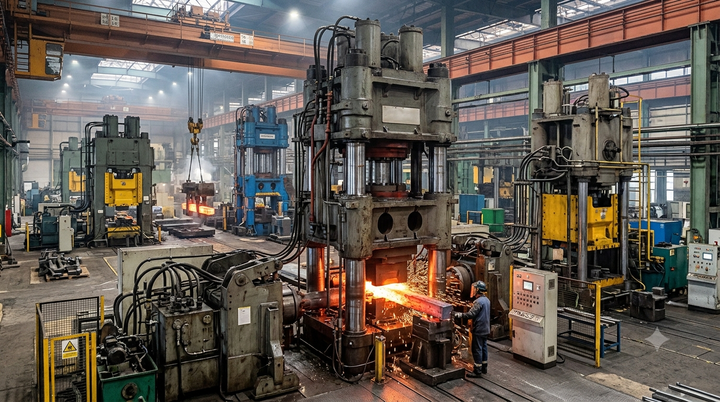
The machine generally includes a frame, bed, ram, drive or hydraulic system, die area, control system, and safety equipment. The upper die is connected to the moving ram, while the lower die is supported by the bed. The workpiece is placed between the dies and shaped as the ram moves.
How forging presses developed
Early metal-forming presses relied mainly on mechanical systems. Later designs introduced hydraulic power, electronic controls, sensors, programmable controllers, and more detailed monitoring. Modern systems can therefore combine high forming force with controlled movement and process information.
Forging presses are used in processes such as hot forging, cold forging, open-die work, impression-die forging, and ring-related forming operations. The suitable machine arrangement depends on the material, part geometry, forming temperature, die design, and required force.
Importance
Why capacity and force matter
Capacity describes the range of forming work a press is designed to handle, while force indicates the compressive load that the machine can apply. These terms are related but should not be treated as identical. A machine specification may use tonnes-force, kilonewtons, or another engineering unit.
The required force depends on factors such as material strength, temperature, workpiece size, die geometry, friction, and the stage of forming. A larger numerical rating does not automatically mean that a press is appropriate for every application.
Understanding stroke and speed
Stroke is the distance through which the ram travels during a working cycle. A longer stroke can provide more movement between the open and closed positions, while a shorter stroke may suit processes where the forming action occurs over a smaller distance.
Speed describes how quickly the ram moves. Some forging processes require a controlled approach, a forming speed, and a return movement. Modern control systems can manage these stages separately, depending on the machine design.
Why control systems matter
Control systems coordinate motion, pressure, timing, sensors, and operator inputs. Programmable logic controllers, position sensors, pressure monitoring, and human-machine interfaces can help operators observe machine conditions and repeat defined operating sequences.
Safety controls are also important. Guarding, emergency stopping arrangements, interlocks, two-hand controls, and other protective measures may be used depending on the press design and applicable safety requirements.
Recent Updates
Greater use of digital monitoring
From 2024 through 2026, the broader manufacturing sector has continued moving toward connected equipment, electronic monitoring, and data-based process control. In forging applications, this trend can include sensors for pressure, position, temperature, vibration, and hydraulic conditions.
Digital monitoring can make machine information easier to record and review. It can also support condition monitoring by identifying changes in operating parameters. These capabilities vary considerably between machine designs and control architectures.
Increased attention to machinery safety
Machine safety has also received continued attention in India. The Bureau of Indian Standards maintains standards for machine safety, including IS 17277 Part 3:2021, which addresses safety requirements for hydraulic presses and was reviewed in 2025. BIS has also conducted industry awareness activity on machine-press safety and risk assessment.
Engineering guidance has also addressed foundations for forging and stamping presses. A BIS document published during the recent period describes forging presses as mechanical or hydraulic machines and notes that foundation design needs to account for machine capacity, size, and transmitted vibration.
More integrated automation
Current press systems increasingly combine mechanical or hydraulic power with electronic controls. Depending on the application, this can include programmable sequences, position feedback, pressure sensing, fault monitoring, and interfaces that display operating information.
The degree of automation varies. Some presses use relatively simple controls, while larger production systems may integrate the press with material handling, die monitoring, quality inspection, and factory data systems.
Laws or Policies
Machinery safety in India
In India, workplace machinery safety is addressed through occupational safety legislation and applicable rules, together with relevant Indian Standards. The Occupational Safety, Health and Working Conditions Code, 2020 includes matters such as fencing of machinery, work near machinery in motion, power cut-off devices, revolving machinery, pressure equipment, safety officers, and accident-related requirements.
The exact requirements applicable to a forging press can depend on the workplace, machine type, state rules, and the legal provisions in force for the particular installation. Organizations should therefore check the current requirements applicable to their location and operation.
Indian Standards and conformity information
BIS provides a system for identifying Indian Standards and related technical information. Its standards portal allows users to search by standard number or keyword. BIS also explains that certification is generally voluntary unless a government notification makes compliance compulsory for a particular product category.
For press safety, standards in the IS 17277 series are relevant to different press types. For example, IS 17277 Part 3:2021 covers hydraulic presses. The applicable standard should be confirmed against the exact machine type and current regulatory requirements.
Key specification terms
The following table summarizes common forging press machine terms:
| Specification | Meaning | Why it matters |
|---|---|---|
| Capacity | General rating or working range of the press | Helps describe the machine's intended forming range |
| Force | Maximum or specified forming load | Relates to the pressure applied to the workpiece |
| Stroke | Ram travel distance | Defines available movement during the cycle |
| Speed | Ram movement rate | Affects forming time and process control |
| Control system | Hardware and software managing operation | Coordinates movement, monitoring, and safety functions |
| Bed size | Working support area | Relates to die and workpiece dimensions |
| Throat or working space | Available forming area | Affects part positioning and die arrangement |
Tools and Resources
Specification and engineering tools
Readers studying forging press machines can use several types of technical resources. A unit-conversion calculator can convert tonnes-force, kilonewtons, and related engineering units. A stroke-speed calculator can help estimate basic cycle movement when the required parameters are known.
Machine documentation is another important resource. Technical manuals, drawings, electrical diagrams, hydraulic diagrams, and control-system documentation can explain the actual configuration of a particular press.
Standards and reference platforms
The BIS “Know Your Standard” portal provides access to Indian Standards information, including standard details, revisions, and related documents. It can be used to check whether a particular standard is relevant to a machine or process.
BIS also publishes information about machinery safety certification and applicable technical requirements. The specific regulatory status of a machine should be checked against the current BIS information and government notifications rather than assumed from an older document.
Basic specification checklist
When reading a forging press specification sheet, useful fields to identify include:
- Press type: mechanical or hydraulic
- Rated force or capacity
- Maximum and minimum stroke
- Ram speed or adjustable speed range
- Bed and die-space dimensions
- Motor or hydraulic power information
- Control architecture
- Sensor and monitoring functions
- Guarding and safety devices
- Foundation and installation requirements
FAQs
What is a forging press machine?
A forging press machine is equipment that shapes metal by applying compressive force through dies. It may use a mechanical drive or hydraulic system, depending on its design and application.
What does force mean in a forging press?
Force is the compressive load applied by the ram to the workpiece. Forging press force is commonly expressed in kilonewtons or tonnes-force, depending on the specification system.
How does stroke affect a forging press machine?
Stroke is the distance traveled by the ram. It affects the available forming movement, die opening, and sequence of the pressing operation.
What control systems are used in forging press machines?
Control systems may include programmable logic controllers, position sensors, pressure sensors, human-machine interfaces, and safety circuits. The exact arrangement varies by machine type and application.
Are forging press machines covered by safety standards in India?
Yes. Indian Standards include requirements for press safety, and IS 17277 Part 3:2021 addresses hydraulic presses. Workplace requirements can also arise from occupational safety legislation and applicable rules.
Conclusion
Forging press machines shape metal through controlled compressive force, with capacity, force, stroke, speed, and control systems forming important parts of their specifications. Mechanical and hydraulic presses can differ substantially in their operating principles and control arrangements. Recent developments have increased the use of sensors, electronic controls, monitoring, and machinery-safety practices. In India, applicable legislation and Indian Standards provide an important framework for safe machine operation and technical assessment.

You May Also Like