Industrial Automation Systems Guide With Smart Manufacturing and Technology Insights
Industrial automation systems combine machines, sensors, controllers, software, and communication networks to manage manufacturing activities with limited manual intervention. They are closely connected with smart manufacturing, Industry 4.0, industrial robotics, programmable logic controllers, industrial IoT, and digital monitoring.
In recent years, manufacturers have increasingly connected production equipment so that operating information can move between machines, control systems, and management platforms. In India, government-backed Industry 4.0 initiatives such as SAMARTH Udyog Bharat 4.0 have also supported demonstrations, training, and technology development for smart manufacturing.
Context
What industrial automation systems mean
Industrial automation systems are integrated arrangements that allow production equipment to perform repetitive, controlled, or monitored activities. A typical system may include sensors for collecting information, actuators for physical movement, controllers for processing instructions, and software for monitoring production.
The basic idea developed from earlier mechanical and electrical control methods. As electronic controls became more capable, factories began using programmable logic controllers, computerized numerical control equipment, robotics, and supervisory control platforms.
Today, industrial automation can connect physical equipment with digital systems. This creates a production environment where information about temperature, pressure, speed, position, energy use, equipment conditions, and production status can be collected and analyzed.
Main components of automation
An industrial automation system normally contains several connected layers.
- Sensors detect physical conditions such as temperature, pressure, position, vibration, or speed.
- Controllers process signals and execute programmed instructions.
- Actuators convert control signals into physical movement or other actions.
- Human-machine interfaces allow operators to view information and interact with equipment.
- Industrial networks connect machines, controllers, sensors, and software.
- Industrial software collects, visualizes, stores, and analyzes production information.
These components can operate together in packaging, automotive production, food processing, electronics assembly, chemical processing, material handling, and many other industrial environments.
From automation to smart manufacturing
Traditional automation generally focuses on controlling a defined production process. Smart manufacturing adds connectivity, data analysis, machine communication, and software-based monitoring to that foundation.
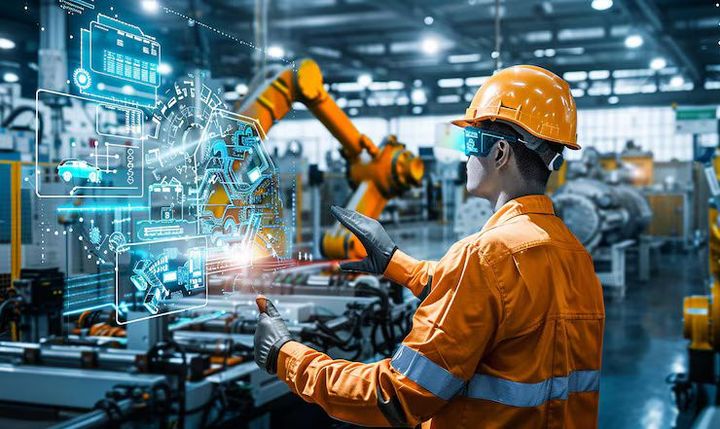
A smart manufacturing environment can connect equipment across production cells and use collected information to identify changes in operating conditions. Digital twins, industrial IoT, machine vision, robotics, and predictive analytics can also be integrated into broader automation architectures.
Importance
Why industrial automation matters
Industrial automation addresses several practical manufacturing challenges. Repetitive activities can be performed through programmed sequences, while sensors can continuously observe operating conditions.
Automation can also improve process consistency because machines can follow defined operating parameters. Data collection gives production teams additional information for identifying process changes, equipment interruptions, or quality variations.
The technology affects many groups, including:
- Manufacturing operators
- Production engineers
- Maintenance teams
- Quality personnel
- Equipment designers
- Factory managers
- System integrators
- Technology researchers
- Small and medium industrial manufacturers
Common applications
Industrial automation systems are used in many types of production environments.
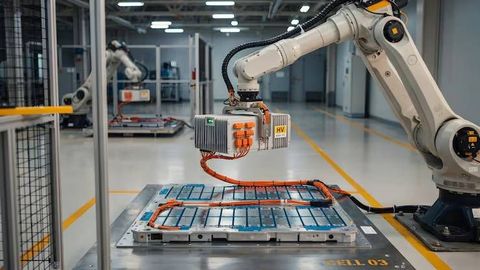
Robotic systems can perform assembly, welding, material movement, packaging, and inspection activities. PLC-based systems can control conveyors, pumps, motors, valves, and production sequences.
Machine vision can inspect dimensions, surface conditions, labels, components, and product positioning. Industrial IoT platforms can connect equipment data to monitoring applications, while digital control systems can provide information about production status.
Automation system comparison
| Technology | Main function | Typical application | Information handled |
|---|---|---|---|
| PLC | Machine and process control | Production equipment | Control signals |
| SCADA | Supervisory monitoring | Factory processes | Operational data |
| HMI | Operator interaction | Machine control | Status and commands |
| Industrial IoT | Equipment connectivity | Connected factories | Sensor and machine data |
| Robotics | Automated physical tasks | Assembly and handling | Motion and process data |
| Machine vision | Visual inspection | Quality monitoring | Images and measurements |
| Digital twin | Digital process representation | Simulation and analysis | Equipment and process models |
Challenges that require attention
Automation does not remove the need for planning and technical oversight. Industrial environments may contain older machines, different communication protocols, limited network connectivity, and equipment from multiple manufacturers.
Cybersecurity is another consideration because connected machines can increase the number of digital entry points within a production environment. Access control, network segmentation, software maintenance, backups, and monitoring therefore become important parts of an automation strategy.
Recent Updates
Expansion of Industry 4.0 programs
Recent developments have placed greater emphasis on connecting automation with data analytics, artificial intelligence, robotics, digital twins, and industrial IoT.
India's SAMARTH Udyog Bharat 4.0 initiative has established four Smart Advanced Manufacturing and Rapid Transformation Hub centres. Government information published during the period also describes additional Industry 4.0 experience centres and programs for industrial training and technology adoption.
By 2026, the Ministry of Heavy Industries reported that the four SAMARTH centres had supported more than 2,700 industries through onsite demonstrations and awareness activities, with approximately 33,000 professionals trained through more than 300 training programs.
Greater use of connected production data
Another notable trend is the movement from isolated automation toward connected production environments. Manufacturers increasingly combine PLC systems, industrial networks, sensors, databases, cloud or edge computing, and analytical software.
Edge computing is particularly relevant where production information needs to be processed close to machines. This can reduce dependence on sending every data point to a remote platform and can support applications that require rapid responses.
Artificial intelligence and machine vision
Artificial intelligence is increasingly being explored for inspection, anomaly detection, forecasting, process analysis, and production planning. Machine vision can generate structured information from images, while analytical systems can identify patterns that may be difficult to recognize through manual observation alone.
These technologies remain dependent on appropriate data quality, system design, cybersecurity controls, and human oversight.
Updated machinery safety thinking
Safety standards are also evolving alongside integrated manufacturing. A 2025 BIS draft for IS 15296 aligned with ISO 11161:2025 and addressed safety requirements for integrating machinery into a system, including risk assessment and risk reduction measures.
Laws or Policies
Industrial safety requirements in India
Industrial automation equipment operates within a wider framework of machinery safety, electrical safety, workplace protection, and factory regulation. India's Ministry of Labour and Employment identifies the Factories Act, 1948 among the legislation handled in its industrial safety and health framework, while state governments have roles in administering factory rules.
The Occupational Safety, Health and Working Conditions Code, 2020 also establishes provisions concerning workplace health, safety, working conditions, hazardous processes, and factory-related requirements.
Machinery and electrical equipment requirements
India has also been developing technical requirements for machinery and electrical equipment. The Ministry of Heavy Industries records amendments and subsequent withdrawal of the Machinery and Electrical Equipment Safety Omnibus Technical Regulation during the recent regulatory period. Its current records show that the 2024 order was withdrawn in January 2026.
This distinction is important because a withdrawn regulation should not be treated as a current blanket requirement. Applicable BIS standards, product-specific requirements, factory rules, electrical provisions, and other regulations can vary according to the equipment and application.
Government technology initiatives
Government programs also influence the development of smart manufacturing. SAMARTH Udyog Bharat 4.0 is designed around Industry 4.0 awareness, demonstrations, training, research, and adoption within the Indian manufacturing ecosystem.
Regulatory requirements can change, so manufacturers and technical teams generally need to verify the current rules applicable to their particular equipment and industrial activity.
Tools and Resources
Automation engineering tools
Several categories of tools are commonly used when developing or studying industrial automation systems:
- PLC programming environments for controller configuration
- HMI development platforms for operator interfaces
- SCADA platforms for supervisory monitoring
- CAD and electrical design software for system planning
- Industrial network diagnostic tools for communication analysis
- Simulation software for testing processes digitally
- Machine vision platforms for image-based inspection
- Data analytics platforms for production information
- Digital twin platforms for process modeling
Learning and planning resources
Industry 4.0 demonstration centres, technical standards, manufacturer documentation, engineering training materials, and industrial automation laboratories can help readers understand how individual technologies fit into a complete system.
India's SAMARTH centres provide demonstrations, training, and Industry 4.0 awareness activities. The Ministry of Heavy Industries also maintains information and resources related to the initiative and capital goods technology programs.
FAQs
What are industrial automation systems?
Industrial automation systems are combinations of controllers, sensors, actuators, software, networks, and machines used to control and monitor industrial processes. They can range from a single automated machine to a connected factory environment.
How does smart manufacturing differ from traditional automation?
Traditional automation mainly focuses on controlling machines and processes. Smart manufacturing adds connectivity, data collection, analytics, digital technologies, and communication between production systems.
What role does industrial IoT play in automation?
Industrial IoT connects machines, sensors, controllers, and software so that operational information can be collected and exchanged. It can support monitoring, analysis, maintenance planning, and production visibility.
Are industrial automation systems affected by safety regulations?
Yes. Industrial equipment can be subject to machinery, electrical, workplace safety, factory, and technical standards. The applicable requirements depend on the equipment, industry, location, and regulatory framework.
What technologies are used in smart manufacturing?
Common technologies include PLCs, robotics, industrial IoT, machine vision, SCADA, digital twins, industrial networks, edge computing, data analytics, and artificial intelligence.
Conclusion
Industrial automation systems combine physical equipment and digital control technologies to manage modern production processes. Smart manufacturing extends this foundation through connectivity, data analysis, robotics, industrial IoT, machine vision, and other digital technologies. Recent Industry 4.0 initiatives in India have expanded training, demonstrations, and technology development, while machinery and workplace safety requirements continue to evolve. Understanding the relationship between automation hardware, software, data, safety, and industrial policies provides a clearer view of modern manufacturing environments.