Industrial Machine Automation Guide: Technologies, Controls, Applications, Benefits and Industry Uses
Industrial machine automation refers to the use of control systems, sensors, software, electrical equipment, and mechanical devices to operate industrial machines with limited manual intervention. An Industrial Machine Automation system can control individual machines or coordinate several machines as part of a connected production process.
Context
Industrial machine automation refers to the use of control systems, sensors, software, electrical equipment, and mechanical devices to operate industrial machines with limited manual intervention. An Industrial Machine Automation system can control individual machines or coordinate several machines as part of a connected production process.
The concept developed from earlier mechanical and electrical control methods. Traditional factories depended heavily on manual operation, switches, relays, timers, and fixed mechanical controls. As manufacturing processes became more complex, programmable systems made it possible to monitor conditions, change operating sequences, and coordinate multiple machines.
Today, Industrial Machine Automation commonly combines programmable logic controllers (PLCs), human-machine interfaces (HMIs), sensors, drives, robots, industrial networks, and software. These technologies can be used in manufacturing, packaging, food processing, automotive production, pharmaceuticals, electronics, logistics, energy, and other industrial environments.
The main purpose is to coordinate machine actions according to defined instructions. A sensor may detect the position of a component, a PLC can process that information, and an actuator or motor can then perform the required movement. This creates a sequence in which machines can respond to changing conditions without requiring a person to control every individual step.
Basic automation structure
A typical automated machine can be understood through several connected layers:
- Sensors: Detect temperature, pressure, position, speed, level, proximity, or other conditions.
- Controllers: Process information and determine what action should occur.
- Actuators: Convert control signals into physical movement or other machine actions.
- Drives: Control motors and their speed, direction, or torque.
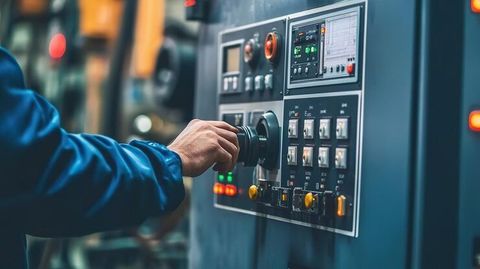
- HMI systems: Allow operators to view information and interact with the machine.
- Industrial networks: Connect controllers, machines, sensors, and supervisory systems.
- Software: Stores programs, collects information, monitors processes, and supports analysis.
Importance
Industrial Machine Automation matters because modern production systems often involve repeated movements, precise sequences, continuous monitoring, and coordination between different machines. Manual operation alone can make these processes difficult to manage consistently, particularly when many machine functions must occur in a specific order.
Automation can also help operators monitor processes rather than manually perform every repetitive machine action. Depending on the application, automated controls can support consistent operating sequences, equipment monitoring, process documentation, and faster identification of abnormal conditions.
Problems addressed by automation
Industrial automation is commonly used to address several practical manufacturing challenges:
- Repetitive machine movements
- Continuous production processes
- Monitoring of operating conditions
- Coordination between multiple machines
- Precise positioning and motion control
- Detection of abnormal operating conditions
- Collection of production information
- Reduction of unnecessary manual intervention
Automation does not eliminate the need for people. Operators, technicians, engineers, and maintenance personnel remain important for programming, supervision, inspection, troubleshooting, safety procedures, and system improvement.
Where industrial machine automation is used
| Industry | Common automation applications |
|---|---|
| Automotive | Assembly, welding, painting, inspection |
| Food processing | Filling, sorting, packaging, temperature control |
| Electronics | Component placement, testing, inspection |
| Packaging | Conveyors, labeling, filling, sealing |
| Metal manufacturing | Cutting, forming, machining, handling |
| Chemical processing | Process monitoring and control |
| Warehousing | Conveyors, sorting, automated movement |
| Energy | Equipment monitoring and process control |
Technologies and Controls
Industrial Machine Automation involves several technologies that work together. The exact configuration depends on the machine, production process, operating environment, and required level of control.
Programmable logic controllers
A programmable logic controller, or PLC, is a computer designed for industrial control. It receives information from input devices, processes programmed instructions, and sends signals to output devices.
For example, a PLC may receive a signal from a proximity sensor indicating that a component has reached a particular position. The controller can then instruct a motor, valve, cylinder, or other device to perform the next operation.
Sensors and measurement systems
Sensors provide information about physical conditions. Common examples include proximity sensors, temperature sensors, pressure sensors, photoelectric sensors, encoders, flow sensors, and level sensors.
The information from these devices allows an automated system to respond to actual machine conditions rather than following a fixed sequence without feedback.
Human-machine interfaces
An HMI provides an interface between an operator and an automated machine. It may display operating status, temperatures, alarms, production information, and machine settings.
Modern HMI systems can use touchscreens and graphical displays. They can also help operators identify which part of a process requires attention.
Motors and motion control
Motors are commonly controlled through variable frequency drives, servo drives, or other motor-control equipment. Motion-control systems can regulate movement according to programmed requirements.
Servo systems are frequently used where controlled positioning, acceleration, or repeatable movement is important. Simpler motor applications may use conventional motor starters or variable-speed drives.
Industrial robots
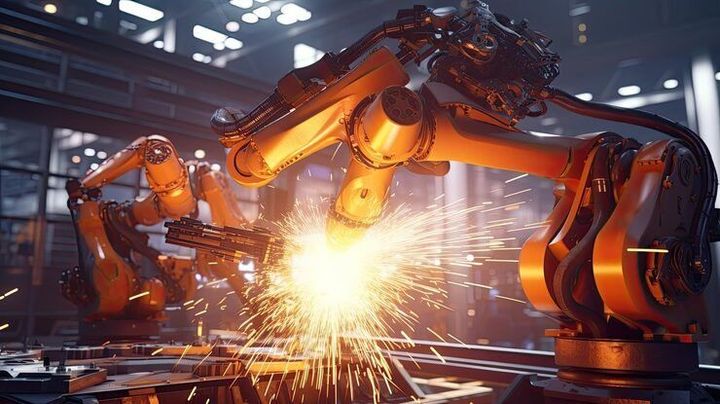
Robots can perform programmed movements such as material handling, welding, assembly, palletizing, and machine loading. Robotic systems usually combine mechanical arms with controllers, sensors, safety systems, and application-specific tooling.
The robot itself is only one part of an automated cell. Safe operation also depends on guarding, control logic, emergency stopping, access management, and appropriate risk assessment.
Recent Updates
Industrial Machine Automation has increasingly moved toward connected and data-oriented systems during 2024–2026. Industrial Internet of Things technologies, edge computing, machine vision, robotics, digital monitoring, and artificial intelligence are being integrated into some manufacturing environments.
One notable direction is the connection of machine-level controls with higher-level software. Instead of keeping information inside individual controllers, factories can collect operating data for monitoring, analysis, maintenance planning, and process evaluation.
Artificial intelligence is also being explored for machine-vision inspection, anomaly detection, production analysis, and predictive maintenance. However, AI does not automatically replace conventional automation controls. PLCs, safety systems, sensors, and established control architectures continue to perform important real-time functions.
Connected automation
Industrial networks can connect PLCs, HMIs, drives, robots, sensors, and supervisory systems. This allows information to move between different parts of a production system.
Another development is the use of edge computing. Some data can be processed close to the machine instead of being transferred entirely to a remote system. This can support applications where rapid local analysis is useful.
Machine safety developments
Machinery safety standards have also continued to evolve. India's Bureau of Indian Standards maintains standards covering machinery risk assessment, electrical equipment, emergency-stop functions, guards, interlocking devices, and safety-related control systems. BIS records include updates and reviews of several machinery-safety standards during the recent period.
Laws or Policies
In India, industrial automation is influenced by workplace safety requirements, machinery standards, electrical requirements, and product-specific regulations. The regulatory framework can vary according to the type of machinery, factory, industry, and state.
The Ministry of Labour and Employment identifies the Factories Act, 1948 as the principal legislation historically governing safety, health, and welfare requirements in factories, with state governments and Union Territory administrations responsible for framing and enforcing related rules.
Bureau of Indian Standards publications also provide machinery-safety references. These include IS standards corresponding to international standards for machinery risk assessment, electrical equipment of machines, emergency-stop functions, safety distances, guards, and safety-related control systems.
BIS also maintains certification information for machinery categories under Scheme-X and related technical regulations. Its current information includes machine-safety certification guidance and product-specific requirements for categories such as metal-cutting machinery and machinery for working rubber and plastics.
Because requirements differ by machine and application, organizations need to determine which Indian Standards, electrical rules, factory requirements, and product-specific regulations apply to a particular installation.
Tools and Resources
Several resources can help readers understand Industrial Machine Automation and related safety requirements.
Standards and technical references
The Bureau of Indian Standards provides a “Know Your Standard” facility that allows users to search Indian Standards by standard number or keyword. The system can also provide information about amendments, related documents, testing laboratories, and certification details.
Useful areas for further study include:
- PLC programming references
- HMI configuration guides
- Industrial networking documentation
- Motor and drive manuals
- Machinery risk-assessment references
- Electrical machine-safety standards
- Robotics safety documentation
- Machine-vision guides
- Industrial automation training materials
Automation planning tools
Automation projects may also use process diagrams, input-output lists, electrical schematics, PLC simulation software, HMI design software, maintenance records, and production-monitoring dashboards.
A basic automation assessment can examine the machine sequence, required sensors, control points, safety functions, communication requirements, operator interfaces, and maintenance requirements before the control system is developed.
FAQs
What is Industrial Machine Automation?
Industrial Machine Automation is the use of controllers, sensors, software, motors, actuators, and related equipment to control industrial machines and processes with limited manual intervention.
How does an Industrial Machine Automation system work?
A typical system receives information from sensors, processes that information through a controller such as a PLC, and sends commands to actuators, motors, valves, or other equipment. An HMI may allow an operator to monitor and interact with the system.
What technologies are used in Industrial Machine Automation?
Common technologies include PLCs, HMIs, sensors, variable frequency drives, servo systems, industrial robots, machine vision, industrial communication networks, supervisory software, and data-analysis systems.
Why is machine safety important in industrial automation?
Automated machines can contain moving, electrical, thermal, pneumatic, or hydraulic hazards. Safety measures such as guards, interlocks, emergency-stop functions, risk assessment, and appropriate control-system design help address these hazards.
Is Industrial Machine Automation used outside manufacturing?
Yes. Automation technologies are also used in logistics, energy, utilities, food processing, packaging, building systems, material handling, and other environments where machines or processes require monitoring and control.
Conclusion
Industrial Machine Automation combines control systems, sensors, software, motion equipment, robotics, and communication technologies to operate industrial processes. Its applications range from individual machines to connected production systems across many industries. Recent developments have increased the use of connected equipment, machine data, robotics, machine vision, and AI-assisted analysis. In India, machinery automation is also shaped by workplace requirements, Indian Standards, electrical safety provisions, and machine-specific regulations.