Industrial Machine Tools Explained: Types, Functions, Applications, Benefits and Key Considerations
Industrial machine tools are machines designed to shape, cut, drill, grind, form, or finish materials such as metals and other rigid materials. They are an important part of manufacturing because many products require accurately shaped components before assembly. Modern machine tools range from manually controlled equipment to computer numerical control (CNC) systems that use programmed movements for repeatable production.
Context
What industrial machine tools are
The basic idea behind a machine tool is to control the movement of a cutting or forming element against a workpiece. Depending on the machine, material may be removed through cutting, drilling, grinding, electrical discharge, or another process. Some machines instead reshape material through pressing, bending, or forming.
Common industrial machine tools include lathes, milling machines, drilling machines, grinders, machining centers, presses, turning centers, and electrical discharge machines. CNC versions use programmed instructions to control axes, spindle movement, tooling, and other functions.
How the field developed
Early machine tools were largely mechanical and manually operated. As manufacturing became more precise and production requirements became more complex, numerical control and later CNC systems were introduced. Digital controls, sensors, software, robotics, and automated material handling have gradually expanded machine capabilities.
The Bureau of Indian Standards describes machine tools as equipment used to shape or machine metal and other rigid materials through cutting, boring, grinding, shearing, or deformation. Indian standards also address safety and accuracy requirements for several machine-tool categories.
Importance
Why machine tools matter
Machine tools provide controlled methods for creating components with defined dimensions and surface characteristics. They are used across automotive manufacturing, aerospace production, electronics, medical equipment, energy systems, construction equipment, and general engineering.
For everyday products, their role may not be immediately visible, but many items depend on machined parts. Shafts, gears, brackets, housings, molds, fixtures, and structural components can involve one or more machining processes.
Problems they help address
Industrial machine tools can address several manufacturing challenges:
- Dimensional accuracy: controlled movements help produce parts within specified measurements.
- Repeatability: CNC programs can repeat defined movements across multiple workpieces.
- Material flexibility: different machines can process metals, alloys, plastics, ceramics, and other rigid materials depending on their design.
- Complex geometry: multi-axis machining can create shapes that may be difficult to produce manually.
- Production consistency: standardized programs and tooling can reduce variation between parts.
- Process integration: modern equipment can connect with inspection, robotics, data systems, and automated handling.
These capabilities are particularly useful when components must fit together correctly or when a manufacturing process involves repeated operations.
Types, Functions and Applications
Lathe and turning machines
A lathe rotates the workpiece while a cutting tool moves against it. Turning machines are commonly used to produce cylindrical surfaces, grooves, threads, tapers, and related features. CNC turning centers can combine several operations in one programmed sequence.
Milling machines and machining centers
A milling machine generally rotates a cutting tool while the workpiece is positioned against it. Milling can create slots, pockets, flat surfaces, contours, and holes. Machining centers can combine milling with drilling, tapping, tool changes, and other operations under computer control.
Drilling machines
Drilling machines create holes using rotating drill tools. Depending on the design, equipment may also support reaming, countersinking, tapping, or related operations. They are used in metal fabrication, component manufacturing, and engineering processes.
Grinding machines
Grinding machines use abrasive wheels or other abrasive tools to remove small amounts of material. They are commonly used when controlled surface characteristics or close dimensional tolerances are required. Surface, cylindrical, centerless, and tool grinding represent different forms of grinding equipment.
Presses and forming machines
Presses apply controlled force to cut, bend, draw, or form material. They are widely used for sheet-metal components and formed parts. Hydraulic and mechanical presses differ in how force is generated and controlled.
Electrical discharge machines
Electrical discharge machining, often called EDM, removes material through controlled electrical discharges. It is useful for conductive materials and complex shapes that may be difficult to produce with conventional cutting tools. Wire EDM and sinker EDM are two common forms.
| Machine tool type | Main function | Typical applications |
|---|---|---|
| Lathe | Turning and cylindrical machining | Shafts, threads, bushings |
| Milling machine | Cutting surfaces and profiles | Slots, pockets, contours |
| Machining center | Multiple CNC operations | Complex components |
| Drilling machine | Hole making | Plates, frames, assemblies |
| Grinding machine | Fine material removal | Finishing and precision surfaces |
| Press | Cutting and forming | Sheet-metal parts |
| EDM | Electrical material removal | Dies, molds, complex features |
Benefits and Key Considerations
Operational benefits
The benefits of industrial machine tools depend on the machine, material, tooling, programming, and production process. CNC systems can provide repeatable programmed movement, while suitable tooling can support controlled material removal. Automation can also connect machining with inspection and material handling.
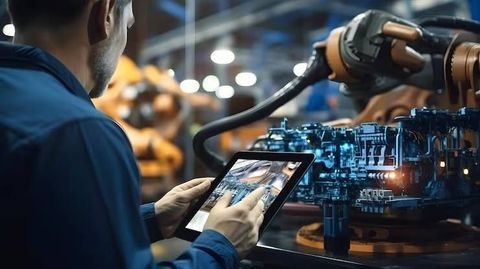
Digital machine tools increasingly use sensors and software to collect information about machine condition, process behavior, and production status. This can support monitoring and process analysis when the necessary data infrastructure is available.
What to consider
Evaluating industrial machine tools involves several factors:
- Material: hardness, thickness, strength, and machinability influence process selection.
- Part geometry: cylindrical, flat, contoured, or complex shapes may require different machines.
- Accuracy requirements: tighter dimensional requirements can affect machine configuration, tooling, and measurement methods.
- Production volume: repeated production may support the use of CNC automation or integrated handling.
- Work envelope: the machine must accommodate the size and weight of the workpiece.
- Tooling: cutters, drills, abrasive wheels, fixtures, and holders affect the process.
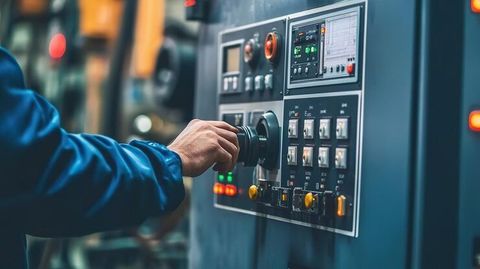
- Control system: CNC capability, programming options, sensors, and data connectivity may influence operation.
- Safety: guarding, emergency controls, interlocks, and operating procedures are important.
- Inspection: measuring equipment is needed to verify dimensions and process results.
- Energy and space: electrical requirements, floor area, ventilation, and supporting equipment should be considered.
Recent Updates
CNC, automation and digital manufacturing
From 2024 through 2026, the general direction of industrial machine tools in India has continued toward CNC equipment, automation, robotics, digital monitoring, and advanced manufacturing. Government and industry discussions have placed additional attention on domestic capabilities in CNC machine tools, controllers, testing and metrology, robotics, and additive manufacturing.
India's Ministry of Heavy Industries reported machine-tool production of about ₹14,286 crore in 2024–25, compared with ₹13,571 crore in 2023–24. These figures indicate continued activity in domestic machine-tool manufacturing.
Smart manufacturing
Industry 4.0 concepts are increasingly connected with machine tools. Examples include industrial sensors, machine monitoring, digital twins, robotics, automated tool handling, and data-based process analysis. A 2025 NITI Aayog manufacturing roadmap identified artificial intelligence, advanced materials, digital twins, and robotics as important technologies for advanced manufacturing.
Laws or Policies
Indian standards and machinery safety
In India, machine-tool requirements can involve Indian Standards and government notifications depending on the machine category. BIS states that certification is generally voluntary, but certification becomes compulsory for products covered by government Quality Control Orders.
For certain machinery, BIS Scheme X includes certification requirements, and the listed categories include metal cutting machine tools. BIS also provides product-specific guidance for metal cutting machines and related machinery.
Safety standards cover areas such as turning machines, machining centers, milling machines, electrical discharge machines, and other machine-tool categories. Manufacturers and users should identify the standards and regulatory requirements applicable to the specific equipment and operating environment.
Manufacturing policy
India's capital-goods policies have emphasized technology upgrading, skill development, modern manufacturing capacity, and domestic industrial capability. The Ministry of Heavy Industries identifies machine tools as a core part of the capital-goods sector because they supply equipment used across manufacturing.
Tools and Resources
Standards and technical references
The BIS Know Your Standard portal allows users to search Indian Standards by standard number or keyword and access related documents, amendments, notifications, testing information, and other standard details.
Manufacturing and calculation tools
Common resources used with machine tools include:
- Machining calculators for spindle speed, feed rate, and cutting parameters.
- Tool catalogs and technical datasheets for compatible tooling information.
- CNC programming references for codes, coordinate systems, and machine functions.
- Measurement guides covering calipers, micrometers, gauges, and coordinate measuring systems.
- CAD/CAM software for creating part geometry and generating CNC toolpaths.
- Technical institutions such as CMTI for information related to manufacturing technology, testing, and metrology.
The appropriate resource depends on the machine type, material, process, and required level of accuracy.
FAQs
What are industrial machine tools?
Industrial machine tools are machines used to cut, shape, form, drill, grind, or otherwise process rigid materials. Common examples include lathes, milling machines, grinders, presses, machining centers, and EDM equipment.
What are the main types of industrial machine tools?
The main types include turning machines, milling machines, drilling machines, grinding machines, presses, machining centers, and electrical discharge machines. Each type is designed around particular material-removal or forming processes.
How does CNC work in machine tools?
CNC uses programmed instructions to control machine movements and functions. A CNC machine can coordinate axes, spindle operation, tool changes, and other functions according to the programmed process.
What should be considered when selecting machine tools?
Important considerations include material, part size and geometry, required accuracy, production volume, tooling, control capability, safety features, inspection methods, energy requirements, and available workspace.
Are machine tools covered by Indian standards?
Some machine-tool categories are covered by Indian Standards and related regulatory requirements. Depending on the category, government Quality Control Orders may make BIS conformity requirements applicable. The specific machine and its classification should be checked against current BIS information.
Conclusion
Industrial machine tools provide controlled methods for cutting, forming, drilling, grinding, and shaping materials used in manufactured products. Their development has moved from manual equipment toward CNC, automation, robotics, sensors, and connected manufacturing systems. In India, standards and government policies provide a framework for safety, conformity, and industrial development. Understanding machine types, functions, applications, operating factors, and applicable standards helps explain how these systems fit into modern manufacturing.