Industrial Robotics Manufacturing Systems Information With Robotic Production and Engineering Insights
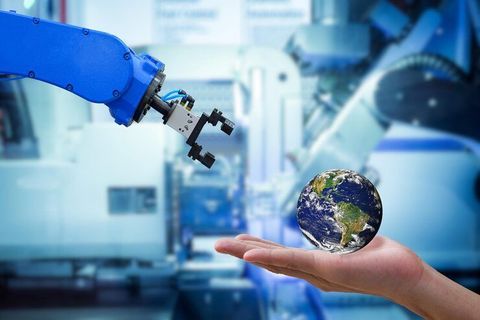
Industrial robotics manufacturing systems combine programmable robots, automated machinery, sensors, control software, and production equipment to perform manufacturing tasks.
These systems are used in industries such as automotive production, electronics assembly, metal fabrication, food processing, packaging, and pharmaceutical equipment manufacturing.
Industrial robotics developed from the need to improve the consistency, speed, and repeatability of factory operations. Traditional manufacturing relied heavily on manual handling and mechanical equipment, while modern production environments increasingly combine human expertise with programmable robotic technology.
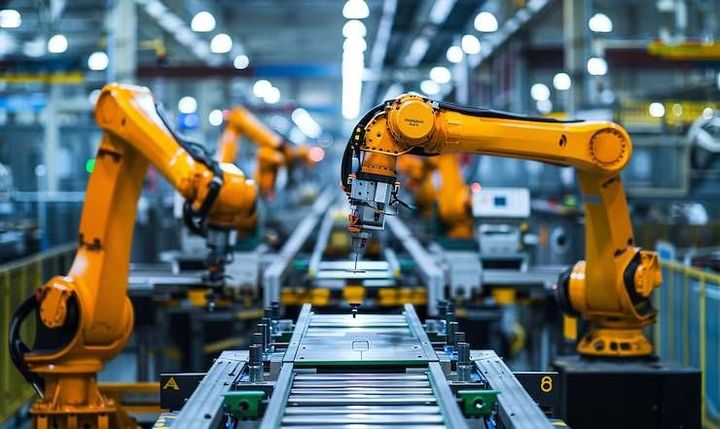
A typical robotic manufacturing system includes a robotic arm, an end effector, a controller, sensors, safety equipment, and supporting machinery. Depending on the application, the robot may weld metal components, move materials, assemble products, apply coatings, inspect parts, or transfer finished items between production stages.
Main Components of Robotic Production Systems
Each component performs a specific function within the manufacturing process. Their coordination determines how accurately and safely a production line operates.
Industrial robots: Programmable machines that perform repetitive or precisely controlled movements.
End effectors: Grippers, welding tools, suction devices, and other attachments that interact with materials.
Sensors and vision systems: Equipment that detects object positions, dimensions, surface conditions, and other process information.
Robot controllers: Units that execute movement instructions and coordinate robotic operations.
Programmable logic controllers: Systems that manage equipment sequences, conveyor operations, and communication between machines.
Safety systems: Guards, interlocks, scanners, and other protective devices that reduce exposure to hazards.
Industrial robotics manufacturing systems may operate as individual workstations or as connected production cells. A production cell generally combines equipment, software, and safety measures to complete one or more manufacturing operations.
Common Types of Industrial Robots
Different robot designs support different movement patterns, payload requirements, and levels of precision.
Robot type | Main characteristics | Typical applications |
|---|---|---|
Articulated robot | Multiple rotating joints | Welding, painting, assembly |
SCARA robot | Fast horizontal-plane movement | Small-part assembly |
Cartesian robot | Linear movement along defined axes | Machine tending, material handling |
Delta robot | Lightweight parallel-arm structure | Sorting and high-speed picking |
Collaborative robot | Designed for specified human-interaction applications | Assembly, inspection, handling |
Autonomous mobile robot | Moves materials through a facility | Internal material transportation |
The correct configuration depends on the workpiece, production volume, operating environment, required accuracy, and available floor space.
Importance
Why Robotic Manufacturing Matters
Industrial robotics manufacturing systems help manufacturers address challenges associated with repetitive work, inconsistent processes, material handling, and production scheduling. Robots can repeat programmed movements across many production cycles, helping maintain consistent operations when equipment is properly configured and maintained.
Automation also supports tasks that involve heavy components, hot surfaces, hazardous materials, or awkward working positions. By assigning suitable tasks to machines, manufacturers can reduce some forms of direct worker exposure while allowing employees to focus on supervision, setup, inspection, troubleshooting, and process improvement.
However, automation does not eliminate every production challenge. Equipment failures, incorrect programming, sensor errors, unsuitable tooling, and poorly designed workflows can interrupt operations or create quality problems.
Applications Across Manufacturing Industries
Robotic production technology is used in a wide range of industrial environments.
Automotive manufacturing: Robots perform body welding, adhesive application, painting, component handling, and selected assembly operations. Coordinated robotic cells help manage complex production sequences.
Electronics manufacturing: Compact robots handle circuit boards, small components, inspection tasks, and precision assembly. Careful control of movement and electrostatic conditions may be necessary for sensitive electronic products.
Metal fabrication: Robotic systems support cutting, welding, grinding, and material positioning. Their performance depends on fixture design, tool condition, component variation, and process parameters.
Food and packaging: Robots can pick, sort, pack, palletize, and transfer products. Equipment design must account for hygiene, cleaning procedures, and contact requirements.
Warehousing and industrial logistics: Robotic handling systems move materials between storage, production, and dispatch areas. Integration with inventory software helps coordinate material availability.
Comparing Manual and Robotic Production
Factor | Manual production | Robotic production |
|---|---|---|
Repetitive movement | Depends on worker consistency | Follows programmed motion |
Task changes | Often requires retraining | May require reprogramming and tooling changes |
Initial setup | Often simpler for small tasks | Requires system design and integration |
Operating oversight | Direct human execution | Monitoring and technical supervision |
Production flexibility | Depends on worker skills and process | Depends on robot design and programming |
Safety considerations | Human exposure to task hazards | Machine hazards require engineered protection |
Neither approach is appropriate for every situation. Some production lines use fully automated cells, while others combine robotic equipment with manual inspection and specialized assembly work.
Productivity, Quality, and Workforce Skills
Robotic systems can support stable production rates and repeatable processes, particularly when tasks are clearly defined. Their contribution to product quality depends on the complete manufacturing process, including incoming materials, calibration, fixtures, inspection methods, and maintenance.
The expansion of robotics also increases the importance of technical skills. Employees may need knowledge of robot programming, electrical systems, mechanical troubleshooting, industrial networks, and production data analysis.
Recent Updates
Artificial Intelligence and Machine Vision
Recent developments in industrial robotics have increased interest in machine vision, artificial intelligence, and adaptive automation. Traditional robotic systems often rely on predefined movements, whereas vision-guided systems can use cameras and image-processing software to identify objects and adjust selected actions.
AI-assisted inspection can help identify surface defects, unusual patterns, or variations in component appearance. Its reliability depends on training data, lighting, camera placement, product variation, and validation procedures.
These technologies do not make every robotic process autonomous. Many applications still require structured environments, carefully defined operating limits, and human review of uncertain results.
Connected Factories and Predictive Maintenance
Industrial robotics is increasingly connected with manufacturing execution systems, industrial networks, and production monitoring platforms. These connections allow equipment status, cycle information, alarms, and production data to be collected in a central system.
Predictive maintenance uses equipment measurements and historical operating data to identify possible signs of deterioration. Depending on the available data, maintenance teams may monitor motor temperatures, vibration, operating cycles, or error patterns.
Flexible and Collaborative Automation
Manufacturers are also examining smaller robotic cells, collaborative robots, and reconfigurable production equipment. These systems can be useful where product designs change frequently or several tasks must share limited floor space.
Collaborative robot applications still require risk assessment. A robot described as collaborative is not automatically safe for every interaction, tool, workpiece, speed, or surrounding environment.
Laws or Policies
Industrial Robot Safety Requirements
Industrial robotics manufacturing systems must be designed and operated with appropriate attention to machinery safety, electrical hazards, moving equipment, and workplace conditions. Applicable requirements depend on the country, industry, equipment configuration, and intended use.
International standards such as ISO 10218 address industrial robot safety, while ISO/TS 15066 provides additional guidance relevant to collaborative robot applications. These standards help inform system design and risk assessment, but their legal status and applicability vary by jurisdiction.
Common safety measures include:
Physical guarding around hazardous movements
Interlocked access doors
Emergency-stop controls
Safety-rated sensors where appropriate
Defined operating and maintenance procedures
Training for operators and technical personnel
Documented risk assessments and inspections
Electrical and Machine Integration
Robotic production cells combine electrical controls, mechanical equipment, software, and sometimes pneumatic or hydraulic systems. Their integration must account for electrical protection, unexpected movement, stored energy, and safe access during maintenance.
IEC 60204-1 addresses electrical equipment of machines, including relevant control and protection considerations. Manufacturers and system integrators must determine which standards and local requirements apply to their specific installation.
Worker Training and Operational Responsibilities
Organizations using industrial robots need procedures that explain authorized access, equipment startup, fault recovery, and maintenance activities. Lockout and energy-isolation procedures are particularly important when personnel enter hazardous areas or work on machinery.
Safety responsibilities extend beyond the robot itself. Conveyors, fixtures, tools, nearby machines, and the overall production layout can introduce additional risks that must be considered together.
Tools and Resources
Robot Simulation and Programming Software
Robot simulation software helps engineers plan movements, test workstation layouts, and identify potential collisions before equipment is commissioned. Depending on the platform, simulations may also estimate cycle times, reach, and production-cell utilization.
Offline programming tools allow selected robot programs to be prepared or reviewed away from the production floor. Simulation results should still be validated against actual equipment because real-world tolerances, payloads, tool behavior, and communication delays can affect performance.
Manufacturing Data and Maintenance Platforms
Manufacturing monitoring platforms collect operating information from robots, controllers, sensors, and production equipment. Engineers can use these records to investigate interruptions, compare production cycles, and identify recurring faults.
Useful information sources include:
Robot controller diagnostic records
Equipment maintenance logs
Production quality reports
Sensor and machine-vision data
Energy monitoring systems
Manufacturing execution software
Industrial automation documentation
Planning and Evaluation Tools
A robotic manufacturing feasibility assessment usually considers the entire production process rather than the robot alone. Engineers may evaluate expected output, staffing requirements, integration work, tooling, maintenance, downtime, and product changeovers.
A basic evaluation table can organize the main considerations.
Evaluation factor | Question to examine |
|---|---|
Production volume | How many units must be processed per shift? |
Cycle time | Can the system meet the required production sequence? |
Payload and reach | Can the robot handle the workpiece and tool safely? |
Accuracy | What positioning and inspection tolerances are required? |
Integration | Can the robot communicate with existing equipment? |
Maintenance | Are spare parts, diagnostics, and trained personnel available? |
Safety | Have all relevant hazards been assessed and controlled? |
This approach helps distinguish a technically possible installation from a system that fits the wider manufacturing operation.
FAQs
What are industrial robotics manufacturing systems?
Industrial robotics manufacturing systems combine programmable robots, controllers, sensors, tools, and supporting machinery to automate manufacturing activities such as welding, assembly, inspection, and material handling.
How does robotic production improve manufacturing processes?
Robotic production can improve repeatability, maintain consistent movement patterns, and support continuous or scheduled operations. Results depend on system design, maintenance, programming, material quality, and production conditions.
What types of robots are used in industrial manufacturing?
Common types include articulated, SCARA, Cartesian, delta, collaborative, and autonomous mobile robots. Each design supports different movement patterns, payloads, workspace requirements, and industrial applications.
What safety standards apply to industrial robotics?
Relevant standards may include ISO 10218 for industrial robot safety, ISO/TS 15066 for collaborative applications, and IEC 60204-1 for electrical equipment of machines. Applicable legal requirements depend on the installation and jurisdiction.
What tools are used to design robotic manufacturing systems?
Engineers commonly use robot simulation software, offline programming tools, computer-aided design systems, machine-vision platforms, controller diagnostics, and manufacturing monitoring software to plan and evaluate robotic production.
Conclusion
Industrial robotics manufacturing systems combine mechanical equipment, control software, sensors, and safety measures to support a wide range of production activities. Developments in AI, machine vision, connected manufacturing, and flexible automation are expanding the ways robots can be integrated into industrial workflows. Effective implementation depends on process requirements, equipment compatibility, maintenance planning, workforce skills, and risk assessment. A complete engineering approach considers the robot as part of the wider manufacturing system rather than as an isolated machine.