Industrial Robotics Tools Guide: Designs, Functions, Applications, Features and Considerations
Industrial robotics tools are important parts of modern automated manufacturing systems. They include robotic arms, end-effectors, grippers, sensors, controllers, vision equipment, programming devices, and related safety equipment. Together, these tools allow industrial robots to handle materials, assemble components, weld, inspect products, package items, and perform other repeatable operations with controlled movements.
Context
What Are Industrial Robotics Tools?
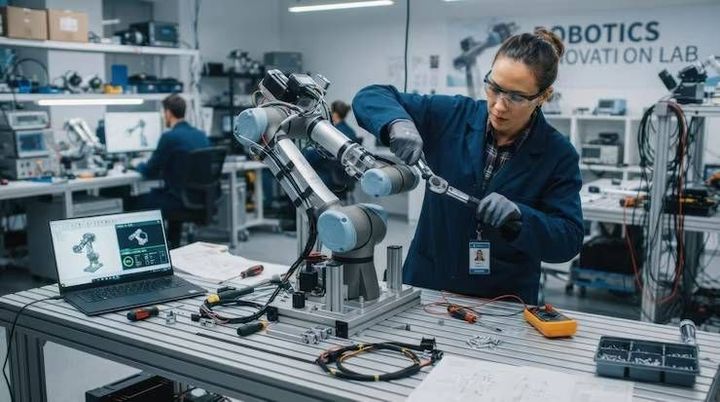
Industrial robotics tools are hardware and software components used to make robotic systems perform specific manufacturing tasks. An industrial robot generally consists of a mechanical structure, motors, controllers, sensors, and a programmable system. Additional tools are attached to the robot or integrated around it according to the application.
The most visible component is often the robotic arm. However, the arm alone cannot complete many manufacturing processes. An end-effector, such as a gripper or welding tool, interacts directly with the workpiece, while sensors and cameras help the system detect position, movement, or other process conditions.
How Industrial Robotics Developed
Industrial robotics developed from the need to automate repetitive and physically demanding manufacturing activities. Early systems were mainly designed for structured production environments where the position and movement of objects were predictable.
Modern systems can combine robotics with machine vision, digital control, artificial intelligence, data collection, and connected manufacturing equipment. This has expanded industrial robotics tools into applications involving variable parts, inspection, material handling, and flexible production.
Common Types of Robotics Tools
Industrial robotics tools can be grouped according to their function:
- Robotic arms: Move tools or materials through programmed paths.
- End-effectors: Grippers, suction devices, welding equipment, cutters, and other task-specific attachments.
- Sensors: Detect position, force, proximity, temperature, or other conditions.
- Vision systems: Cameras and image-processing equipment used for identification and inspection.
- Controllers: Coordinate robot movements and communicate with connected equipment.
- Safety equipment: Includes protective barriers, interlocks, scanners, emergency controls, and related devices.
- Programming tools: Teach pendants, software interfaces, simulation platforms, and programming environments used to configure robot movements.
Importance
Why Robotics Tools Matter in Manufacturing
Industrial robotics tools help factories manage repetitive movements, precise positioning, material handling, and other controlled activities. They can also be used in environments where repetitive lifting, heat, hazardous substances, sharp materials, or continuous motion may create additional workplace risks.
Their importance extends beyond large factories. Smaller production facilities can also use compact robotic systems for packaging, inspection, machine tending, assembly, and material movement when the process is suitable for automation.
Who Uses These Tools?
Automotive manufacturing is a major robotics application, but industrial robots are also used in electronics, metal processing, plastics, food production, logistics, pharmaceuticals, and general manufacturing.
The choice of robotics tools depends on factors such as:
- Type and weight of the workpiece
- Required movement range
- Desired positioning accuracy
- Production cycle requirements
- Available floor space
- Interaction with human workers
- Environmental conditions
- Integration with existing machinery
- Required inspection or sensing functions
Basic Tool Comparison
| Robotics Tool | Main Function | Common Application |
|---|---|---|
| Robotic arm | Controlled movement | Assembly and machine tending |
| Gripper | Holds objects | Material handling |
| Vacuum tool | Lifts suitable surfaces | Packaging and sheet handling |
| Welding tool | Performs welding operations | Metal fabrication |
| Vision camera | Detects and examines objects | Inspection and sorting |
| Force sensor | Measures applied force | Assembly and insertion |
| Safety scanner | Detects people or objects | Robot cell protection |
| Robot controller | Coordinates movements | Automated production |
Recent Updates
Artificial Intelligence and Vision
From 2024 onward, robotics development has increasingly focused on artificial intelligence, machine vision, data analysis, and more adaptable programming methods. The International Federation of Robotics identified analytical, physical, and generative AI as major robotics trends, including systems that can use sensor information and virtual environments to improve robotic operations.
Vision systems are also becoming more important because cameras can help robots identify parts, check positioning, detect defects, and respond to changes in a production environment. These capabilities can make robotic applications more flexible than systems that depend entirely on fixed positions.
Collaborative Robots and Mobile Systems
Collaborative robots, commonly called cobots, are designed for applications where people and robots may work within the same general area under appropriate safety conditions. Their use has expanded into assembly, material handling, inspection, and other activities. Mobile manipulators combine a mobile platform with a robotic arm, allowing movement between different areas of a facility.
Growth in Industrial Robot Deployment
Global industrial robot installations remained substantial through 2024, with 542,000 units installed worldwide according to the International Federation of Robotics. Asia accounted for 74% of new installations that year. The organization also reported that the worldwide operational stock reached about 4.66 million industrial robots in 2024.
The trend continued into 2025, with AI integration, energy efficiency, new application areas, and changing manufacturing requirements influencing industrial robotics development. In India, robotics adoption has also been expanding as manufacturers increase automation across several industrial sectors.
Safety Standards Are Evolving
Robot safety standards have also received attention during this period. In India, the Bureau of Indian Standards circulated revised drafts related to industrial robot safety based on the ISO 10218 series. The 2024 draft for Part 1 addressed industrial robot safety requirements, while another draft addressed robot applications and robot cells.
These developments reflect the need to consider both the robot itself and the complete work cell in which it operates.
Laws or Policies
Industrial Safety in India
In India, industrial robotics safety is influenced by workplace safety requirements, machinery standards, and applicable state and central regulations. The Occupational Safety, Health and Working Conditions Code, 2020 became effective along with the other four Labour Codes on November 21, 2025, according to the Ministry of Labour and Employment.
The framework addresses occupational safety, health, and working conditions. For robotic manufacturing areas, this makes appropriate risk assessment, safe operating procedures, worker protection, and workplace controls important considerations.
BIS Standards for Robotics
The Bureau of Indian Standards develops and maintains Indian Standards covering machinery and robotics. The revised Indian framework around IS/ISO 10218 addresses industrial robot safety, while the related Part 2 covers robot applications and robot cells.
Not every standard automatically means that a particular robot requires mandatory certification. BIS explains that certification is generally voluntary unless the government makes compliance compulsory for a particular product through an applicable regulatory order.
Manufacturers and facility operators therefore need to identify the standards and regulations applicable to their particular machinery, workplace, and application rather than assuming that one rule covers every robotic system.
Tools and Resources
Standards and Reference Platforms
The BIS “Know Your Standard” platform allows users to search Indian Standards by standard number or keyword. It can provide access to standard-related documents, amendments, testing information, and other details.
The International Federation of Robotics provides industry statistics, definitions, research material, and reports covering industrial robot installations and technology trends. These resources can help readers understand terminology and broad developments in robotics.
Simulation and Programming Tools
Robot simulation platforms allow engineers and operators to create virtual layouts, test movement sequences, and examine potential interference before physical deployment. Programming environments and teach pendants are commonly used to configure robot movements and process sequences.
Machine-vision software can support object recognition and inspection, while sensor-monitoring platforms can collect information about robot movement and equipment conditions. The exact tools required depend on the robot model, controller, production process, and integration architecture.
Safety Assessment Resources
Safety documentation should normally include operating procedures, risk assessments, emergency procedures, maintenance records, and training material. Safety scanners, interlocked guards, emergency-stop controls, and protective fencing may also be used depending on the design of the robot cell.
BIS maintains information about machinery safety standards and conformity assessment processes through its standards and certification platforms.
FAQs
What are industrial robotics tools?
Industrial robotics tools are components used with industrial robots to perform specific manufacturing tasks. They include robotic arms, grippers, sensors, cameras, controllers, programming systems, and safety equipment.
What tools are commonly used with industrial robotic arms?
Common tools include mechanical grippers, vacuum grippers, welding equipment, cutting tools, force sensors, cameras, and automatic tool changers. The appropriate tool depends on the material, task, movement, and required level of control.
How do industrial robotics tools improve manufacturing?
They can support repetitive movement, material handling, assembly, inspection, and other controlled processes. Their usefulness depends on appropriate system design, programming, workplace conditions, and integration with other equipment.
Are industrial robotics tools covered by safety standards in India?
Yes. Industrial robot safety is addressed through relevant Indian Standards, including standards aligned with the ISO 10218 series. Workplace safety is also shaped by India's occupational safety framework.
What should be considered when selecting industrial robotics tools?
Important considerations include payload, reach, accuracy, cycle requirements, workpiece characteristics, environmental conditions, safety arrangements, controller compatibility, integration requirements, and available workspace.
Conclusion
Industrial robotics tools include much more than robotic arms, covering end-effectors, sensors, vision systems, controllers, programming equipment, and safety components. Recent developments have brought greater attention to AI, machine vision, collaborative robotics, mobile systems, and updated safety standards. In India, workplace regulations and BIS standards provide important context for robotic manufacturing environments. Understanding the design, function, application, and safety requirements of each tool helps explain how modern robotic systems are structured.