Industrial Welding Robots: Explore Next-Generation Welding Technology
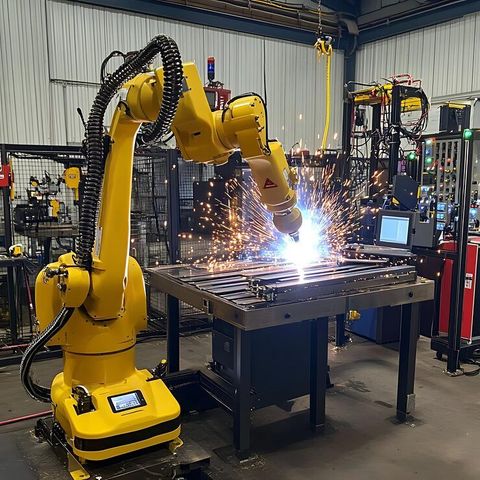
Industrial welding robots are programmable robotic systems designed to perform welding operations with controlled and repeatable movements. They are commonly used with arc welding processes such as MIG, MAG, TIG, spot welding, and other automated joining methods.
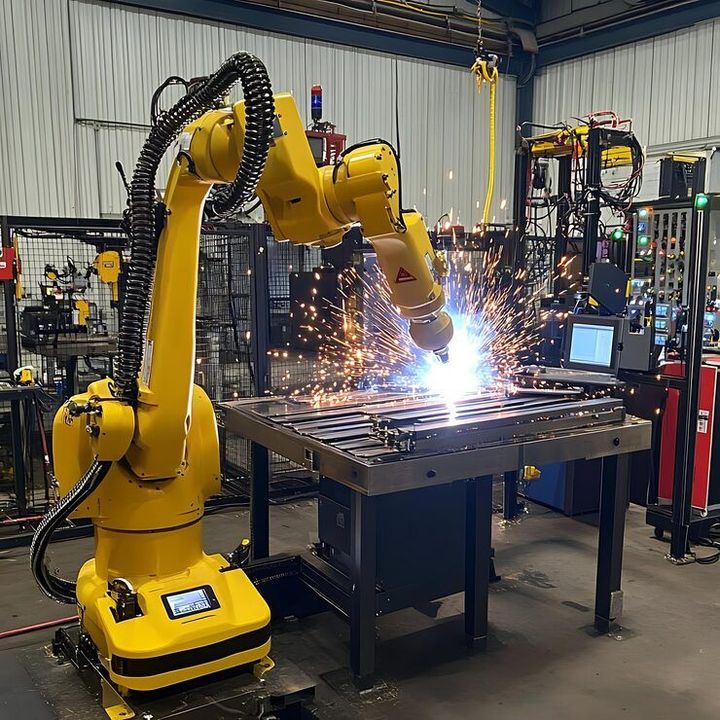
A typical robotic welding cell combines an industrial robot, welding power source, torch, wire-feeding equipment, fixtures, sensors, safety devices, and control software. Together, these components create a coordinated production environment.
The main purpose of welding automation is to perform repetitive welding movements with consistent positioning and controlled process parameters. This can be especially useful when manufacturers need repeatable weld paths across large numbers of similar components.
Robotic welding technology has developed from basic programmed movements into more connected industrial automation systems. Modern systems can integrate sensors, vision technologies, digital monitoring, automatic parameter adjustment, and production data collection.
How Robotic Welding Systems Work
A robotic welding process usually begins with a digital program that defines the robot's movement, welding position, speed, and sequence. The workpiece is positioned using a fixture so that the robot can reach the required welding points.
The main stages generally include:
- Loading and positioning the workpiece
- Securing the component in a fixture
- Moving the welding torch to the programmed position
- Starting the welding process
- Following the programmed weld path
- Monitoring selected process parameters
- Completing the weld sequence
- Inspecting the finished joint
Sensors can provide additional information about joint position, torch location, or process conditions. In advanced robotic welding cells, machine vision and other sensing technologies can support positioning and inspection tasks.
Why Industrial Welding Robots Matter
Industrial welding robots are important because welding often involves repetitive movements, controlled positioning, heat, fumes, bright arcs, and physically demanding work areas. Automation can help move some repetitive operations into controlled robotic cells while people focus on programming, inspection, maintenance, process planning, and system supervision.
Robotic welding can also support manufacturing consistency. Once a suitable process has been developed and validated, a robot can repeat programmed movements with high positional repeatability.
The technology is used in industries such as:
- Automotive manufacturing
- Heavy equipment production
- Metal fabrication
- Agricultural machinery
- Construction equipment
- Industrial machinery
- Transportation equipment
- Energy-related equipment
- Structural metal manufacturing
The benefits depend on the application, component design, welding process, material, fixture quality, programming, and production environment. Automation does not automatically guarantee better weld quality; the complete process still requires appropriate engineering and inspection.
Key Components of a Robotic Welding Cell
| Component | Main Function |
|---|---|
| Industrial robot | Moves the welding tool along programmed paths |
| Welding power source | Generates the electrical welding process |
| Welding torch | Directs the welding arc toward the joint |
| Wire feeder | Controls welding wire delivery where applicable |
| Fixture | Holds and positions the workpiece |
| Sensors | Detect position or process information |
| Controller | Coordinates robot movement and system functions |
| Safety equipment | Helps control access and hazardous movement |
| Programming software | Defines robot paths and process sequences |
| Inspection equipment | Helps evaluate weld quality and consistency |
Recent Developments in Welding Automation
Industrial welding technology has continued to move toward smarter and more connected manufacturing systems.
One significant development occurred in February 2025, when ISO published ISO 10218-1:2025, covering safety requirements for industrial robots. ISO also published ISO 10218-2:2025, which focuses on industrial robot applications and robot cells, including integration, commissioning, operation, maintenance, and decommissioning. These updated standards are important developments for modern industrial robot design and integration.
Current technology trends include:
- AI-assisted weld inspection
- Machine vision for component positioning
- Sensor-based weld tracking
- Digital production monitoring
- Offline robot programming
- Simulation of robotic welding cells
- Improved human-machine interfaces
- Connected industrial automation systems
- Data-driven maintenance planning
- More flexible robotic cells for varied production
Another important direction is the development of systems that can adapt to variations in components and welding conditions. Instead of relying entirely on fixed programming, sensors can provide additional information that helps the control system respond to changes.
These technologies are particularly relevant when manufacturers need greater flexibility while maintaining consistent production processes.
Laws, Standards, and Safety Policies
Robotic welding involves several safety considerations because a welding cell can contain moving machinery, electrical hazards, heat, welding radiation, fumes, compressed gases, and other risks.
Requirements vary by country and application, so manufacturers should identify the regulations and recognized standards applicable to their location.
In the United States, OSHA does not have one dedicated regulation covering the entire robotics industry. Instead, several workplace safety requirements can apply to robotic systems, including machinery guarding, personal protective equipment, hazardous-energy control, noise exposure, and other workplace hazards. OSHA also references recognized robotics standards for safety evaluation.
For robotic welding, AWS D16.1M/D16.1 is an industry safety specification addressing hazards associated with operating, integrating, maintaining, and setting up arc-welding robot systems.
The European Union is also moving toward updated machinery requirements. Regulation (EU) 2023/1230 is scheduled to apply from 20 January 2027, creating an important regulatory milestone for machinery placed on the EU market. Manufacturers and integrators working with European markets should review the applicable requirements and transition arrangements.
A proper risk assessment should consider the complete robotic welding cell rather than the robot alone. Safeguarding, emergency stops, access control, electrical protection, welding-fume controls, training, maintenance procedures, and hazardous-energy isolation can all be relevant.
Tools and Resources for Robotic Welding
Several categories of tools can help engineers, operators, and students understand or plan robotic welding systems.
Useful resources include:
- Robot simulation software for offline programming
- Welding parameter calculators
- Weld-size and joint-design references
- Production monitoring dashboards
- Digital maintenance checklists
- Risk-assessment templates
- Welding inspection worksheets
- Robot programming training materials
- CAD-to-robot programming tools
- Welding procedure documentation templates
Simulation tools can help visualize robot reach, torch orientation, movement paths, fixture placement, and potential interference before physical production begins.
Welding calculators can also assist with technical estimates involving parameters such as travel speed, heat input, material thickness, and joint configuration. However, calculated values should be reviewed against the applicable welding procedure and engineering requirements.
Industrial Welding Robots and High-Value Automation Trends
Robotic welding is part of a wider industrial automation ecosystem. Related technologies include industrial robot programming, machine vision, PLC automation, manufacturing execution systems, predictive maintenance, digital twins, and industrial IoT.
These areas are increasingly connected. For example, a robotic welding cell may send production information to a monitoring platform, while sensors provide process information for analysis.
AI is also becoming more relevant to industrial inspection and process analysis. However, AI-based systems should be evaluated according to their specific application rather than being treated as automatic replacements for engineering controls or human inspection.
The future direction of welding automation is likely to involve greater connectivity, improved sensing, more flexible programming, and better integration with broader smart manufacturing systems.
Frequently Asked Questions
What are industrial welding robots?
Industrial welding robots are programmable robotic machines designed to perform welding operations along defined paths. They are normally integrated with welding equipment, fixtures, controllers, sensors, and safety systems.
What types of welding can robots perform?
Depending on the equipment and application, robotic systems can perform processes such as MIG, MAG, TIG, spot welding, and other automated welding methods. The appropriate process depends on material, joint design, thickness, and production requirements.
Are robotic welding systems safe?
Robotic welding systems can be designed with multiple safety controls, but they still contain hazards. Risk assessment, guarding, access control, emergency stopping, hazardous-energy procedures, welding protection, and appropriate training are important parts of a safe system.
Can AI be used with welding robots?
Yes. AI and machine-learning technologies can be used in areas such as visual inspection, defect detection, process monitoring, and data analysis. Their effectiveness depends on the quality of the data, system design, and application.
What is the role of ISO 10218 in robotic welding?
ISO 10218 provides safety requirements for industrial robots and robotic applications. The 2025 editions address industrial robots and complete robot applications or cells, making them relevant to modern robotic system design and integration.
Conclusion
Industrial welding robots are an important part of modern manufacturing automation. They combine robotic movement, welding technology, sensors, fixtures, control systems, and safety equipment to perform repeatable welding operations.