Metal Cutting Band Saws Explanation: Components, Blade Movement, Cutting Process and Uses
Metal cutting band saws are machine tools designed to cut metal stock into sections, shapes, or required lengths. Unlike a circular saw, which uses a rotating disc, a band saw uses a continuous metal blade that moves around two or more wheels. This continuous blade movement allows the machine to make controlled cuts through materials such as steel, stainless steel, aluminum, brass, and other engineering metals.
The basic idea behind the metal cutting band saw comes from the development of continuous-loop saw blades and mechanical cutting machines during the industrial era. As metalworking developed, manufacturers needed equipment that could divide bars, pipes, tubes, structural sections, and other workpieces with controlled cutting action.
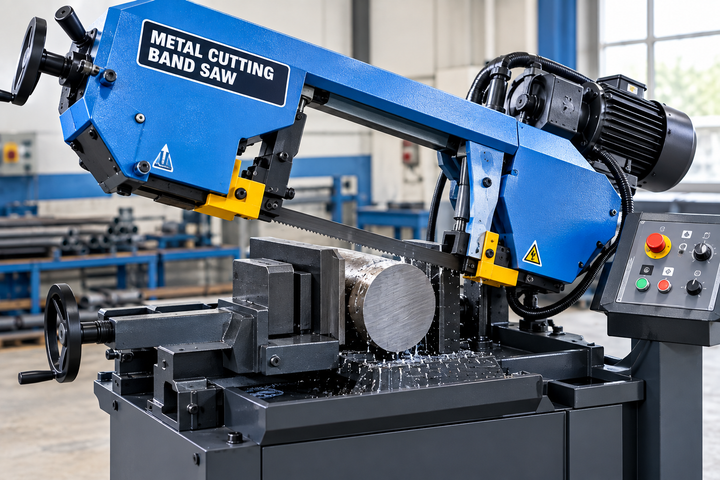
A modern metal cutting band saw normally combines a frame, blade wheels, drive motor, blade guides, work table or vise, tension mechanism, and control system. Depending on the machine design, it may operate horizontally or vertically, with manual, semi-automatic, or automated controls.
The blade travels continuously around the wheels while the workpiece remains supported. The teeth gradually remove material as the blade passes through the workpiece. Blade speed, tooth arrangement, feed pressure, material type, and workpiece dimensions all influence how the cutting process behaves.
Importance
Metal cutting band saws are important in manufacturing, fabrication, construction, maintenance, metal processing, and engineering environments because many metal components begin as longer sections that need to be divided into manageable pieces. Cutting accuracy can affect later operations such as drilling, machining, welding, bending, and assembly.
The machine also addresses a practical challenge: different metals have different hardness levels, thicknesses, shapes, and cutting characteristics. A band saw can be configured with different blade materials, tooth patterns, speeds, and cutting conditions to handle a range of workpieces.
Common materials and workpieces
Metal cutting band saws can be used with many forms of metal stock, including:
- Round bars and square bars
- Pipes and tubes
- Angle sections and channels
- Structural sections
- Aluminum profiles
- Stainless steel sections
- Steel plates and blocks
- Engineering alloys
The suitability of a particular blade and machine depends on the material and dimensions. Harder materials generally require appropriate tooth geometry and controlled cutting conditions, while thin sections require blade arrangements that reduce the possibility of tooth damage.
Main components of a metal cutting band saw
The machine contains several components that work together during cutting.
| Component | Main function |
|---|---|
| Blade | Removes material from the workpiece |
| Drive wheel | Transfers motion to the continuous blade |
| Idler wheel | Supports the blade loop and maintains movement |
| Blade guides | Keep the blade aligned during cutting |
| Blade tension system | Maintains appropriate blade tension |
| Vise or workholding system | Holds the workpiece in position |
| Motor | Provides rotational power |
| Feed mechanism | Controls movement of the blade or cutting head |
| Coolant system | Helps manage heat and remove cutting debris |
| Control panel | Allows operating parameters to be adjusted |
The frame provides structural support for these components. Guards are also used around moving parts to reduce exposure to mechanical hazards.
Recent Updates
From 2024 through 2026, developments in metal cutting band saws have generally focused on automation, improved process control, blade technology, monitoring, and workplace safety rather than a complete change in the fundamental cutting principle.
Automation and process control
Many newer industrial machines incorporate programmable controls for blade speed, feed movement, cutting cycles, and workpiece handling. Semi-automatic and automated systems can reduce the amount of repeated manual adjustment required during multiple cutting cycles.
Some machines also use sensors to monitor conditions such as blade movement, machine position, or abnormal operating conditions. These features can help integrate band saws into broader manufacturing workflows.
Blade technology
Modern metal cutting band saw blades are available in several constructions, including carbon steel, bi-metal, and carbide-tipped designs. Tooth pitch and tooth geometry can be selected according to material thickness and type.
BIS has also continued work around Indian Standards for metal-cutting band saw blades. A draft revision concerning characteristics and dimensions of metal-cutting band saw blades was published during this period, while a 2025 BIS circular discussed an application concerning IS 5030 (Part 2):2016.
Greater attention to machine safety
Safety requirements and conformity assessment have received increased attention in India's machinery sector. BIS published machine-category-specific guidance for metal cutting machines under its Scheme-X framework, covering areas such as technical documentation, marking, grouping, and certification scope. The BIS page containing product-specific machinery guidance was updated in 2026.
Laws or Policies
In India, metal cutting equipment can be affected by Indian Standards, machinery safety requirements, and occupational safety rules. The exact requirements depend on the machine category, workplace, installation, and applicable regulations.
BIS standards and machinery safety
The Bureau of Indian Standards maintains standards and certification frameworks related to machine safety. BIS identifies safety of machinery standards covering subjects such as risk assessment, electrical equipment of machines, and protective devices.
BIS also provides a "Know Your Standard" platform where users can search Indian Standards by IS number or product keyword and review associated documents, amendments, notifications, testing information, and related details.
India's machinery safety framework has undergone changes during 2024–2026. BIS records amendments to the Machinery and Electrical Equipment Safety framework and lists a 2026 rescission of the 2024 Omnibus Technical Regulation Order. Because requirements can change, the applicable notification and current BIS guidance should be checked for a particular machine or installation.
Workplace safety
Workplace safety is also addressed through India's occupational safety framework. The Occupational Safety, Health and Working Conditions Code, 2020 contains provisions concerning occupational safety and health and provides a framework for rules and standards. The Ministry of Labour and Employment has also published draft rules and related material as implementation has developed.
For a metal cutting band saw, practical safety considerations include guarding moving parts, keeping the blade properly enclosed where required, securing the workpiece, using suitable personal protective equipment, and following the machine manufacturer's operating instructions. Historical Indian factory safety rules also contain specific guarding provisions for band saws, illustrating the longstanding importance of protecting blades, pulleys, and other moving components.
These general points do not replace applicable workplace regulations, machine documentation, risk assessments, or professional safety guidance.
Tools and Resources
Several resources can help readers understand metal cutting band saws and their operating requirements.
Blade selection references
Blade manufacturers and technical publications commonly provide tooth-pitch charts, material compatibility tables, blade-speed references, and cutting-condition guides. These resources can help explain why a particular tooth arrangement is used for a specific material thickness.
BIS standards database
The BIS "Know Your Standard" platform allows users to search Indian Standards by product name or IS number. It can be useful when researching standards related to metal cutting machines, machine safety, or band saw blades.
Machine manuals
The operating manual supplied with a particular band saw is an important technical reference. It normally contains information about blade installation, tension, recommended operating procedures, controls, maintenance intervals, guarding, and permitted workpiece dimensions.
Cutting calculators and reference tables
Online cutting calculators and technical tables may provide estimates for blade speed, tooth pitch, cutting time, or material compatibility. Results should be treated as reference information because actual cutting conditions depend on the machine, blade, material, workholding arrangement, and operating setup.
Basic inspection checklist
A simple inspection routine can include:
- Checking that the blade is correctly installed
- Inspecting blade teeth for visible damage
- Confirming that guards are positioned correctly
- Checking that the workpiece is securely held
- Inspecting coolant or lubrication arrangements where applicable
- Checking that emergency controls are accessible
- Removing accumulated metal chips using an appropriate method
FAQs
What is a metal cutting band saw?
A metal cutting band saw is a machine tool that uses a continuous toothed blade moving around wheels to cut metal workpieces. It is commonly used for cutting bars, pipes, tubes, structural sections, and other metal stock.
How does blade movement work in a metal cutting band saw?
The blade forms a continuous loop around the machine's wheels. A powered wheel moves the blade while guide assemblies maintain its position as the teeth pass through the workpiece.
What components are found in a metal cutting band saw?
Common components include the blade, drive and idler wheels, blade guides, tension system, motor, workholding vise, feed mechanism, frame, guards, controls, and, on many machines, a coolant system.
What affects the metal cutting band saw cutting process?
Blade speed, feed pressure, tooth pitch, blade material, workpiece dimensions, metal type, and workholding can all affect the cutting process. Incorrect settings can contribute to excessive heat, premature blade wear, vibration, or an uneven cut.
Where are metal cutting band saws used?
They are used in fabrication, manufacturing, construction-related metalwork, maintenance, engineering, structural preparation, and metal processing. Typical applications include cutting bars, tubes, pipes, profiles, and other metal sections into specified lengths.
Conclusion
Metal cutting band saws use a continuous toothed blade to divide metal workpieces through controlled blade movement and material removal. Their main components include the blade, wheels, guides, tension system, workholding mechanism, motor, controls, and protective guards. Developments during 2024–2026 have included greater automation, process monitoring, blade development, and continued attention to machine safety and standards. In India, BIS standards and occupational safety requirements provide important references for understanding the safe design, operation, and conformity of machinery.