Sheet Metal Bending Machines Guide: Designs, Working Principles, Materials and Key Features
Sheet metal bending machines are industrial machines used to shape flat metal sheets into angles, channels, boxes, panels, brackets, and other formed components. A typical sheet metal bending machine applies controlled force to a metal sheet between or around forming tools so that the material changes shape without being completely cut.
The basic idea of bending metal is centuries old, but modern machinery developed alongside industrial manufacturing. Early bending processes depended heavily on manual tools and mechanical force. As manufacturing became more precise, hydraulic, mechanical, electrical, and computer-controlled systems were developed to handle different sheet thicknesses and production requirements.
Today, the term sheet metal bending machine covers several designs. Press brakes are widely used for straight-line bends, while folding machines, panel benders, and specialized forming equipment are used for particular shapes. Computer numerical control (CNC) systems can control movement, positioning, bending sequences, and other parameters.
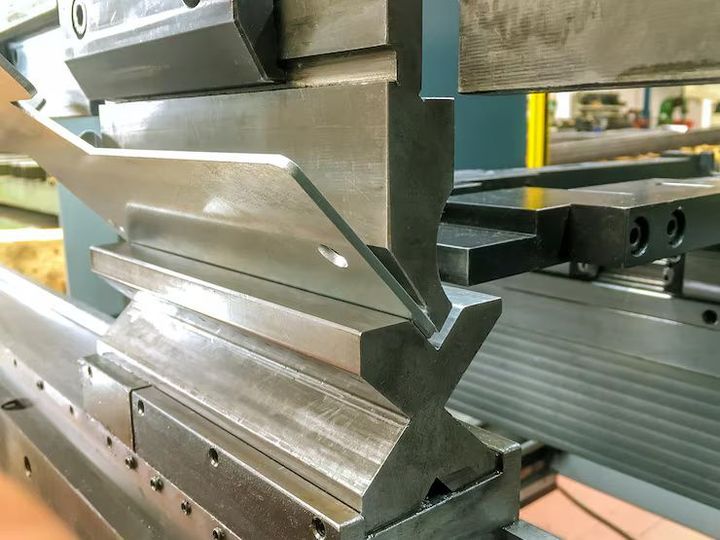
A sheet metal bending machine generally consists of a frame, working table, bending beam or ram, punch and die or other forming tools, backgauge system, drive mechanism, and control system. The exact arrangement depends on the machine design.
Basic working principle
The bending process begins with positioning the sheet against a reference point or backgauge. The machine then moves a forming tool with controlled force. The sheet deforms around the tool, creating the required angle.
Several factors affect the result, including:
- Sheet thickness
- Material type
- Material strength
- Bend angle
- Bend radius
- Tool geometry
- Bending force
- Grain direction
- Backgauge position
- Springback
Springback occurs when a metal sheet partially returns toward its original shape after pressure is released. CNC systems and angle-measuring technologies can help account for this effect during production.
Importance
Sheet metal bending is important because many everyday products contain formed metal components. Enclosures, electrical cabinets, vehicle parts, construction components, furniture frames, heating equipment, industrial panels, and machinery structures may involve one or more bending operations.
The process also affects dimensional accuracy. A small difference in bend angle or position can change how several components fit together during later assembly. Consistent bending is therefore relevant to manufacturers that work with repeated shapes or components with multiple bends.
Problems addressed by bending machines
Without controlled bending equipment, producing repeated angles in metal sheets can require substantial manual measurement and adjustment. Machines provide a controlled method for applying force and positioning the workpiece.
Common production challenges include:
- Maintaining consistent bend angles
- Handling different sheet thicknesses
- Controlling springback
- Positioning multiple bends accurately
- Reducing setup variation
- Handling large or heavy sheets
- Managing different tool configurations
- Protecting operators from moving machine components
The technology also affects workers who operate, program, inspect, or maintain metal-forming equipment. Safe operating procedures, suitable training, machine guarding, and workplace controls are important parts of industrial use.
Common applications
Sheet metal bending machines are used across several industries. Examples include:
- Automotive component manufacturing
- Electrical and electronic enclosures
- Construction equipment production
- Heating and ventilation equipment
- Agricultural machinery
- Industrial cabinets
- Furniture and architectural components
- General metal fabrication
- Transportation equipment
- Machinery frames and panels
Recent Updates
From 2024 through 2026, developments in sheet metal bending have increasingly focused on automation, digital controls, process monitoring, flexible tooling, and energy management. Modern systems can combine CNC controls with sensors, automated tool handling, robotic material movement, and digital production information.
One notable development is the use of automatic tool changers. Modern press brake systems can automatically select or change forming tools for different components, which is particularly relevant when production involves many different part designs. AMADA, for example, describes automatic tool-changing systems designed for high-mix, small-batch production.
Another development is robotic bending. Current systems can combine a press brake with articulated robots that load, position, manipulate, and unload sheets. Some systems use sensors for angle correction during robotic bending.
Digital controls are also becoming more prominent. Modern machines may include touch-based interfaces, offline programming, automatic angle correction, thickness detection, force control, and production-data connectivity. These functions are intended to reduce manual parameter entry and improve process consistency.
Current technology trends
Several developments can be seen across contemporary sheet metal bending equipment:
| Technology | Main purpose |
|---|---|
| CNC control | Controls programmed machine movements |
| Automatic tool changing | Changes tools between different forming operations |
| Angle sensors | Measures or assists with bend-angle correction |
| Robotic handling | Moves and positions workpieces |
| Thickness detection | Helps identify material thickness |
| Digital programming | Creates and manages bending sequences |
| Hybrid drives | Combines drive technologies for controlled movement |
| Production connectivity | Transfers machine and process information |
Energy use is another area receiving attention. Some newer hybrid and servo-driven systems are designed around more controlled power use. Individual machine specifications vary, so energy performance needs to be considered according to the machine design and operating conditions rather than assumed from the machine category alone.
Designs and Types
Mechanical press brakes
Mechanical press brakes use mechanical systems to generate the force required for bending. They have historically been used for repetitive forming operations and can have relatively straightforward mechanical arrangements.
Their suitability depends on the material, thickness, required bending length, production pattern, and machine specifications.
Hydraulic press brakes
Hydraulic press brakes use hydraulic cylinders to move the ram or bending beam. They are commonly associated with machines capable of handling a broad range of sheet thicknesses and bending forces.
Hydraulic systems can provide controlled movement and substantial forming force. Their performance depends on hydraulic components, control systems, tooling, and machine configuration.
Electric and servo-driven machines
Electric and servo-driven bending machines use electronically controlled motors and drive systems. These systems can provide precise movement control and can be integrated with digital controls and automation equipment.
Some modern systems combine servo drives with other mechanical or hydraulic technologies rather than relying on a single drive method.
Panel benders and folding machines
Panel benders and folding machines use different forming arrangements from conventional press brakes. They can be designed around specific panel shapes, repeated bends, or automated material handling.
The appropriate design depends on the geometry of the component, number of bends, material characteristics, and production requirements.
Materials Used in Sheet Metal Bending
Different metals respond differently to bending. Material strength, ductility, thickness, grain direction, and surface condition can influence the required force and final shape.
Common sheet materials
Steel is widely used because different grades provide different combinations of strength, formability, and durability. Stainless steel is used where corrosion resistance and particular surface properties are required.
Aluminum is lighter than steel and is used in applications where weight and corrosion characteristics are important. Copper and brass can also be formed, although their mechanical properties require appropriate tooling and process settings.
A simplified comparison is shown below:
| Material | General characteristic | Bending consideration |
|---|---|---|
| Mild steel | Relatively common structural sheet material | Requires appropriate force and tooling |
| Stainless steel | Corrosion-resistant material | Higher strength can affect forming requirements |
| Aluminum | Lightweight metal | Springback and surface marking may require attention |
| Copper | High electrical conductivity | Material softness and surface condition matter |
| Brass | Copper-based alloy | Alloy composition affects forming behavior |
Material selection should always be considered together with the machine's rated capacity and tooling specifications.
Key Features
Bending capacity
Bending capacity describes the range of material thickness, width, and force that a machine can process under specified conditions. Press capacity is commonly expressed in kilonewtons, while bending length is generally expressed in millimeters.
Backgauge system
A backgauge helps position the sheet before bending. CNC-controlled backgauges can move to programmed positions for multiple bends, helping maintain repeatable positioning.
Tooling
Punches and dies determine how the sheet is formed. Different tool profiles are used for different bend angles, radii, materials, and sheet thicknesses.
Angle measurement
Some modern machines use angle sensors or related measurement systems to detect the result of bending and support automatic correction. This can be useful where repeated angle accuracy is important.
Safety systems
Safety features can include guards, light curtains, emergency controls, two-hand controls, monitored access systems, and other protective devices, depending on machine design and applicable requirements.
Operators should follow the machine manufacturer's operating instructions and workplace safety procedures. Training is particularly important because bending machines contain moving components capable of generating substantial force.
Laws or Policies
In India, workplace safety for industrial machinery is shaped by national labour legislation and applicable rules. A significant recent development was the implementation of the Occupational Safety, Health and Working Conditions Code, 2020, along with the other three Labour Codes, with effect from November 21, 2025. The Ministry of Labour and Employment states that these codes rationalised 29 existing central labour laws.
The Occupational Safety, Health and Working Conditions Code covers workplace health and safety requirements for covered establishments. Its framework includes provisions concerning occupational safety, health, working conditions, and dangerous operations.
For factories using sheet metal bending machines, practical safety considerations include machine guarding, worker training, safe operating procedures, inspection arrangements, and appropriate protective measures. Exact requirements can depend on the establishment, process, state rules, and applicable notifications.
India's Ministry of Labour and Employment also maintains occupational safety resources and digital systems related to workplace safety information and inspections.
Because industrial regulations can change and implementation details may vary, businesses should consult the current central and applicable state requirements when establishing machine-safety procedures.
Tools and Resources
Several resources can help readers understand sheet metal bending without requiring advanced engineering knowledge.
Machine manuals are useful for identifying rated capacity, tooling requirements, safety controls, operating procedures, and maintenance instructions for a particular machine.
Manufacturer technical documentation can provide information about machine configurations, press capacity, bending length, tooling systems, sensors, and automation features. Technical specifications should be read alongside the exact machine model rather than applied to every machine in a category.
Basic bend calculators can help estimate relationships between material thickness, bend allowance, bend deduction, inside radius, and finished dimensions. These calculations are useful for understanding how a flat sheet changes dimensions during forming.
CAD and sheet-metal design software can also help create flat patterns and three-dimensional models. Such software may account for bend allowances and other manufacturing parameters according to selected material and tooling assumptions.
For Indian workplace regulations, the Ministry of Labour and Employment website is a relevant government source for labour codes, rules, occupational safety information, and related documents. The current legal framework should be checked before applying any regulatory information to a specific workplace.
FAQs
What is a sheet metal bending machine?
A sheet metal bending machine is equipment used to form flat metal sheets into controlled angles or shapes. Press brakes are a common type and use punches, dies, or related forming tools.
How does a sheet metal bending machine work?
The machine positions a sheet and applies controlled force through a forming tool. The sheet bends around the tool, while factors such as material thickness, strength, bend radius, and springback affect the final result.
What materials can sheet metal bending machines process?
Many machines can process materials such as mild steel, stainless steel, aluminum, copper, and brass. The suitable material range depends on the machine's rated capacity, tooling, material thickness, and forming requirements.
What are the key features of modern sheet metal bending machines?
Common features include CNC controls, programmable backgauges, digital interfaces, angle sensors, automatic tool changing, thickness detection, and robotic material handling. Not every machine includes all of these features.
What safety rules apply to sheet metal bending machines in India?
Industrial workplaces in India are subject to applicable occupational safety and workplace regulations. Since the Labour Codes came into force in November 2025, the Occupational Safety, Health and Working Conditions Code, 2020 is an important part of the current framework. Specific requirements depend on the workplace and applicable rules.
Conclusion
Sheet metal bending machines use controlled force and tooling to transform flat metal sheets into useful formed components. Major machine designs include mechanical, hydraulic, electric or servo-driven press brakes, along with panel benders and folding systems. Modern equipment increasingly incorporates CNC controls, sensors, automation, robotic handling, and digital production features. In India, machine use is also connected with occupational safety requirements under the current labour-law framework.