Spin Coating Systems Guide: Equipment Types, Coating Methods, Features and Applications
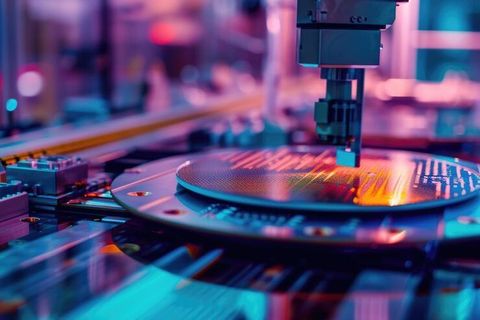
Spin coating systems are equipment setups used to spread a liquid coating across a flat surface while the surface rotates at controlled speed. A typical spin coating system may include a rotating chuck, motor, liquid dispensing arrangement, enclosure, exhaust path, controls, and process monitoring features. The method is widely associated with semiconductor and microelectronics manufacturing, but spin coating also appears in research laboratories, optics, displays, sensors, and other applications where a thin and relatively uniform film is needed.
The basic idea is simple. A measured amount of liquid is placed on or near the center of a substrate, and rotation causes the liquid to move outward. Centrifugal motion, liquid viscosity, solvent evaporation, rotation speed, and process timing together influence the resulting film. This makes spin coating useful when a controlled coating thickness is needed over a relatively flat surface.
Context
How Spin Coating Developed
Spin coating grew from the need to produce thin, repeatable films on small, flat substrates. As electronics and microfabrication developed, manufacturers needed methods for applying photoresist and other functional materials in controlled layers. The process became closely connected with photolithography, where a photoresist film is patterned to help create structures on semiconductor wafers.
A basic cycle normally has four stages: dispensing, acceleration, spinning, and drying or solvent evaporation. Some systems also include a final heating step, such as a soft-bake process, depending on the coating material and application.
Main Equipment Types
Spin coating systems vary from compact laboratory units to enclosed production equipment. Common configurations include manual systems, semi-automatic systems, and fully automated systems.
Manual systems are often used for research, education, process development, and small experimental batches. The operator controls important steps such as substrate placement, liquid dispensing, and rotation settings.
Semi-automatic systems add programmable controls and repeatable process sequences. Fully automated systems can coordinate substrate handling, dispensing, rotation, exhaust, and recipe control with limited operator intervention.
The equipment may also be described by substrate format or process environment. Some systems are designed for small samples, while others accommodate semiconductor wafers or larger substrates. Enclosed systems are useful when containment of liquid droplets and vapors is important.
Importance
Why Controlled Coating Matters
The quality of a thin film can influence later manufacturing steps. Uneven thickness, particles, air bubbles, edge buildup, or incomplete coverage can affect processes that depend on a consistent surface.
In semiconductor fabrication, spin coating is particularly important because photoresist thickness and uniformity influence subsequent photolithography steps. Research published in 2025 reviewed the continuing focus on modeling, experimentation, simulation, and machine learning for improving control of spin-coated films.
Spin coating is also relevant to coatings used in optical components, sensors, laboratory devices, display-related materials, and selected protective or functional layers. The exact process depends on the substrate, liquid formulation, desired thickness, and downstream operation.
Key Process Factors
Several variables work together during coating:
- Rotation speed affects how rapidly liquid spreads and can influence final thickness.
- Acceleration determines how quickly the substrate reaches its selected speed.
- Dispensed volume affects whether the surface receives sufficient liquid for coverage.
- Liquid viscosity influences flow behavior and film formation.
- Solvent evaporation changes the liquid concentration during spinning.
- Spin time affects how long spreading and drying continue.
- Substrate condition can influence adhesion, wetting, and uniformity.
- Ambient conditions, including temperature and humidity, may affect repeatability.
Changing one variable can alter the effect of another. For this reason, spin coating systems normally use defined process recipes rather than relying on rotation speed alone.
Common Spin Coating Methods
Different process methods can be selected according to the material and substrate. Static dispensing places liquid on a stationary substrate before rotation begins. Dynamic dispensing introduces liquid while the substrate is already rotating.
| Process factor | Typical role in coating |
|---|---|
| Rotation speed | Controls spreading and contributes to final film thickness |
| Acceleration | Controls how quickly rotation reaches the selected level |
| Spin time | Determines the duration of spreading and drying |
| Liquid viscosity | Influences flow and film formation |
| Dispensed volume | Helps determine surface coverage |
| Solvent evaporation | Changes liquid concentration during spinning |
| Substrate condition | Affects wetting and adhesion |
| Ambient environment | Can influence repeatability |
Recent Updates
Modeling and Process Control
Recent work has placed greater attention on understanding spin coating through mathematical modeling, experiments, numerical simulation, and machine learning. A 2025 review of spin coating in semiconductor lithography described these approaches as part of ongoing efforts to understand film thickness and uniformity more precisely.
Advanced Packaging and Thin Films
From 2024 through 2026, semiconductor manufacturing has continued to place emphasis on advanced packaging, thin-film processes, metrology, and materials development. Industry and research publications have highlighted the importance of controlled wet processes and material characterization as device structures become more complex.
Spin coating is not the only method used for thin-film formation, but it remains relevant for selected photoresist, polymer, and other material layers. Research on photosensitive polyimides has also examined their role in advanced semiconductor packaging, where polymer films can provide electrical insulation and other functional properties.
Automation and Data Analysis
Modern manufacturing environments increasingly connect process equipment with measurement and data systems. In spin coating, this can include recipe management, sensor readings, film-thickness measurements, and statistical process monitoring.
These developments provide additional ways to identify variation and understand relationships between settings and coating results.
Laws or Policies
India and Electronics Manufacturing
In India, spin coating equipment used in electronics or semiconductor manufacturing can fall within a broader industrial and environmental compliance framework. The Ministry of Electronics and Information Technology has established programs intended to strengthen domestic electronics and semiconductor manufacturing. One example is the Scheme for Promotion of Manufacturing of Electronic Components and Semiconductors, which covers specified capital expenditure categories for eligible activities.
Environmental and Electronic Waste Requirements
Industrial facilities may also need to consider environmental permissions, chemical handling requirements, waste management, workplace controls, and local pollution-control rules. Where electronic equipment reaches the end of its useful life, India's E-Waste Management Rules establish requirements concerning covered electrical and electronic equipment and the management of electronic waste.
Tools and Resources
Process Planning Tools
Several types of tools can help people understand and document spin coating processes. A process recipe sheet can record substrate type, liquid formulation, dispensing conditions, acceleration, rotation speed, spin time, and drying conditions.
A film-thickness measurement system can be used to examine coating results. Depending on the material and application, measurement methods may include profilometry, optical techniques, ellipsometry, or other laboratory metrology methods.
Research and Reference Resources
Technical databases, university laboratory guides, equipment manuals, and semiconductor process references can help explain coating principles. Simulation software may also be used to study fluid movement and drying behavior.
For Indian electronics manufacturing policy information, MeitY publications are relevant government resources. For environmental and electronic-waste requirements, government notifications and Central Pollution Control Board materials can provide regulatory information. Requirements should be checked against the current rules applicable to a specific facility.
FAQs
What is a spin coating system?
A spin coating system is equipment that rotates a substrate while a liquid coating spreads across its surface. The system normally includes a rotating chuck, motor, dispensing arrangement, controls, and containment or exhaust components.
How does a spin coating system control film thickness?
Film thickness is influenced by factors such as rotation speed, acceleration, spin time, liquid viscosity, solvent evaporation, and the amount of liquid dispensed. The relationship is material-dependent, so actual thickness is normally verified through measurement.
What are common spin coating equipment types?
Common types include manual, semi-automatic, and fully automated spin coating systems. Equipment can also differ by substrate size, enclosure design, dispensing method, and level of process control.
Where are spin coating systems used?
Spin coating systems are used in semiconductor photolithography, microelectronics, optics, sensors, displays, laboratory research, and other applications involving thin films. The required equipment configuration varies with the substrate and coating material.
What should be considered when using spin coating methods?
Important considerations include substrate condition, liquid properties, dispensing method, rotation profile, drying behavior, environmental conditions, and film-thickness measurement. Safety controls are also important when the coating formulation contains volatile or hazardous substances.
Conclusion
Spin coating systems provide a controlled way to form thin liquid films on flat substrates through rotation. Equipment types range from manual laboratory units to automated systems with programmable process control and measurement features. Recent developments have increased attention to simulation, machine learning, advanced packaging, metrology, and data-based process control. In India, equipment and facilities may also be affected by electronics manufacturing programs and environmental requirements.