Narrow Fabric Weaving Machines Guide With Automated Textile Technology and Manufacturing Solutions
Narrow fabric weaving machines are specialized textile machines used to produce fabrics that are narrower than conventional woven fabric rolls. These machines create continuous strips of material from yarns and are used to produce ribbons, tapes, webbings, elastic bands, labels, medical textiles, technical textiles, and various industrial components.
Narrow fabric weaving machines combine yarn preparation, warp and weft control, weaving mechanisms, tension management, and fabric take-up within a compact production system.
The development of narrow fabric weaving is connected with the wider history of textile manufacturing. Traditional weaving methods used manually controlled looms to interlace lengthwise and crosswise yarns. Industrialization introduced mechanical looms, allowing continuous production with more controlled yarn movement and repeatable fabric structures.
Modern narrow fabric weaving machines use electronic controls, sensors, programmable settings, and automated monitoring. Depending on the machine design, they can produce several narrow fabric constructions at different widths, patterns, densities, and yarn combinations.
Narrow fabrics have applications across clothing, packaging, transportation, safety equipment, home furnishings, healthcare-related textiles, outdoor products, and industrial manufacturing. Their physical characteristics can be adjusted through yarn selection, weave structure, finishing methods, and machine settings.
How Narrow Fabric Weaving Machines Work
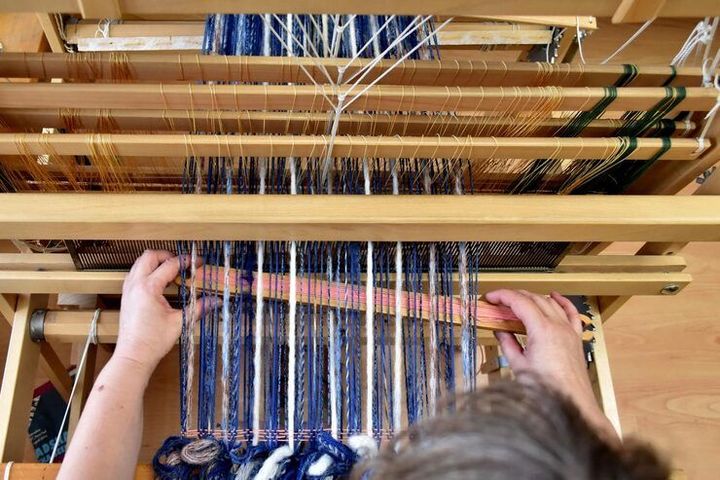
The weaving process begins with warp yarns arranged longitudinally through the machine. Weft yarn is inserted across the warp according to the programmed weaving sequence. The interlacing of these yarns forms the fabric structure.
A shedding mechanism separates selected warp yarns to create an opening through which the weft is inserted. The reed then positions the inserted yarn against the existing fabric. This sequence repeats continuously as the finished material moves toward the take-up section.
The machine maintains yarn tension throughout the process. Consistent tension is important because significant variation can affect fabric width, density, appearance, and dimensional stability.
Main Machine Components
A narrow fabric weaving machine can contain several interconnected components:
Warp beam or yarn supply system for feeding warp yarn
Shedding mechanism for separating warp yarns
Weft insertion mechanism for inserting crosswise yarn
Reed for controlling fabric density and positioning
Tension system for maintaining yarn control
Take-up mechanism for winding finished fabric
Sensors for monitoring selected operating conditions
Electronic control system for machine coordination
Display interface for setup and monitoring
Lubrication and maintenance components
Machine configuration varies according to fabric width, yarn type, weave pattern, production requirements, and desired automation level.
Importance
Narrow fabric weaving machines are important because many products require strong, flexible, lightweight, or decorative textile strips rather than wide fabric sheets. Webbing and tape can be designed for specific dimensions and performance characteristics, making them useful in many manufacturing environments.
The machines also support repeatable production of narrow textile structures. Automated control can help maintain programmed weaving parameters while reducing the need for constant manual adjustment.
Applications of Narrow Fabrics
Narrow fabrics appear in numerous everyday and industrial products. Common applications include:
Clothing trims and decorative ribbons
Elastic bands
Seat and safety webbing
Bags and luggage components
Packaging straps
Labels and identification tapes
Furniture and upholstery components
Outdoor equipment
Technical textile structures
Industrial reinforcement materials
The required fabric construction depends on the final application. A decorative ribbon may prioritize appearance and pattern, while an industrial webbing product may emphasize dimensional stability, strength, abrasion resistance, or controlled elongation.
Yarn Selection
Yarn selection directly influences the characteristics of narrow woven fabrics. Natural fibers, synthetic fibers, blended yarns, and specialized technical yarns can be used depending on the application.
Important yarn characteristics can include:
Yarn thickness
Tensile characteristics
Flexibility
Surface properties
Moisture behavior
Thermal resistance
Color stability
Abrasion behavior
The machine must be configured to handle the selected yarn appropriately. Yarn tension, insertion conditions, and loom settings can change according to the material.
Fabric Structures
Narrow fabric weaving machines can produce different structures by changing warp and weft arrangements. Plain structures are relatively simple, while more complex patterns can incorporate decorative effects, raised structures, multiple colors, or specialized reinforcement arrangements.
Pattern control can be mechanical, electronic, or a combination of both. Electronic systems allow operators to configure defined patterns through digital controls, depending on machine capabilities.
Recent Updates
From 2024 through 2026, narrow fabric weaving technology has continued moving toward greater automation, electronic control, digital monitoring, energy awareness, and flexible production. These developments form part of a broader transformation across textile manufacturing.
Automated Textile Technology
Modern machines increasingly use electronic controllers to coordinate weaving operations. Parameters such as machine speed, yarn tension, pattern sequences, and production counts can be monitored through digital interfaces.
Automated adjustment systems can respond to selected machine conditions within defined operating limits. This can reduce manual intervention during repetitive production sequences while maintaining operator oversight.
Electronic Pattern Control
Electronic pattern systems allow manufacturers to configure complex textile designs through programmable controls. Depending on the machine architecture, different patterns can be stored and recalled for defined production runs.
Digital pattern development can also make it easier to modify designs before physical production. This can reduce the need for extensive mechanical changes when switching between certain pattern configurations.
Sensors and Monitoring
Sensors can monitor conditions such as yarn presence, tension, machine movement, temperature, vibration, or production status. When a sensor detects an abnormal condition, the control system may generate an alarm or stop the machine according to its programmed safety or operating logic.
Digital monitoring can also record production information. Historical records may help maintenance teams examine recurring interruptions or operating patterns.
Energy and Machine Efficiency
Textile machinery manufacturers are also paying attention to motor control, drive systems, lubrication, compressed-air requirements where applicable, and overall energy management.
Variable-speed drives can regulate motor operation in suitable applications. Monitoring electrical consumption can provide facility operators with information about machine usage and production patterns.
Connected Manufacturing
Narrow fabric weaving machines can increasingly be connected to wider manufacturing networks. Production data may be transferred to supervisory systems, manufacturing execution platforms, or production dashboards.
This can support centralized monitoring of machine status, production quantities, alarms, and maintenance information. Data integration depends on the machine's communication architecture and the systems used by the facility.
Laws or Policies
Narrow fabric manufacturing is influenced by workplace safety requirements, textile product rules, chemical and environmental regulations, electrical standards, and machinery safety requirements. The exact rules depend on the country, product category, facility, and intended use of the finished textile.
Machinery Safety
Weaving machines contain moving shafts, heddles, gears, belts, needles or insertion mechanisms, rotating components, and electrical systems. Machinery safety requirements can therefore address guarding, emergency stopping, electrical protection, access control, and maintenance procedures.
Operators should have appropriate instructions covering normal operation, machine setup, cleaning, inspection, and controlled access to moving components.
Textile Product Requirements
Some narrow fabrics are incorporated into products subject to specific material or performance requirements. For example, safety-related webbing, protective equipment components, or transportation-related textile products may have additional technical requirements.
Product specifications should therefore be established according to the intended application and applicable standards.
Environmental Considerations
Textile manufacturing can involve electricity, water, dyes, finishing materials, packaging, and production waste. Environmental requirements may address wastewater, emissions, chemical handling, waste management, and resource consumption.
Facilities may use monitoring systems and documented procedures to track relevant environmental parameters according to local requirements.
Tools and Resources
Planning and operating narrow fabric weaving machines involves several technical resources. Machine specification sheets provide information about weaving width, machine speed, yarn compatibility, pattern capabilities, power requirements, control systems, and production configuration.
Textile design software can assist with pattern development and visualization. Yarn calculators can help estimate yarn requirements based on fabric width, construction, density, and production length.
Useful resources include:
Textile design software
Yarn consumption calculators
Fabric construction worksheets
Warp planning tools
Production scheduling software
Machine maintenance checklists
Digital pattern libraries
Quality inspection forms
Energy monitoring platforms
Manufacturing execution systems
Equipment specification documents
Production data dashboards
A simplified comparison of machine characteristics is shown below:
| Machine Feature | Main Purpose | Planning Consideration |
|---|---|---|
| Warp Control | Feeds lengthwise yarns | Yarn tension |
| Weft Insertion | Adds crosswise yarn | Insertion mechanism |
| Shedding System | Separates warp yarns | Pattern structure |
| Reed System | Controls yarn positioning | Fabric density |
| Take-Up Unit | Collects finished fabric | Winding consistency |
| Electronic Control | Coordinates machine functions | Automation architecture |
| Sensor System | Monitors machine conditions | Measurement requirements |
| Pattern Control | Creates defined designs | Product complexity |
Production planning may also involve calculating expected yarn consumption, machine utilization, fabric width, production length, and changeover requirements. These calculations help connect machine settings with broader manufacturing plans.
FAQs
What are narrow fabric weaving machines?
Narrow fabric weaving machines are specialized looms designed to produce relatively narrow woven materials such as ribbons, tapes, webbings, labels, elastic structures, and technical textile components.
How does automated textile technology work in narrow fabric weaving?
Automated textile technology uses electronic controls, sensors, drives, and programmable systems to coordinate yarn movement, weaving sequences, tension management, production monitoring, and other machine functions.
What are narrow fabric weaving machines used for?
They can produce materials used in clothing, bags, packaging, transportation, outdoor equipment, furniture, labels, safety-related products, and various industrial applications.
What factors affect narrow fabric weaving machine selection?
Important factors include fabric width, yarn type, weave structure, pattern complexity, production volume, machine speed, tension requirements, automation level, available floor space, and intended product application.
How do sensors help narrow fabric weaving machines?
Sensors can monitor yarn presence, tension, machine movement, temperature, vibration, and other selected conditions. The control system can use this information for monitoring, alarms, or defined machine responses.
Conclusion
Narrow fabric weaving machines produce specialized woven materials used across apparel, packaging, transportation, technical textiles, and industrial manufacturing. Modern equipment increasingly incorporates electronic pattern control, sensors, automated tension management, digital monitoring, and connected production systems. Machine selection and configuration depend on yarn characteristics, fabric structure, width, production requirements, and intended application. Workplace protection, product requirements, environmental considerations, and applicable machinery rules also form part of textile manufacturing planning.