LED Lighting Guide: Technologies, Designs, Applications, Performance and Key Considerations
An LED Lighting Guide explains how light-emitting diode technology works, the different lighting designs available, and how these products are used in homes, offices, factories, streets, and public buildings. LED stands for light-emitting diode, an electronic component that produces light when an electric current passes through a semiconductor. Unlike traditional incandescent bulbs, which produce light by heating a filament, LEDs generate light through a process called electroluminescence.
Context
An LED Lighting Guide explains how light-emitting diode technology works, the different lighting designs available, and how these products are used in homes, offices, factories, streets, and public buildings. LED stands for light-emitting diode, an electronic component that produces light when an electric current passes through a semiconductor. Unlike traditional incandescent bulbs, which produce light by heating a filament, LEDs generate light through a process called electroluminescence.
LED lighting has developed from small indicator lights into a broad range of general lighting products. Modern systems include LED bulbs, ceiling panels, strip lights, outdoor luminaires, industrial fixtures, and smart lighting equipment. Their design, light output, electrical requirements, and control features vary according to their intended application.
How LED Lighting Works
An LED contains semiconductor materials that emit light when electrical energy passes through them. A driver regulates the electrical power supplied to the LED, helping it operate within its required limits. Many lighting products also include heat-management components because excess heat can affect light output and operating life.
White LED lighting is commonly produced using a blue LED combined with a phosphor coating that converts part of the emitted light into a broader spectrum. Other designs combine red, green, blue, or additional LED channels to create adjustable colors and different lighting effects.
Main LED Lighting Technologies
LED technology appears in several product types, including:
Standard LED bulbs: Designed to replace compatible traditional bulbs in household fixtures.
Integrated LED luminaires: Lighting fixtures with built-in LED modules and associated electronic components.
LED panels: Flat lighting units commonly used in offices, schools, and commercial interiors.
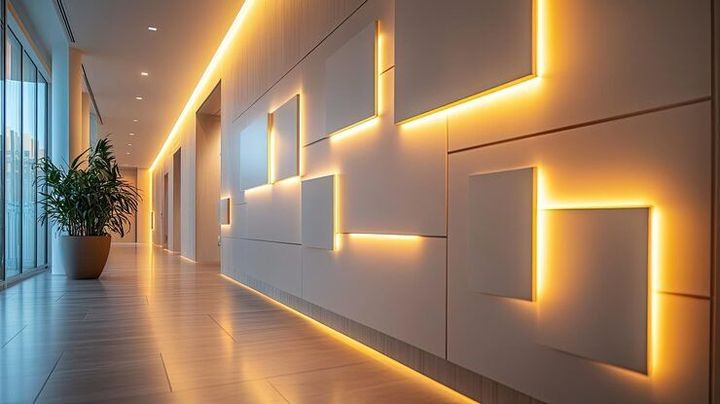
LED strip lights: Flexible or rigid strips used for decorative lighting, shelves, cabinets, and architectural details.
High-bay LED lights: Fixtures designed for spaces with high ceilings, such as warehouses and manufacturing facilities.
Smart LED lighting: Products that support dimming, scheduling, sensors, or network-based control.
These categories differ in construction and purpose. Compatibility with the existing fixture, electrical supply, installation environment, and control system affects which design is suitable for a particular space.
Importance
LED lighting matters because illumination affects visibility, comfort, productivity, safety, and electricity use. Households use it for everyday activities, while businesses and public facilities depend on lighting for work areas, walkways, storage spaces, transport facilities, and outdoor environments.
Lighting requirements differ from one location to another. A reading area needs suitable illumination with limited glare, while a warehouse may require uniform light across aisles and workstations. Outdoor lighting must also account for weather exposure, visibility, mounting height, and the effect of light on nearby properties and wildlife.
Understanding LED Lighting Performance
Several measurements help explain how an LED product performs.
Lumens: Measure the total visible light emitted by a source. Lumens are generally more useful than watts when comparing light output.
Watts: Measure electrical power consumption.
Lumens per watt: Indicate how efficiently a light source converts electrical power into visible light.
Kelvin: Describes correlated color temperature. Lower values generally appear warmer, while higher values generally appear cooler.
Color Rendering Index (CRI): Indicates how accurately a light source reveals object colors compared with a reference source under specified conditions.
Beam angle: Describes the spread of light from a directional fixture.
Rated life: Estimates the period of operation under specified test conditions. It does not necessarily indicate when a lamp will suddenly stop working.
Comparing Common Lighting Characteristics
| Lighting characteristic | Typical meaning | Why it matters |
|---|---|---|
| 450–800 lumens | Light output range for many household bulb applications | Helps compare brightness |
| 2700–3000 K | Warm-looking white light | Often used in living areas |
| 3500–4000 K | Neutral-looking white light | Common in offices and kitchens |
| 5000–6500 K | Cooler-looking white light | Used in some task and outdoor settings |
| High CRI | More faithful color appearance | Relevant to art, retail displays, and detailed work |
| Dimmable driver | Supports compatible brightness control | Allows adjustment to activities |
These figures are general examples rather than universal design requirements. Appropriate light output, color temperature, and color rendering depend on the room, task, fixture, and personal preference.
Common LED Lighting Challenges
LED products can still experience problems. Poor thermal management may accelerate light degradation, while incompatible dimmers can cause flickering, buzzing, or limited dimming range. Incorrect color temperature, excessive brightness, and poorly positioned fixtures can also create discomfort or glare.
Recent Updates
Developments in LED lighting during 2024–2026 have continued to emphasize improved energy efficiency, more precise light control, connected systems, and application-specific fixture designs. Progress varies by manufacturer and product category, and not every newer product includes every feature.
Smart and Connected Lighting
Smart LED systems can connect to mobile applications, wireless networks, occupancy sensors, daylight sensors, or building management systems. Depending on the equipment, users may schedule lighting, adjust brightness, change color temperature, or switch fixtures according to occupancy.
In commercial buildings, connected lighting can support monitoring and centralized control across multiple rooms or floors. However, compatibility between communication protocols, controllers, drivers, and existing electrical systems should be checked before installation.
Energy Efficiency and Human-Centered Lighting
LED product development continues to focus on producing suitable light output with less electrical power. Optical design, improved drivers, thermal management, and better control systems can influence overall performance. Actual energy use depends on the fixture, operating hours, selected brightness, and control settings.
Tunable-white lighting allows color temperature to change during the day or between activities. Some systems are designed around human-centered lighting principles, which consider how light characteristics may affect comfort and daily routines. Outcomes depend on intensity, timing, exposure, and individual circumstances; these systems should not be treated as a substitute for medical care.
Circular Design and Maintenance
Manufacturers and building operators increasingly consider repairability, replaceable components, material use, and end-of-life handling. Some luminaires allow the LED module or driver to be replaced separately, while others use integrated designs that may require replacement of the entire fixture when a major component fails.
Proper maintenance includes cleaning fixtures safely, checking connections, and following manufacturer instructions. Electronic lighting components should be handled and disposed of according to applicable local waste and recycling requirements.
Laws or Policies
LED lighting is influenced by electrical safety rules, energy-efficiency requirements, product standards, building regulations, and waste-management policies. Requirements depend on the product category and the country where the lighting equipment is manufactured, imported, sold, or installed.
LED Lighting Regulations in India
In India, the Bureau of Indian Standards (BIS) develops and publishes standards relevant to electrical products, including applicable lighting equipment. Certain products may be subject to mandatory certification or conformity requirements under the relevant government orders. The exact requirements depend on the product type and the rules in force.
The Bureau of Energy Efficiency (BEE) also administers energy-efficiency initiatives and product-labeling programs for specified equipment categories. Consumers and organizations can check the applicable product category and current labeling requirements rather than assuming every LED bulb or fixture follows an identical scheme.
Electrical Safety and Installation
LED lighting installations must account for voltage, wiring, grounding where required, moisture exposure, temperature, and fixture compatibility. Outdoor or industrial installations may need equipment with suitable ingress protection and environmental ratings. Electrical work should comply with the applicable installation rules and be performed by appropriately qualified personnel when required.
India's E-Waste (Management) Rules, 2022, as amended, establish requirements for covered electrical and electronic equipment and relevant stakeholders. The precise classification and obligations for a lighting product depend on the applicable rules. Electronic drivers and lighting assemblies should not automatically be treated as ordinary household waste where separate collection or recycling arrangements apply.
Tools and Resources
LED lighting tools help users estimate illumination needs, compare product specifications, assess energy use, and plan installations. Results depend on the quality of the input data and the assumptions used.
Lighting Calculators and Planning Software
Illumination calculators can estimate the number of fixtures needed for a room based on its dimensions, desired illuminance, light output, and estimated light losses. These calculations provide an initial planning estimate, not a substitute for a detailed lighting design in a complex building.
Lighting professionals may use software such as DIALux or Relux to model fixture placement, illuminance distribution, glare, and other design factors. Product photometric files can help these applications represent how a particular luminaire distributes light.
Product Information and Energy Tools
Manufacturer specification sheets help users compare lumens, watts, color temperature, CRI, dimming compatibility, rated life, operating temperature, and warranty conditions. In India, the BIS and BEE websites provide information about applicable standards, certification, and energy-labeling programs.
A basic energy-use calculation can estimate electricity consumption:
Energy used (kWh) = Power (watts) × Operating hours ÷ 1,000
For example, a 10-watt LED lamp operating for 5 hours per day uses approximately 0.05 kWh daily, or 1.5 kWh over 30 days. Actual consumption may differ slightly depending on the driver and operating conditions.
Practical Selection Checklist
Before choosing LED lighting, it helps to review the following points:
Confirm the required light output and color temperature.
Check the lamp base, fixture dimensions, voltage, and dimmer compatibility.
Select an appropriate beam angle and distribution pattern.
Verify moisture, dust, and temperature ratings for the installation location.
Review electrical safety information and applicable certification.
Consider replaceable components, maintenance access, and end-of-life handling.
FAQs
What is LED lighting and how does it work?
LED lighting uses semiconductor devices that emit light when an electric current passes through them. A driver regulates the electrical supply, while the fixture's design helps direct and manage the light.
What are the main types of LED lighting?
Common types include LED bulbs, panels, strip lights, integrated luminaires, high-bay fixtures, and smart LED systems. Each type serves different residential, commercial, industrial, or outdoor applications.
How do lumens and watts differ in LED lighting?
Lumens measure visible light output, while watts measure electrical power consumption. Comparing both figures helps explain how much light a product produces relative to the power it uses.
What color temperature is suitable for indoor LED lighting?
Warm white around 2700–3000 K is commonly used in relaxing spaces, while neutral white around 3500–4000 K is often used in kitchens and work areas. The appropriate selection depends on the task, interior design, and user preference.
What should be checked before installing LED lighting?
Check electrical compatibility, light output, color temperature, dimming support, environmental ratings, and applicable safety requirements. Complex or high-voltage installations may require qualified electrical personnel.
Conclusion
LED lighting combines semiconductor technology, electronic drivers, and optical design to provide illumination across residential, commercial, industrial, and outdoor environments. Product performance depends on light output, electrical efficiency, color characteristics, thermal management, and installation conditions. Smart controls and energy-efficiency developments are expanding the range of available lighting systems, while safety standards and waste regulations shape their use. Understanding these factors provides a practical foundation for evaluating LED lighting technologies and applications.